Subsea Cable Cuts: Does Local Hosting Protect Your Services?
How subsea cable outages disrupt services hosted outside Africa, what the 2024 East and West Africa incidents showed, and how local hosting reduces risk.
Yes—local hosting can keep domestic users served during a subsea cable outage, provided the application, its essential dependencies and the network path remain in the country. During the March 2024 West Africa outage, the Internet Society found that operational internet exchanges kept locally available content reachable. That is the practical case for bringing critical services closer to their users. Internet Society’s West Africa report
Three separate cable incidents occurred between February and May 2024. The March and May events disrupted connectivity across about 20 African countries; the February Red Sea cuts removed routes, but Cloudflare observed no corresponding traffic loss in the African countries it examined. Cloudflare’s Q1 report, May outage analysis
Moving a server is only part of the answer. A domestic application can still depend on overseas login, payment, DNS or database services. The right objective is to keep the whole essential customer journey usable.
Evidence reviewed through 22 October 2026. These incidents are historical examples. For a current problem, see Is a cable cut causing your problem right now?.
Key takeaways
- A cut can mean congestion, lost connectivity or both. Surviving routes determine the impact. Kentik
- Local hosting helps when traffic stays domestic. Operational exchanges kept local content reachable in March 2024. Internet Society
- A domestic address does not establish a domestic route. October 2026 measurements found international detours to hosts in both Kenya and Nigeria. Kenyan measurements, Nigerian measurements
- A cache cannot replace every application function. Dynamic requests still need a working origin. Cloudflare’s caching limits
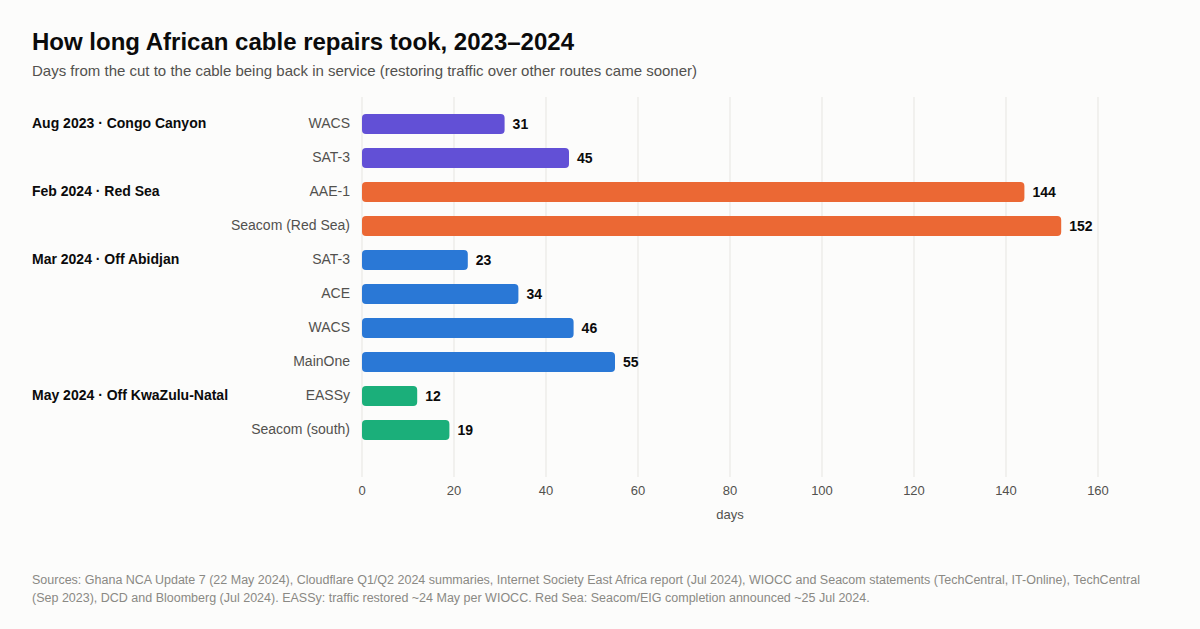
- Plan for weeks of reduced capacity. The four cables damaged off Abidjan in March 2024 took 23–55 days to repair. Ghana NCA’s restoration dates
- Use a hybrid continuity design: domestic production for domestic demand, diverse connectivity, controlled dependencies and a tested recovery copy.
What happens when a subsea cable is cut
For an overseas-hosted service, the path from a customer in Nairobi or Lagos includes international transport before reaching the application. Landlocked markets depend on neighbouring countries for that transport: the Internet Society describes Kampala’s terrestrial connection to submarine capacity at Mombasa. Internet Society’s East Africa report
The distinction to make is between capacity and connectivity. A network may retain a route to the destination while losing enough capacity that normal traffic no longer fits comfortably. Other networks may lose reachability altogether. During the May 2024 incident, Kentik measured longer cloud-to-cloud routes, including an increase of at least 120 milliseconds between AWS Cape Town and Google Singapore. Kentik’s May analysis
That helps explain why one mobile network can appear usable while another struggles. Safaricom reported activating redundancy measures during the May cuts, while Kentik identified Tanzania as experiencing the most severe disruption. The effect depended on the routes available to each operator. Cloudflare’s operator statements, Kentik
Why a large platform may work while your website does not
Locally available content has a different exposure from an overseas origin. During the West Africa incident, Ghana’s regulator reported operators using local caches and internet exchanges to maintain some data services. The Internet Society also identified local caches as part of the resilience available during the East Africa cuts. Ghana NCA’s notices, East Africa report
A cached page or video is different from a fresh database query. Caches need connectivity to refresh content, and Cloudflare explicitly states that its Always Online feature cannot serve dynamic content while the origin is offline. A homepage loading successfully therefore says little about whether login or checkout works. Internet Society, Cloudflare Always Online
Why several cables can fail together
Different cable names do not necessarily mean physically independent routes. The four systems damaged in March 2024 converged off Côte d’Ivoire; Ghana’s regulator later located all four faults at the Trou Sans Fond canyon crossing near Abidjan. The Internet Society identified that convergence as a single point of failure. Ghana NCA, Internet Society
Do not assume sabotage whenever a cable breaks. The International Cable Protection Committee reports approximately 150–200 submarine telecommunications cable faults globally each year, with around 70–80% caused by accidental human activity, including fishing and anchors. Natural hazards and technical failures account for other faults. ICPC factsheet
Why repairs take weeks
A repair requires fault location, vessel mobilisation, permits, transit, cable recovery, jointing and testing. The July 2026 ITU/ICPC report says Africa has only one permanently stationed, wholly dedicated repair vessel, positioned in Cape Town. A comparable fault off West Africa may take 12–18 days just to reach the repair stage because of mobilisation distances. ITU/ICPC’s 2026 report
Service can recover before the damaged cable does. Nigeria’s regulator reported services restored to approximately 90% of peak utilisation capacity by 18 March 2024 through capacity on unaffected cables. Physical repairs continued into May. NCC’s recovery statement, Ghana NCA’s repair record
What happened in 2024: three separate incidents
| Incident | Systems affected | Cause and observed impact | Physical restoration |
|---|---|---|---|
| 24 February: Red Sea | Seacom/TGN-Eurasia and AAE-1; EIG was already down from an earlier fault | Widely attributed to the dragging anchor of the Rubymar, without formal confirmation. Routing changed, but Cloudflare observed no traffic loss in the African countries examined. | Repairs completed in July 2024. |
| 14 March: West Africa | WACS, MainOne, SAT-3 and ACE | Submarine landslide/turbidity current at Trou Sans Fond canyon off Abidjan. Disruption measured across 13 countries. | SAT-3: 6 April; ACE: 17 April; WACS: 29 April; MainOne: 8 May. |
| 12 May: East and Southern Africa | EASSy and Seacom, off KwaZulu-Natal near Mtunzini | Suspected dragged anchor; Seacom subsequently attributed the damage to trawler activity. Seven countries showed traffic declines in Cloudflare’s analysis. | EASSy traffic restoration around 24 May; Seacom physical repair on 31 May; Internet Society reported all repairs complete by 3 June. |
Sources: Kentik on the Red Sea, Cloudflare Q1, Ghana NCA, Cloudflare on May, TechCentral quoting WIOCC, IT-Online quoting Seacom, Internet Society, ITU/ICPC.
February removed an alternative route
The Red Sea event matters because it reduced the available options before the May incident. Kentik identified cuts to Seacom and AAE-1 on 24 February and established that EIG was already down. Reporting by ITWeb Africa described Seacom moving Europe-bound traffic onto Equiano, PEACE and WACS, with some additional latency. Kentik, ITWeb Africa
It would be inaccurate to describe February as an African internet blackout. Cloudflare reported no observed traffic loss across the African countries it checked. Cloudflare Q1
March exposed shared infrastructure and service dependencies
Cloudflare recorded March disruption in Benin, Burkina Faso, Cameroon, Côte d’Ivoire, Gambia, Ghana, Guinea, Liberia, Namibia, Niger, Nigeria, South Africa and Togo. The severity and duration varied; Nigeria was not uniformly offline. Cloudflare’s March analysis
The disruption extended beyond ordinary browsing. The Internet Society reported problems accessing Microsoft Teams and Office 365 even from countries not directly affected by the cable damage. Cloudflare also observed MainOne’s website and nameservers becoming unreachable during part of the incident. These are examples of service impact, not proof that a particular business failed because it hosted offshore. Internet Society’s West Africa report, Cloudflare
May hit the southern route from East Africa
The May cuts were separate from the February Red Sea damage. Together, they constrained both northern and southern options on Seacom. Cloudflare reported initial traffic drops of 10–25% in Kenya, Uganda, Madagascar and Mozambique, and one-third or more in Rwanda, Malawi and Tanzania, compared with the previous week. These are traffic measurements, not percentages of people disconnected. Cloudflare’s May analysis, Kentik
The Internet Society found that no country experienced a total internet outage: surviving submarine systems, terrestrial routes, internet exchanges and local caches all helped. East Africa report
What local connectivity preserved
The strongest evidence for domestic hosting is the Internet Society’s finding that operational IXPs kept content available through them reachable during the West Africa outage. This supports a specific conclusion: local content with working local interconnection can remain accessible when international capacity fails. It does not establish that every locally hosted application remained functional. West Africa report
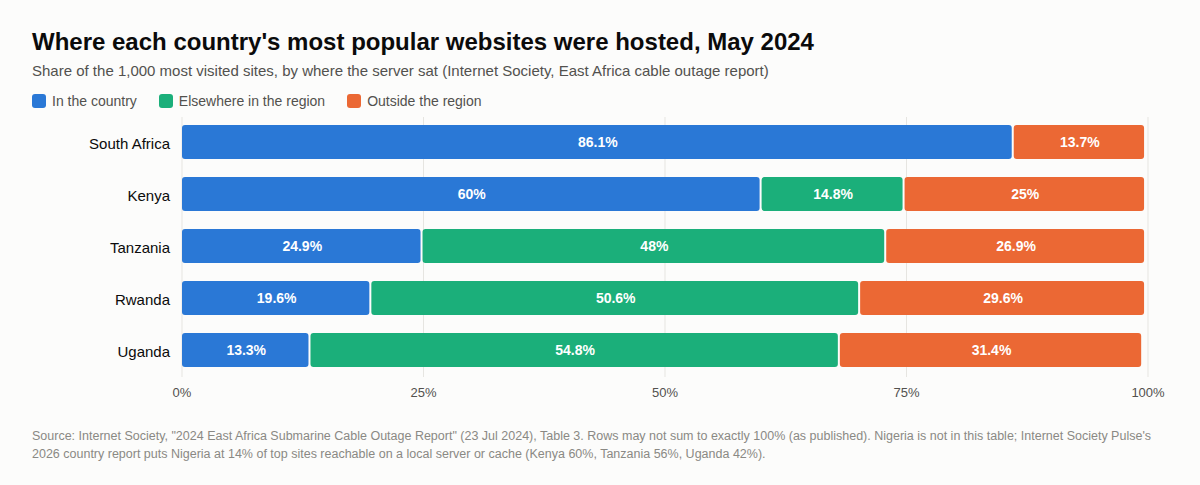
The amount of content already available locally differed substantially between markets.
The pattern continued after 2024
Later incidents included a PEACE cut in the Red Sea in October 2025 and a WACS incident affecting Cameroon that same month. From 1–4 January 2026, Cloudflare measured Republic of Congo traffic 82% below expected levels during a WACS incident reported by Congo Telecom. Cloudflare Q4 2025, Cloudflare Q1 2026
The September 2025 Red Sea cuts also disrupted connectivity, but Cloudflare’s account identified impacts in South Asia and the Gulf, without listing an affected African country. They should not be presented as another measured African outage. Cloudflare Q3 2025
In June 2026, Graphic Online reported an MTN Ghana notice attributing disruption to cable cuts off Abidjan; the notice did not name the cables. Graphic Online’s report
Is a cable cut causing your problem right now?
Treat widespread slow international access, differences between mobile and fixed connections, and a site working abroad but failing locally as clues to investigate. They do not identify a physical cable fault.
Use this diagnostic sequence:
- Check notices from your ISP, host and regulator. For Kenya, start with the Communications Authority; for Nigeria, check NCC announcements.
- Repeat the same customer journey on two networks. Compare the same page, login and transaction, not unrelated websites.
- Compare domestic and overseas observations. Use Cloudflare Radar and IODA to establish whether disruption is broader than your application.
- Separate the failure stages. Record whether DNS resolution fails, the connection times out, the page loads slowly, or an application request returns an error.
- Find the blocking dependency. Inspect login, payment, image, upload and API requests individually.
- Use path measurements as supporting evidence. Compare routes from affected and unaffected networks.
A traceroute can reveal a detour or a latency increase. It cannot establish that a cable has physically broken. The October measurements below show why this matters: some domestic routes already travelled abroad under ordinary conditions. Example Kenyan routes, example Nigerian routes
For immediate operations, try another connection, defer large transfers and publish a precise customer notice. Treat DNS changes and VPNs as targeted experiments: test a different resolver when resolution is the failing stage, or another exit route when the existing route is the problem. Neither should be your substitute for confirming the incident’s scope.
How cable cuts break websites and businesses
A server being operational does not establish that customers can complete a task. The 2024 incidents affected access to remote services while local exchanges and some local content remained available. Availability therefore needs to be assessed from the user’s network and through the application’s dependencies. Internet Society’s West Africa report
The following are hypothetical failure scenarios, not reports about named businesses.
| Scenario | What the customer sees | Dependency to investigate |
|---|---|---|
| Local shop with a remote payment integration | Catalogue works; payment remains pending | Payment submission, callback and reconciliation paths |
| Domestic portal with an overseas identity provider | Public pages work; new sign-ins fail | Identity provider and token renewal |
| Local frontend with an overseas database | Page shell appears; account information fails | Database connection |
| Cached publisher site with an offshore origin | Older articles work; new pages or uncached images fail | Cache misses and origin access |
| Office relying on remote SaaS | Previously synced work is accessible; live collaboration fails | SaaS connection and offline preparation |
| Local application needing a fresh deployment | Existing version runs; rebuilding fails | Container images and package downloads |
Mechanisms: M-Pesa’s asynchronous workflow, Microsoft token lifetimes, Cloudflare’s origin and cache limits, Outlook cached mode, Docker registry caching.
For transaction systems, make uncertain outcomes explicit. M-Pesa Express’s successful submission response is not the final payment result; callbacks and status checks complete the workflow. Stripe documents idempotency keys for safely retrying requests after connection failures. Use those mechanisms to design pending states and reconciliation rather than encouraging customers to submit repeatedly. Safaricom M-Pesa Express, Transaction Status, Stripe idempotency
Would local hosting have kept you online?
For domestic users, yes—if the essential service and its route stayed domestic and remained operational. The 2024 IXP evidence supports that conditional answer. The practical recommendation is to make domestic delivery the starting point for services whose customers are primarily in one country. Internet Society’s West Africa report
What “local” must mean
For a continuity review, require separate evidence for:
- The physical location of compute and data.
- The routes used by the customers’ ISPs.
- The locations and reachability of essential dependencies.
- The recovery process if that location fails.
Do not accept a local company name, invoice currency or country-code domain as the answer to those questions.
Local-to-local traffic can leave the country and return, a behaviour known as tromboning. The Internet Society describes this explicitly in its study of Kenya and Nigeria. Domestic peering is what allows local hosting to deliver its intended network benefit. Internet Society’s interconnection study
What the October 2026 measurements found
The measurement round ran on 21 October 2026, approximately 22:07–22:35 UTC, using IPv4 ICMP traceroutes from 43 responding RIPE Atlas probes: 16 in Kenya, 14 in Nigeria, seven in Tanzania and six in Uganda. It compared in-country network endpoints with Azure Johannesburg, AWS Cape Town and AWS Frankfurt. Representative public results are available for Kenya, Nigeria, Tanzania and Uganda.
Paths were classified using hop networks and geolocation, checked against round-trip times. Apparent foreign locations inconsistent with the timing were excluded; unexplained high-latency domestic destinations were marked indirect. These are observed network paths, not application benchmarks or a cable-outage simulation.
| Probe country | Answered paths to in-country hosts classified domestic | Median RTT to in-country hosts | Azure Johannesburg | AWS Cape Town | AWS Frankfurt |
|---|---|---|---|---|---|
| Kenya | 57/62 — 92% | 1.8 ms | 59.0 ms | 68.3 ms | 172.4 ms |
| Nigeria | 44/56 — 79% | 14.7 ms | 82.4 ms | 57.7 ms | 117.7 ms |
| Tanzania | 21/21 — 100% | 1.2 ms | 69.1 ms | 76.3 ms | 176.3 ms |
| Uganda | 16/18 — 89% | 4.0 ms | 66.8 ms | 80.3 ms | 167.6 ms |
Domestic endpoints: Kenya—Lineserve NBO1, Angani, KENET, KIXP portal; Nigeria—Lineserve LOS1, Nobus, IXPN website, AWS Lagos Local Zone; Tanzania—TCRA, TIX, Aptus mirror; Uganda—RENU mirror, UIXP portal, NITA-U.
International comparisons, respectively Johannesburg/Cape Town/Frankfurt: Kenya 1, 2, 3; Nigeria 1, 2, 3; Tanzania 1, 2, 3; Uganda 1, 2, 3.
The percentages describe probe-to-target paths, not the share of a country’s subscribers. Several probes used the same network. Medians include all answered paths in each category, including detours.
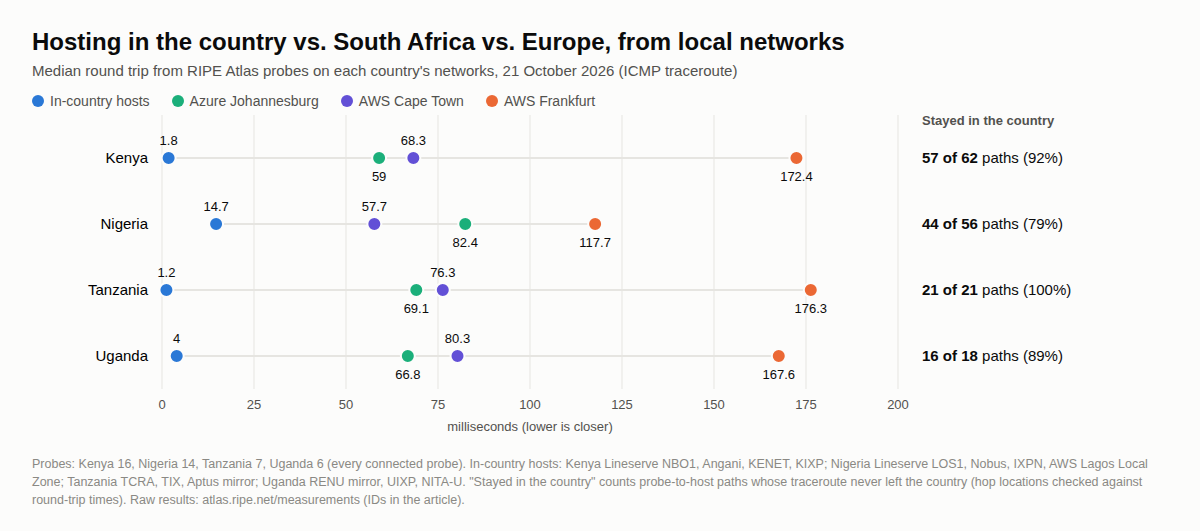
The provider-level results show both the benefit and the exceptions.
| Market | Measured endpoint | Domestic paths / answered paths | RTT range on domestic paths | Exceptions |
|---|---|---|---|---|
| Kenya | Lineserve NBO1 | 14/16 | 0.5–15.4 ms | Two international detours |
| Kenya | Angani | 15/16 | 0.6–17.1 ms | One international detour |
| Kenya | KENET | 14/15 | 0.6–13.3 ms | One international detour |
| Nigeria | Lineserve LOS1 | 11/14 | 1.1–25.1 ms | Three international detours |
| Nigeria | Nobus | 12/14 | 0.5–25.5 ms | Two international detours |
| Nigeria | AWS Lagos Local Zone | 11/14 | 2.5–26.9 ms | Three indirect paths |
Same measurement method and local probe set within each market. Endpoints were public network addresses, not purchased application servers.
Lineserve is a strong candidate for domestic workloads in Kenya and Nigeria on this criterion: most sampled paths to NBO1 and LOS1 remained in-country with the round-trip times shown above. The exceptions matter when assessing a particular customer base.
Workonline’s Kenyan probe reached NBO1 at 200.6 ms and KENET at 336.6 ms through international detours. In Nigeria, MainOne’s two probes reached the IXPN website at approximately 113 ms through an overseas route. These examples show why a hosting decision needs measurements from the networks customers actually use. NBO1, KENET, IXPN
A South African region remained international from every country in the test. The Internet Society’s May report also identifies EASSy and Seacom as predominant routes from East Africa to hyperscale services in South Africa. Choosing an African region does not, by itself, remove cable exposure. East Africa report
Hosting setups compared during a cut
The following are architectural implications of the incident evidence, path measurements and documented cache behaviour—not guarantees for individual deployments.
| Setup | What it can preserve | Exposure to address |
|---|---|---|
| Overseas application and database | Service wherever the international route remains usable | Domestic customers still need international connectivity |
| In-country application and data, reached domestically | Essential domestic journeys that have no blocking foreign dependency | Access network, domestic infrastructure and application failures |
| Domestic frontend with overseas database | Static or explicitly cached functions | Live database operations |
| Local CDN cache with offshore origin | Objects already available in the cache | Cache misses, refreshes and dynamic requests |
| South African region serving East or West Africa | A regional hosting option | Cross-border routes, including submarine capacity |
| Domestic production with a separately prepared recovery site | Domestic delivery plus a recovery option | Synchronisation, switching and recovery-site reachability |
Basis: Internet Society’s local-reachability findings, South African cloud access, Cloudflare’s caching limits, and the Atlas measurements above.
For procurement, assess capacity, scaling, monthly cost and data-location obligations separately from network reachability. A low-latency measurement does not answer those questions.
The verdict: domestic production with tested recovery
For a service built primarily for domestic users, make in-country hosting over verified domestic routes the first hosting change to evaluate. Keep essential application data close to that service, reduce blocking foreign dependencies and prepare a separate recovery copy. This follows the Internet Society’s recommendation to invest in locally hosted content and services after the West Africa outage. West Africa report
Lineserve offers live regions in Nairobi, NBO1, Lagos, LOS1, Dar es Salaam, DAR1, and Kampala, KLA1, billed in their respective local currencies. That gives businesses an in-country placement option in each market.
Treat access faults, domestic fibre, power, a failed data centre, attacks and application errors as separate scenarios in the continuity plan. Require a restore test before counting any backup as a recovery capability.
Dependencies that still need international links
Audit the customer journey and the operational work needed to sustain it. Record the endpoint, owner, route, acceptable interruption and fallback for each dependency.
| Dependency | Failure to test | Recommended preparation |
|---|---|---|
| DNS | Authoritative service unavailable after cached answers expire | Verify local reachability and secondary DNS. Do not assume a resolver enables stale answers. RFC 8767, secondary DNS |
| Identity, SSO and MFA | Fresh sign-in or token renewal fails | Test new and existing sessions; prepare controlled emergency administration. Entra token lifetimes |
| Payments | Submission succeeds but the callback is delayed | Preserve pending states, query status and reconcile before fulfilment. M-Pesa Query, Transaction Status |
| Databases and storage | Local application cannot reach remote data | Put critical serving data within the intended domestic path; test loss of remote access. Internet Society’s service-dependency findings |
| Fonts, scripts, widgets and media | Optional content prevents the useful page from completing | Host essential assets with the application; test with third parties unavailable. Cache/origin limitations |
| CDN, WAF and proxy | Cache miss or origin request fails | Test uncached URLs and dynamic actions, not just the homepage. Cloudflare Always Online |
| Email, SMS and OTP | A required message never reaches the user | Identify delivery endpoints and test approved fallback journeys |
| Staff SaaS | Remote documents or mail are inaccessible | Prepare and test Outlook cached mode and Google Docs offline |
| Images and packages | Deployment needs an unavailable download | Prepare Docker image caching, npm caching and PyPI mirroring |
| Certificates | Renewal cannot complete before expiry | Monitor renewal success and remaining validity. Let’s Encrypt renewal guidance |
| Secrets, licences and management | Recovery requires an unreachable external service | Rehearse administration and recovery with each dependency unavailable |
| Monitoring and support | Overseas checks miss a domestic customer failure | Observe the service from multiple domestic networks and maintain tested communication channels |
Separate every-request dependencies from those that become critical later. Microsoft documents ordinary Entra access-token lifetimes of 60–90 minutes; a session that works at the beginning of an incident is not sufficient evidence that authentication will continue working. Microsoft’s token documentation
Certificates deserve the same attention. Let’s Encrypt shut down OCSP in August 2025, so renewal is the more useful continuity concern for its certificates. Its guidance recommends renewal at approximately two-thirds of the certificate lifetime. For a 45-day certificate, that leaves roughly 15 days—a planning margin shorter than several observed cable repairs, if the CA becomes unreachable. That comparison is an operational inference, not a prediction of renewal failure. OCSP retirement, renewal guidance
Keep security and transaction integrity intact. Do not bypass authentication because its provider is unreachable, or mark an uncertain payment as successful. Design an explicit, useful degraded mode instead.
A continuity plan for future cuts
Use the following eight steps as a design and acceptance checklist.
1. Define what must remain usable
Choose essential journeys: account access, order submission, payment status, public information or internal operations. Assign a recovery time objective and an acceptable data-loss window to each.
Use a prolonged international-capacity constraint in the exercise. The March 2024 repair record supports planning in weeks; the Red Sea repairs show why the scenario should also consider longer disruption. Ghana NCA, ITU/ICPC
Output: an agreed list of essential journeys and recovery objectives.
2. Map the complete service path
Trace each journey from the customer’s ISP through DNS, application, data, identity, payment and notification services. Mark every international dependency and identify who can change it.
Output: a dependency map with owners and failure behaviour.
3. Verify physical connectivity diversity
Ask each ISP which cable systems, landing points and terrestrial routes support its service. Request an explanation of shared failure points and available capacity after a route loss. The March incident demonstrated that four different systems could fail at one geographical convergence. Internet Society’s West Africa report
Consider satellite as an additional access option only where available and permitted, and test the actual business applications over it. Uganda’s regulator, for example, describes Starlink’s provisional licences and national gateway requirement. UCC’s Starlink statement
Output: a documented route-diversity assessment.
4. Put essential workloads near their users
Select production placement by customer market, then verify routes from the networks that matter.
Review your exposure to cable outages: for a domestic workload, evaluate Lineserve Cloud Servers in Kenya, Nigeria or Tanzania, and its Kampala region. Start with the application’s required resources and use domestic path tests as an acceptance criterion. Linux VPS presets provide an alternative for a fixed configuration.
Output: a hosting design for each customer market.
5. Design a useful degraded mode
Specify which functions become read-only, which jobs can wait, which media can be reduced and which transactions must stop safely. Test stale-content delivery only where older information is acceptable; HTTP’s stale-if-error extension permits serving stale responses under defined error conditions. RFC 5861
Output: an approved degraded-mode specification.
6. Prepare and prove recovery
Rehearse restoration, access to recovery credentials, traffic switching and failback. Include the case where the normal deployment platform is unreachable.
Lineserve’s S3-compatible Object Storage is available in NBO1, LOS1 and DAR1, with free transfer and API requests. Include it where object storage fits the backup design, and prove the restore process before relying on it.
Output: a completed restore exercise with measured recovery time.
7. Test as an affected customer would
In staging, deliberately make selected external dependencies unavailable. Add latency and packet loss, then test fresh sign-ins, expired caches, uploads and payment status handling. Repeat from several domestic networks.
Use the October measurements as a reason to diversify test locations: the route to the same host differed substantially between probes. Kenyan example, Nigerian example
Output: results for completed customer journeys, with failures assigned to owners.
8. Assign communications and decisions
Name the person who activates degraded mode, approves failover, handles uncertain transactions and updates customers. Prepare messages that distinguish “service unavailable” from “request pending”.
Output: a short incident runbook with triggers, owners and tested communication channels.
Risk-team acceptance checklist
- Essential journeys and recovery objectives approved.
- International dependencies mapped.
- Customer-network routes measured.
- Shared connectivity failure points documented.
- Degraded mode tested without weakening authentication.
- Pending payments and retries handled safely.
- Backup restoration and failback rehearsed.
- Incident owners and customer messages prepared.
During an outage, and after it ends
During an incident, establish the affected countries, networks and customer journeys before switching infrastructure. Activate the tested degraded mode, reduce non-essential transfers and preserve records of uncertain transactions.
For payments, apply the provider’s documented reconciliation and retry mechanisms. Safaricom provides query/status APIs, while Stripe’s idempotency mechanism supports safe retries after connection errors. Safaricom Query, Stripe idempotency
After connectivity improves, verify stability from several customer networks before declaring recovery. Release queued work gradually, reconcile payments, check data synchronisation and confirm that renewal and backup jobs have resumed.
Make the review concrete: identify the first blocking dependency, the journeys that survived, the recovery actions that worked and the assumptions that failed. Schedule another drill after material architecture changes, with an annual exercise as a minimum planning target.
Is Africa’s connectivity getting more resilient?
New infrastructure is expanding the available options. Meta announced completion of the 2Africa core in November 2025, while Equiano added a Lagos landing and PEACE serves Mombasa. These additions increase the systems available for connectivity, but their existence alone does not establish a particular ISP’s route diversity. Meta’s 2Africa announcement, Google’s Equiano announcement, TeleGeography’s cable map
Local interconnection has also grown. The Internet Society reported that Kenya and Nigeria increased their locally exchanged traffic from roughly 30% in 2012 to 70% in 2020. That progress gives domestic hosting a stronger foundation. Internet Society’s 80/20 report
Repair capacity remains constrained. The July 2026 ITU/ICPC report describes Africa as underserved by repair infrastructure. Orange has ordered replacement vessels for the Léon Thévenin and Antonio Meucci, with delivery expected in 2028 and 2029. ITU/ICPC report, Orange’s fleet announcement
For architecture decisions, assume that faults remain a scenario to design for. Evaluate new capacity alongside domestic delivery and recovery preparation.
How to choose an in-country host for continuity
Ask each shortlisted provider for evidence that answers the same questions:
| Question | Evidence to request |
|---|---|
| Where do compute, storage, backups and management operate? | Named locations for each component |
| Which customer networks reach the service domestically? | Recent measurements from relevant ISPs |
| How are peering and transit arranged? | A documented interconnection explanation |
| Are upstream paths physically independent? | Cable, landing-point and terrestrial-route details |
| What remains after one route fails? | Capacity and failover evidence |
| Can running services be managed during an external dependency outage? | A tested operational procedure |
| Can the service be restored? | Restore results and recovery objectives |
| What does the SLA measure? | Contract wording, measurement method and exclusions |
Lineserve’s measured NBO1 and LOS1 paths provide evidence for the domestic-reachability question, and its published 99.9% SLA provides a contractual reference. Assess those alongside the operational evidence required for your application. NBO1 measurements, LOS1 measurements
For budgeting, compare the actual footprint rather than using latency as a proxy for value. The Kenya VPS cost guide and Nigeria VPS cost guide provide related procurement context.
Frequently asked questions
Can one cable cut take down the internet across Africa?
The 2024 evidence does not support a continent-wide blackout claim. Effects varied by country and operator. Even the May multi-cable event caused no total national outage, according to the Internet Society, because alternative routes and local infrastructure remained available. East Africa report
Why did the 2024 West Africa cuts affect Nigeria, and how can I check a current problem?
The damaged systems reduced capacity used by Nigerian networks. By 18 March, the NCC reported recovery to approximately 90% of peak utilisation capacity using unaffected cables. For a current incident, compare your ISP’s notice with the NCC’s announcements, Cloudflare Radar and a second access network. NCC’s 2024 statement
Were the Red Sea cuts and Kenya’s May 2024 outage the same incident?
No. The February cuts affected the Red Sea route; the May damage affected EASSy and Seacom near Mtunzini in South Africa. The earlier damage had already constrained alternative routing. Kentik’s February analysis, May analysis
Why is the internet slow in Kenya when my server is fine?
The path to the server, or to one of its dependencies, may have lost capacity or moved to a longer route. Kentik measured substantial latency increases following the May cuts, while Cloudflare documented differing operator responses. Kentik, Cloudflare
Can a cable cut affect a website hosted in Kenya or Nigeria?
Yes. A domestic destination may be reached through an international detour, and an application can require remote services. The October measurements found such detours to both Kenyan and Nigerian hosts. Kenyan paths, Nigerian paths
Will my site hosted in Europe or the US go down?
Not necessarily. Customers may retain access through surviving routes, experience slower service or lose reachability while the server continues operating. The 2024 incidents showed both rerouting and service disruption. Test the customer journey from the affected market. Cloudflare’s Q1 analysis
Is a South African cloud region as good as hosting in-country?
For removing international-path exposure from Kenyan, Nigerian, Tanzanian or Ugandan customer traffic, no. The measured South African destinations remained international, and the Internet Society identifies submarine systems as important routes to South African cloud services. AWS’s live Lagos Local Zone is a distinct in-country compute option, associated with its Cape Town region. Internet Society, AWS Local Zones
Will a CDN keep my website online?
It can preserve cached content under the CDN’s caching rules. Cache misses and dynamic operations still need the origin; Cloudflare’s Always Online feature explicitly excludes dynamic content while the origin is offline. Cloudflare documentation
Will switching ISP, changing DNS or using a VPN help?
Try another ISP when measurements show that networks have different reachability. Test a DNS change only when resolution is failing, and a VPN only as a route-specific workaround. Confirm the result with the same customer journey; the measured domestic detours demonstrate why network choice can matter. NBO1 route comparison, LOS1 route comparison
Can satellite connectivity be a backup?
Evaluate it as an additional access path and test it before an incident. As checked on 21 October 2026, Starlink offered service in Kenya, Nigeria and Uganda, while its Tanzania page offered no plans. Availability and regulatory requirements are market-specific; Uganda’s regulator describes provisional licensing and a national gateway requirement. UCC
How long do cable repairs take?
The March 2024 West African repairs took 23–55 days. Seacom’s May physical repair took 19 days, while the Red Sea repairs extended into July, roughly five months after the February damage. User service may recover sooner through alternative capacity. Ghana NCA, Seacom reporting, ITU/ICPC
Which cables serve East Africa and West Africa?
Examples serving Kenya include TEAMS, Seacom, EASSy, LION2, DARE1, PEACE and 2Africa. Nigerian landings include SAT-3, MainOne, Glo-1, WACS, ACE, NCSCS, Equiano and 2Africa. Tanzania has Seacom, EASSy, SEAS, DARE1 and 2Africa; landlocked Uganda reaches submarine capacity through terrestrial connections. A cable landing does not establish which systems your ISP actually uses. TeleGeography’s cable map, Internet Society on Uganda’s connectivity
Build around the journeys your customers need
For domestic demand, prioritise an application and data stack that customers can reach over domestic networks. The 2024 incidents showed why: local exchanges preserved access to locally available content while international services were disrupted. Internet Society’s West Africa report
Start with three actions: map international dependencies, verify domestic reachability from customer networks, and test essential journeys with those external dependencies unavailable.
Lineserve’s in-country regions give businesses a place to build that domestic serving layer. Make the acceptance test a completed login, a correctly recorded transaction and a proven restore.