Which Cloud Providers Have Infrastructure in Nigeria? (2026)
A map of cloud providers serving Nigeria: who operates in Lagos, who resells, where hyperscalers stand, and how to choose.
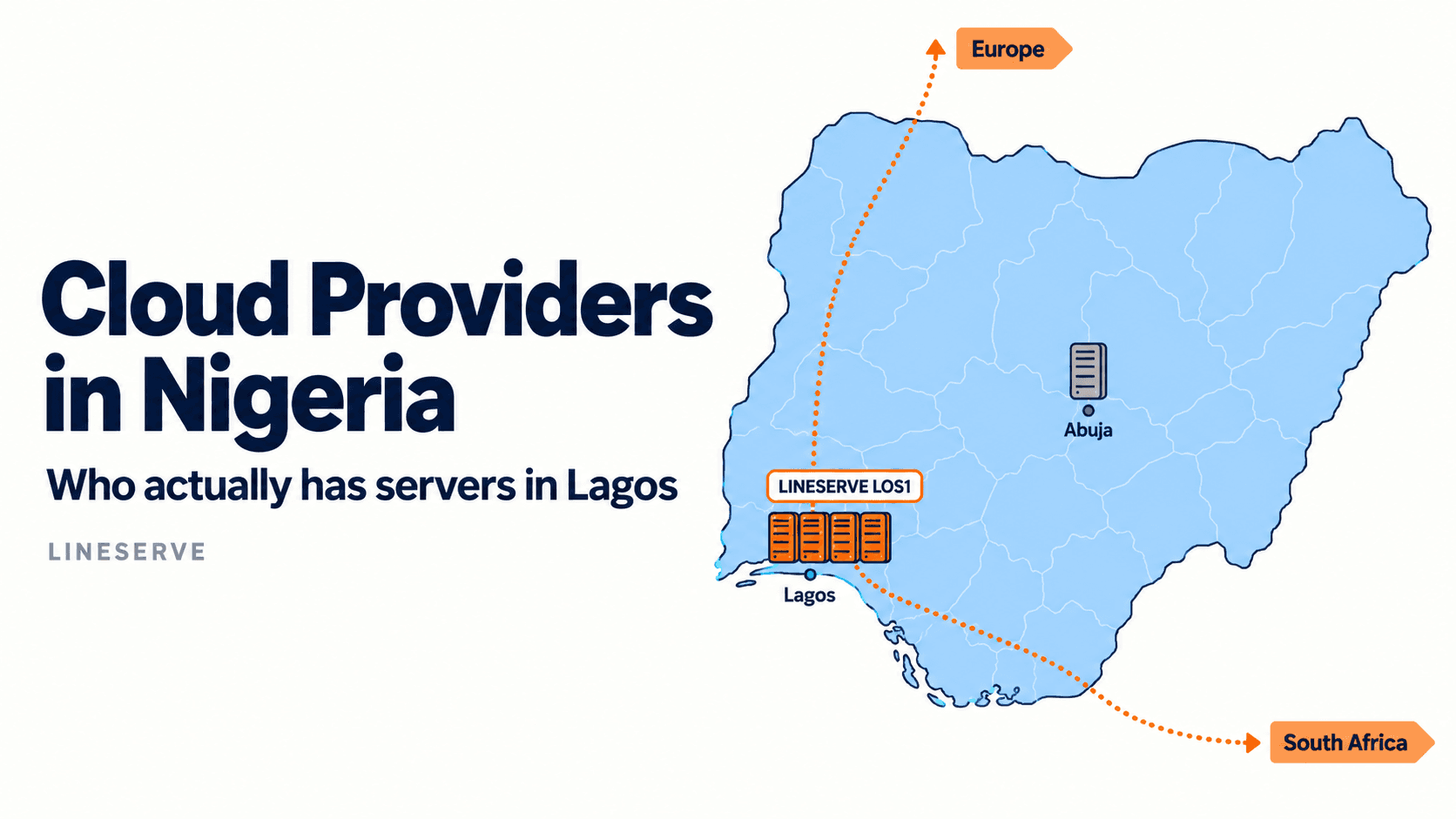
Checked 19 October 2026; latency measured 20 October 2026 from Nigerian ISPs. We checked every provider below against its own pages and the public routing and peering registries (PeeringDB, RIPEstat, AfriNIC), and measured each one with pings and traceroutes from RIPE Atlas probes on Nigerian networks in Lagos, Abuja and Kano. Every Atlas measurement is public on RIPE Atlas, so anyone can check the raw results.
The short answer
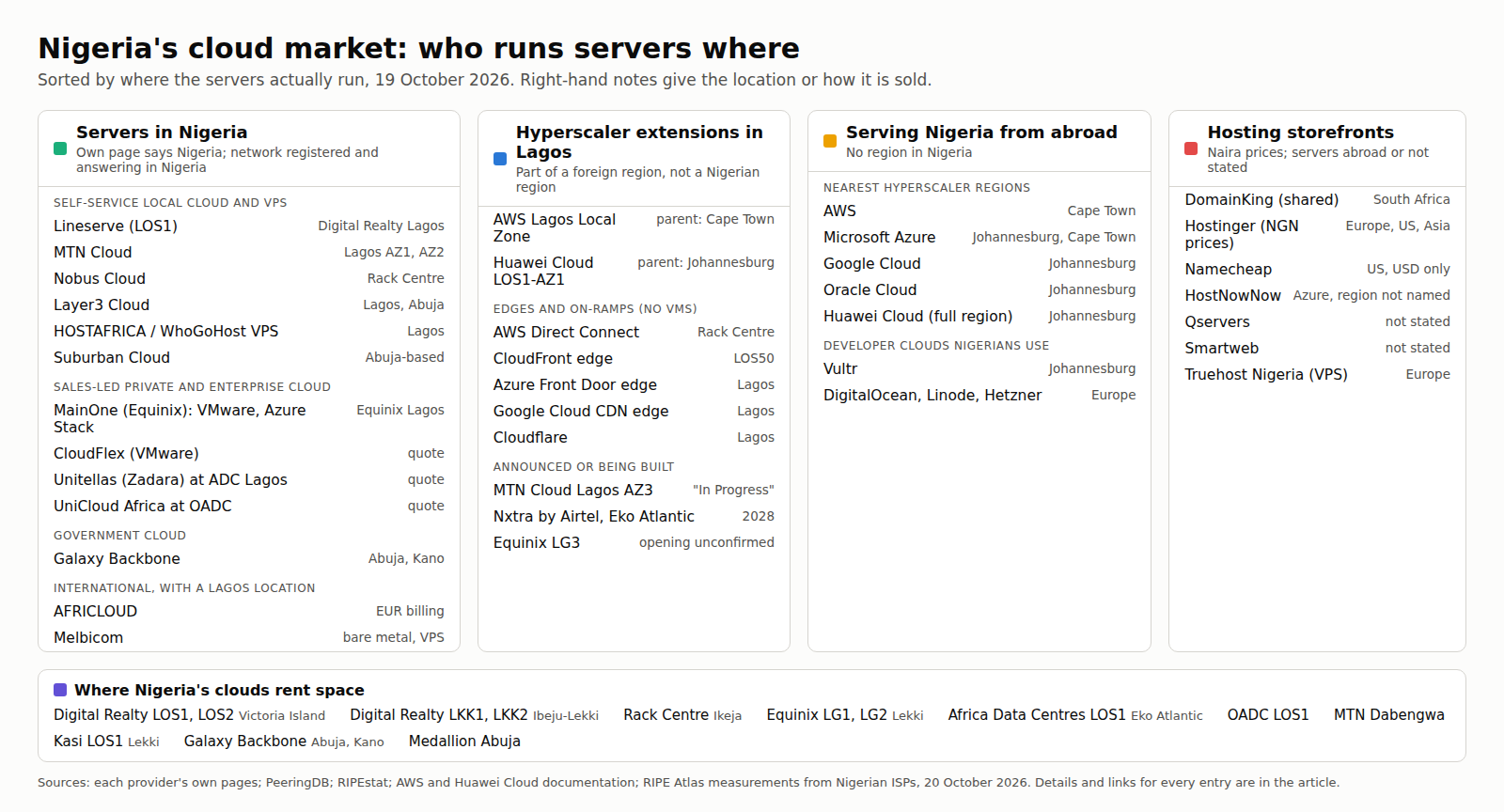
Nigeria has real cloud capacity in the country. Nearly all of it is in Lagos, with Abuja second. It comes in five kinds:
- Local cloud and VPS providers with servers in Nigeria. Lineserve (its LOS1 region, in Lagos), MTN Cloud (two live Lagos zones), Nobus (at Rack Centre), Layer3 (Lagos and Abuja), HOSTAFRICA’s Nigerian VPS range (also sold as WhoGoHost) and Suburban Cloud (Abuja). All of them sell to the public in naira.
- Sales-led enterprise, private and government clouds. MainOne (now part of Equinix) runs VMware and Azure Stack clouds in its Lagos data centres. CloudFlex, Unitellas (Zadara) and UniCloud sell through quotes. Galaxy Backbone runs the federal government’s cloud from Abuja and Kano.
- Hyperscaler extensions in Lagos, not full regions. The AWS Lagos Local Zone (
af-south-1-los-1a) is an extension of AWS’s Cape Town region. Huawei Cloud’s LOS1-AZ1 is an extension of its Johannesburg region. Both run virtual machines in Lagos, but neither is a Nigerian region. - Hyperscalers serving Nigeria from abroad. Microsoft Azure, Google Cloud and Oracle have no region in Nigeria; their nearest are in Johannesburg and Cape Town. What they have in Lagos is edge equipment: content caches and peering. That speeds up delivery, but it doesn’t host your server or database.
- Hosting storefronts that sell servers hosted abroad. A Nigerian address, a .ng domain and a naira price don’t tell you where the server is. On 19 October 2026 DomainKing’s FAQ said its servers are in South Africa, and Truehost Nigeria’s VPS add-ons included an “Extra IPv4 Address in Europe”.
The conclusion: if your data must stay in Nigeria, or your users are in Nigeria and response time matters, shortlist from the first three groups. If you want self-service servers billed in naira, start with the first. For published naira prices, self-service servers in Lagos and regions in four African countries under one account, start with Lineserve: its LOS1 region answered every Nigerian ISP probe we used in 1.3 to 30.3 ms (1.3 ms from IXPN in Lagos, 10 to 13 ms from Abuja, 18 to 22 ms from Kano), never routed abroad, and its 2 vCPU / 4 GB Linux VPS is ₦33,600 a month plus 7.5% VAT, the lowest published price for that size among the providers in our price table with servers in Nigeria. If you need managed databases and Kubernetes on the same platform today, MTN Cloud and Nobus sell them in Lagos, and the AWS Lagos Local Zone puts EC2 and EKS in Lagos while the rest of AWS stays in Cape Town.
One thing our measurements showed that most lists miss: being in Lagos is not enough on its own. Most Lagos providers answered the IXPN and MainOne probes in Lagos in 1 to 3 ms, but several were 85 to 160 ms from some Nigerian probes, because that traffic left the country and came back. Only Lineserve and Huawei Cloud Lagos were reached from every Nigerian network we tested in about 30 ms or less. Before you sign, ask for a test IP and check it from your users’ networks. The steps are near the end.
Key takeaways
- Lagos holds most of Nigeria’s cloud capacity. Abuja is second, and it is mainly government work.
- There is no full hyperscaler region in Nigeria. AWS and Huawei have Lagos zones attached to South African regions.
- Many “Nigerian” hosts bill in naira from servers in South Africa, Europe or the US.
- Naira billing keeps you clear of exchange-rate surprises and bank limits on foreign card spending, but it doesn’t prove the servers are local.
- From 1 January 2027, payment transaction data generated in Nigeria must be stored and managed in Nigeria, and NITDA’s new cloud guideline asks regulated financial institutions to host their financial data in the country.
- From Nigerian ISPs, Lagos providers answer in 1 to 30 ms on good routes; the nearest hyperscaler region, AWS Cape Town, was 56 to 83 ms and London 110 to 154 ms.
- Test from the networks your users are on: a provider can be 2 ms from one Nigerian ISP and 150 ms from another.
- Shortlist in this order: where the data must live, where your users are, what currency you pay in, which services you need, how you’ll recover, then test.
Jump to: the master table · local providers · AWS and the other hyperscalers · hosting companies · naira billing · our latency test · best for your use case · FAQ
What “cloud provider in Nigeria” can mean
The phrase covers businesses that sell very different things. Before comparing them, it helps to know which kind you’re looking at.
| Type | What you get | What it doesn’t promise |
|---|---|---|
| Public cloud (IaaS) | Virtual machines, storage and networks you create yourself in a portal or through an API, billed by the hour or month | A particular building, unless the provider names it |
| VPS and web hosting | Ready-made server plans, shared and WordPress hosting, domains and email | That it’s a cloud platform with APIs, snapshots and networks, or that the server is in Nigeria |
| Managed cloud or reseller | A local contract, local invoice and local support | That the servers are local. They may be in a foreign cloud account the reseller runs |
| Data centre or colocation | Rack space, power, cooling and connectivity for your own hardware | Any compute at all. Rack Centre and Equinix are not cloud providers |
| Telco and government cloud | Sales-led private or public cloud from a telco, or a state-run cloud for public bodies | Self-service sign-up or published prices |
| Hyperscaler extension | A Local Zone or edge zone: a few services of a foreign region run in Lagos | A full region. Control, many services and some data stay in the parent region |
| Edge or CDN point | Cached content and faster delivery from Lagos | Hosting your app, VM or database |
A full region has its own control plane and usually several availability zones. A Local Zone (AWS) or HomeZone (Huawei) is a smaller site in another city that runs a subset of services and depends on its parent region. An edge location caches and routes traffic but runs none of your workloads. A sales office is none of these.
How we sorted and checked the providers
Every provider was sorted on two tests:
- Where the compute and storage physically run: in Nigeria, elsewhere in Africa, or outside Africa.
- What you pay in: an invoice in naira with local payment methods, or a dollar or euro price charged to a card.
We counted a provider as in Nigeria only with evidence that at least one product a customer can buy runs in the country. A Lagos office, a Nigerian phone number, a .ng domain or a naira price was not enough. Evidence, strongest first:
| Evidence | What it proves | Where it came from |
|---|---|---|
| Product documentation naming a Nigerian location | What the provider says it runs, and where | Each provider’s own pages, saved on 19 October 2026 |
| A checkout or price list in naira for a Lagos location | That you can actually buy it there | Pricing pages and calculators |
| Data centre and exchange records | Which Nigerian buildings and internet exchanges the network says it’s in | PeeringDB, the shared database networks use to publish this |
| Routing and address records | Whether the provider runs its own network (an ASN, or autonomous system number) and whether its addresses are registered and geolocated in Nigeria | RIPEstat, AfriNIC whois, Team Cymru whois |
| Measurement from Nigerian ISPs | Whether the addresses are physically close to Nigerian users’ networks, and whether the route stays in Nigeria | Pings (16 per probe) and traceroutes from RIPE Atlas probes on Nigerian networks in Lagos, Abuja and Kano |
Each provider then got one of these labels: confirmed local compute; Local Zone or HomeZone (a foreign region’s Lagos extension); sales-led private or managed cloud; colocation only; served from outside Nigeria; or location not stated.
Limits of the method:
- We measured network addresses each provider announces, not servers we bought. A server you rent could sit in a different address block, so check your own IP.
- We used every connected RIPE Atlas probe in Nigeria on 20 October 2026. Nine are on Nigerian-owned networks: IXPN, MainOne, MTN and Tizeti in Lagos, and MegaMore Wireless in Abuja (two), Kano (two) and central-north Nigeria (one). The results in this article are across those nine. Five more are in Lagos data centres on foreign or foreign-routed networks (Workonline, two SiteHUB, HOSTAFRICA, and Virtual Technologies & Solutions); we report them separately.
- We checked the probes are where they say: the IXPN and MainOne probes reach Lagos addresses in 1 to 2 ms, the Abuja probes in 10 to 13 ms and the Kano probes in 17 to 22 ms, as the distances allow. MTN’s and Tizeti’s probes have a slower last mile (Google’s 8.8.8.8 is 11 ms and 52 ms from them), so their figures carry that extra.
- There is no Atlas probe on Airtel or Glo, and the MTN probe is a fixed line, not a phone. Mobile users will see more.
- Enterprise services with no public test address, such as MainOne’s private cloud or Galaxy Backbone’s government cloud, can’t be tested from outside. For those we rely on the provider’s own statements and the data centre records, and say so.
Nigeria’s cloud market at a glance
Why Lagos. Eight submarine cables land in Lagos, according to TeleGeography’s Submarine Cable Map: SAT-3/WASC (2002), Glo-1 and MainOne (2010), ACE and WACS (2012), NCSCS (2015), Equiano (2023) and 2Africa (2024). Lagos is also home to the main exchange, IXPN Lagos (125 networks in PeeringDB on 19 October 2026), plus AMS-IX Lagos and AF-CIX. IXPN’s peak traffic passed 2 Tbps in March 2026, up from about 1 Tbps in April 2025. Intelpoint counts 21 of Nigeria’s 25 data centres in Lagos.
Why local hosting has grown.
- The naira. After the June 2023 unification the official rate closed at ₦664 to the dollar on 14 June 2023, down from ₦471.67, and hit a record low of ₦1,669.15 in October 2024. On 19 October 2026 the CBN’s NFEM rate was ₦1,333.72 (CBN exchange rates). A $1,000 cloud bill cost ₦471,670 before June 2023, about ₦1.67 million at the October 2024 low and about ₦1.33 million on 19 October 2026.
- Card limits. Nigerian banks suspended or capped naira cards for foreign spending for long periods. They restored overseas use in July 2025 with limits such as GTBank’s $1,000 a quarter, then raised the limits in September 2026, GTBank to $40,000 a quarter. A recurring dollar charge still draws on that allowance every month.
- Data residency. The CBN’s payment-data rule from 1 January 2027 and NITDA’s 2026 cloud guideline push regulated firms towards in-country hosting (see the regulation section).
- Latency. A server in Lagos can answer Lagos ISPs in 1 to 2 ms, and Abuja and Kano in 10 to 22 ms. The nearest hyperscaler region, AWS Cape Town, answered Nigerian ISPs in 56 to 83 ms, and AWS London in 110 to 154 ms.
The constraints. Power is the biggest. The national grid’s first collapse of 2026, on 23 January, took generation to 0.00 MW, so data centres run their own generation. Cables are the second: on 14 March 2024, faults on WACS, MainOne, SAT-3 and ACE disrupted internet access in Nigeria and much of West Africa. Apps hosted abroad were cut off from Nigerian users; apps hosted in Lagos and reached over Nigerian networks were not.
Size. Counts differ. A Verraki study published by TechCabal says Nigeria has about 17 active data centres and nine more under way, with 65 to 86 MW today and more than 400 MW expected within three to five years. PeeringDB lists 18 Nigerian facilities.
Master table: every provider in one place
| Provider | Type | Where the servers are | How you buy and pay | From Nigerian ISPs: median (range), probes ≤ 25 ms | Entry price on 19 Oct 2026 |
|---|---|---|---|---|---|
| Lineserve | Local cloud and VPS | LOS1, Lagos; its network is listed at Digital Realty Lagos (LOS1-2) | Self-service; naira by card or bank transfer | 16.1 ms (1.3–30.3), 8 of 9 | ₦15,400/month + VAT (Cloud Server, 1 vCPU, 1 GB, 20 GB, IPv4); Linux VPS ₦16,800 + VAT (2 GB) |
| MTN Cloud | Telco public cloud | “Nigeria South” region: Lagos AZ1 and AZ2 (live), AZ3 in progress | Self-service sign-up; priced in naira; monthly invoice | 21.3 ms (1.5–157.3), 5 of 8, by TCP | ₦63,444.30/month + VAT (1 vCPU, 2 GB, 10 GB) |
| Nobus | Local cloud | Rack Centre, Lagos (one zone); Nairobi zone since September 2026 | Self-service; naira pre-billing | 20.4 ms (2.7–121.6), 6 of 8 | “As low as ₦9,309/month” (spec not stated) |
| Layer3 | Local cloud | Lagos (two zones) and Abuja; third-party data centres | Self-service; prepaid naira wallet, card or transfer | 27.5 ms (11.8–43.7), 4 of 9; tested address in Abuja | ₦12,750.22/month (1 vCPU, 1 GB, 64 GB; support and IP extra) |
| HOSTAFRICA / WhoGoHost | Regional host, Nigerian VPS range | “Hosted in our Nigeria data centres”; group lists Digital Realty Lagos | Self-service; naira; Paystack, Flutterwave (Rave), PayPal | 19.8 ms (2.2–128.6), 6 of 9 | ₦11,050/month (1 vCPU, 1 GB, 20 GB; ₦5,525 first month) |
| Suburban Cloud | Local cloud | Abuja-based; facility not stated | Console sign-up; pricing not published | 143.3 ms (17.3–241.9), 1 of 9 | Not published |
| AFRICLOUD | International cloud with a Lagos region | Lagos, “carrier-neutral data centre in Lagos’s central business district” | Self-service; euros by card, PayPal or crypto | 15.7 ms (1.0–116.2), 7 of 9 | €20/month (VM1) |
| Melbicom | International bare metal and VPS | Lagos data centre | Self-service; USD or EUR | 16.1 ms (1.3–121.2), 7 of 9 | Varies by configuration |
| MainOne (Equinix) | Enterprise private cloud, Azure Stack | Equinix data centres in Lagos | Sales-led | Not testable | Quote |
| Galaxy Backbone | Federal government cloud | Abuja (Tier III) and Kano (Tier IV) | MDAs and state governments, by arrangement | 27.1 ms (13.5–43.2), 4 of 9 | Not published |
| AWS Lagos Local Zone | Hyperscaler extension | Lagos; parent region Cape Town | Self-service; USD price, card can be charged in naira | 31.6 ms (7.6–41.3), 3 of 9 | t3.medium $0.0624/hour (about $45.55/month) |
| Huawei Cloud LOS1-AZ1 | Hyperscaler extension | Lagos; parent region Johannesburg | Self-service and sales; USD | 17.6 ms (0.9–28.8), 8 of 9 | Pay-as-you-go |
| Azure, Google Cloud, Oracle | Hyperscaler | No Nigerian region; Johannesburg and Cape Town | Self-service; USD | Azure Johannesburg 87.8 ms (75.2–109.6), 0 of 9 | Pay-as-you-go |
Latency: RIPE Atlas, 20 October 2026, the nine probes on Nigerian networks in Lagos, Abuja and Kano, 16 pings each; see what we measured. MTN Cloud drops ping, so it was measured by TCP traceroute to port 443. Prices exclude VAT unless the provider includes it; Nigeria’s VAT is 7.5%. Sources for each row are in the provider sections.
Local cloud and VPS providers with servers in Nigeria
These are the providers whose own pages say Nigeria, whose networks are registered and listed in Nigerian facilities, and whose addresses answered Nigerian ISPs in milliseconds. Lineserve comes first for readers who want published naira prices for every size, self-service Lagos servers and regions in four African countries under one account. The rest are in order of size.
Lineserve (Lagos, LOS1)
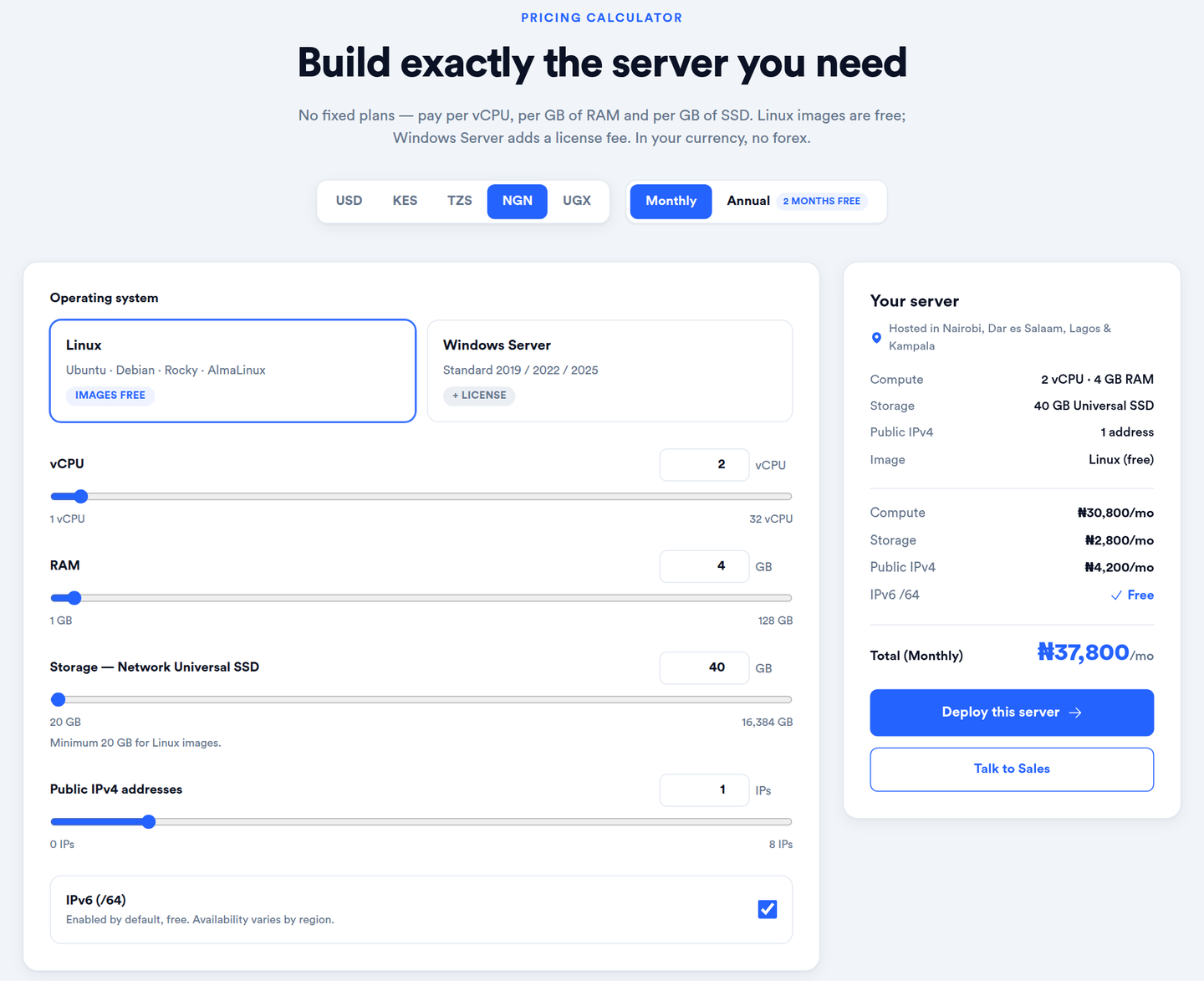
Lineserve is an African cloud provider with four live regions: Lagos (LOS1), Nairobi (NBO1), Dar es Salaam (DAR1) and Kampala (KLA1), with the same per-unit prices in each. In Lagos it sells Cloud Servers built resource by resource, ready-made Linux and Windows VPS plans, dedicated servers and S3-compatible object storage, all billed in naira through www.lineserve.ng.
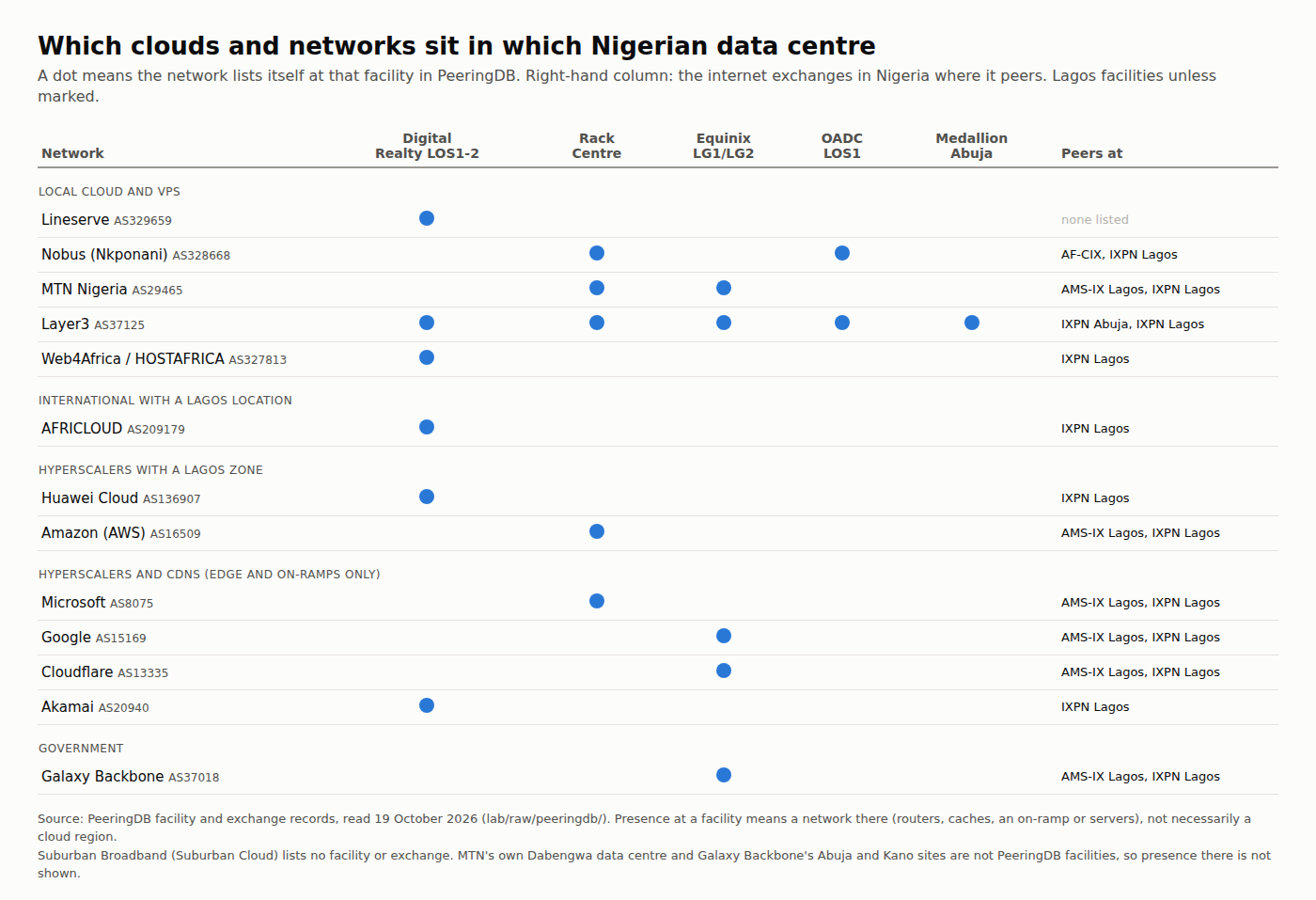
- Where it runs: Lineserve’s network is AS329659. PeeringDB lists it at Digital Realty Lagos (LOS1-2) on Victoria Island, alongside Africa Data Centres NBO1 and iColo NBO2 in Nairobi and Wingu in Dar es Salaam. Its Lagos block, 102.204.2.0/24, is registered with AfriNIC as “LINESERVE-NG”, country NG, and RIPEstat geolocates it to Lagos. (Lineserve’s region code LOS1 isn’t Digital Realty’s building of the same name.)
- What we measured: 102.204.2.10 answered all nine RIPE Atlas probes on Nigerian networks, with no packet loss, in 1.3 to 30.3 ms (median 16.1 ms): 1.3 ms from IXPN and 1.9 ms from MainOne in Lagos, 16.1 ms from MTN’s and 30.3 ms from Tizeti’s slower-access probes, 10.0 to 13.3 ms from Abuja and 17.9 to 21.5 ms from Kano. Eight of the nine were within 25 ms, and no route left Nigeria. With Huawei Cloud Lagos, it was the only Lagos provider every Nigerian network reached in about 30 ms or less. It reaches Nigerian networks through its upstreams, WIOCC (AS37662) and De Choicetech (AS328658), which both have ports at IXPN Lagos (RIPEstat, PeeringDB); see the traceroutes.
- Price: Cloud Servers cost ₦4,200 per vCPU, ₦5,600 per GB of RAM, ₦70 per GB of SSD and ₦4,200 per IPv4 address a month, per the Cloud Servers page. The smallest (1 vCPU, 1 GB, 20 GB SSD, one IPv4) is ₦15,400 a month. The Linux VPS range starts at Linux VPS – 2 GB RAM (1 vCPU, 40 GB SSD, dedicated IPv4) at ₦16,800; 4 GB (2 vCPU, 80 GB) is ₦33,600. The Windows VPS range starts at ₦30,800 for 2 GB, with the Windows Server 2022 licence included. The page says VAT at 7.5% “is calculated and shown separately at checkout”, so the smallest Cloud Server is ₦16,555 a month with VAT and the 2 GB VPS ₦18,060. Every server gets a 1 Gbps port with unlimited local traffic and a free /64 IPv6 block; annual billing charges 10 months for 12.
- Other services in LOS1: object storage sold in 200 GB blocks from ₦18,742.50 a month (Starter), with transfer in and out and API requests free, and dedicated servers from ₦463,500 a month (LineServe Core 1: 16 cores, 32 GB, 2 × 480 GB SSD) plus a ₦148,500 setup fee. Managed Kubernetes, databases, load balancers and block storage are listed as launching soon. Colocation is sold in Nairobi only.
- Payment: in naira by card or bank transfer: “No foreign card or forex conversion is required.”
- Support, SLA and refunds: signed-in tickets, phone and email in East Africa Time business hours, with cover for live incidents. The SLA promises 99.9% a month and credits 10% below 99.9%, 25% below 99.0% and 50% below 95.0%, claimed within 30 days. Fees are billed in advance and non-refundable under its terms, and there is no free trial.
- Best fit: startups, SMEs and developers who want self-service servers in Lagos with naira invoices and consistent response times across Nigerian networks, and businesses that serve several African countries from one account.
MTN Cloud
MTN Nigeria launched its public cloud in July 2025 alongside its new Lagos data centre. BusinessDay reported $20 million invested in the cloud service, powered by a $100 million data centre, and a promised “15 to 20 percent discount compared to international players”.
- Where it runs: one region, “Nigeria South”, per MTN’s region and availability zone guide. “Lagos AZ 1 – Lagos Island” and “Lagos AZ 2 – Lagos Island” are live; “Lagos AZ 3 – Lagos Mainland” is “In Progress”. MTN says “Each AZ is a physically and logically independent site”, with 2 to 3 ms between AZ1 and AZ2, but it doesn’t name the buildings. Its Sifiso Dabengwa data centre has a 4.5 MW first phase of a planned 9 MW, and is certified Uptime Tier III for design and construction on Uptime Institute’s Nigeria list.
- What’s sold: virtual machines, block, object, NFS and SMB storage, managed databases, self-managed Kubernetes, VPN and firewall, per its product catalogue.
- What we measured: MTN Cloud’s site (cloud.mtn.ng, on MTN’s AS29465 in Lagos) drops ping, so we measured it with TCP traceroutes to port 443. From IXPN and MainOne it answered in 1.5 and 2.5 ms, and from MTN’s own probe and the northern probes in 19.6 to 22.0 ms, but from both Abuja probes it took 154.7 and 157.3 ms and from one Kano probe 117.2 ms. Median 21.3 ms across the eight that answered.
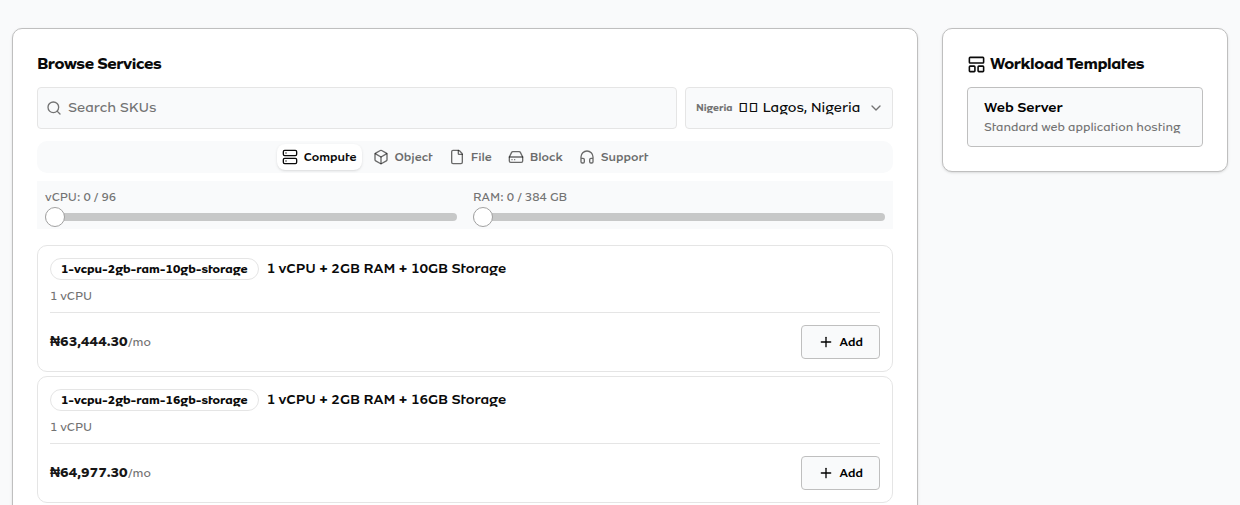
- Price: the pricing calculator says “All prices in NGN (₦)”. The smallest VM (1 vCPU, 2 GB, 10 GB) is ₦63,444.30 a month, and 2 vCPU / 4 GB / 50 GB is ₦134,553.60, before VAT. Withholding tax isn’t deducted in the calculator; MTN handles it “at invoice stage”.
- How you buy: sign-up “Works for individual or business accounts” (onboarding); billing is a monthly tenant invoice. We found no list of accepted payment methods.
- Strengths: two live Lagos zones, the broadest local catalogue (managed databases included), naira pricing from a company that will be around. Limits: the highest list prices in our table at small sizes, and no building named for each zone.
Nobus Cloud
Nobus (Nkponani Ltd) sells Flexible Compute (FCS), Kubernetes and database services. Rack Centre announced that Nobus Cloud Services “Goes live at Rack Centre”, and PeeringDB lists its network (AS328668) at Rack Centre and OADC LOS1, peering at IXPN Lagos and AF-CIX.
- What we measured: 102.223.36.17 answered MainOne’s probe in 2.7 ms, Abuja in 11.9 and 17.8 ms and the other Nigerian probes in 19.8 to 35.0 ms, except one Kano probe at 121.6 ms. Median 20.4 ms across the eight that answered (IXPN’s returned no result).
- Price and billing: FCS is “billed as low as N9,309.00 Naira/ monthly” on a pre-billing system; the page doesn’t give the spec for that price. “Make All Your Payments in Naira!”
- Availability zones: its FCS overview lists “In separate Availability Zones (Coming Soon)”, so in Nigeria it is one zone today. It opened a Nairobi zone in September 2026.
- SLA: its SLA promises 99.98%, with credits of 10%, 30% and 100% below 99.98%, 99.0% and 95%.
- Customer story: Nobus’s COO told TechCabal its prices are “about 30-35% lower than what AWS charges”.
- Best fit: teams that want local Kubernetes and databases in naira today.
Layer3 Cloud
Layer3 is a Nigerian network and data centre company whose cloud offers IaaS, S3-compatible object storage, backup, Kubernetes and disaster recovery, “all hosted locally in Nigeria” (layer3.cloud). Its data centre page lists two Lagos zones and one in Abuja; its founder told Rest of World “We run our cloud services out of third-party data centers in Nigeria”. PeeringDB lists its network (AS37125) in five Nigerian facilities, including Digital Realty, Rack Centre and Equinix in Lagos and Medallion in Abuja.
- What we measured: the address we could test, its website, is in Abuja on RIPEstat’s geolocation. It answered the Abuja probes in 11.8 and 12.3 ms, IXPN and MainOne in Lagos in 12.2 and 13.0 ms (consistent with Lagos to Abuja), and the rest in 27.5 to 43.7 ms, never routed abroad. Median 27.5 ms.
- Price: on its pricing page, 1 vCPU / 1 GB / 64 GB SSD is ₦12,750.22 a month and 2 vCPU / 4 GB / 64 GB is ₦37,621.45, as a “Basic MRC” that excludes support and the IP address (₦1,162 per IP). VAT isn’t stated.
- Billing: a prepaid naira wallet: “Payment may be made by debit card, bank transfer, or wallet top-up” (console terms). Resources are suspended when credit runs out.
- Best fit: buyers who need Abuja as well as Lagos.
HOSTAFRICA and WhoGoHost (Nigerian VPS)
HOSTAFRICA is a South African-headquartered host that has bought several Nigerian brands. WhoGoHost’s own page says it “is a subsidiary of HOSTAFRICA” and “runs on HOSTAFRICA’s infrastructure”, naming Digital Realty Lagos among the group’s data centres. WhoGoHost and HOSTAFRICA Nigeria sell identical VPS plans at identical prices.
- Where it runs: the VPS page says the servers are “hosted in our Nigeria data centres” and offers a location picker (Nigeria, South Africa, Kenya, Ghana). The group’s Nigerian network, Web4Africa (AS327813), is listed at Digital Realty Lagos and peers at IXPN Lagos.
- What we measured: 102.68.84.100 (a Lagos-geolocated Web4Africa block) answered IXPN in 2.2 ms and most other Nigerian probes in 14 to 32 ms, but MainOne in 85.3 ms and one Kano probe in 128.6 ms. Median 19.8 ms.
- Price: C1 (1 vCPU, 1 GB, 20 GB) is ₦11,050 a month, with the first month at ₦5,525 on a promotion to 31 December 2026. C4 (2 vCPU, 4 GB, 100 GB) is ₦36,550. VAT isn’t stated.
- Payment: naira; WhoGoHost’s refund policy names Paystack, Rave (Flutterwave) and PayPal.
- Note: this is the VPS range. The group’s shared hosting is a different matter (see hosting companies).
Suburban Cloud
Suburban Cloud describes itself as a “Hyperscale Sovereign Cloud Service Provider headquartered in Abuja”, offering virtual machines, desktop-as-a-service and virtual data centres through a console. It publishes no prices and doesn’t name a facility. Its console address (on Suburban Broadband’s AS37004) answered IXPN in 17.3 ms but the other eight Nigerian probes in 89 to 242 ms (median 143.3), so most routes to it left the country.
International providers with a Lagos location
- AFRICLOUD opened a Lagos region in August 2026 “from a carrier-neutral data centre in Lagos’s central business district”. PeeringDB lists its network (AS209179) at Digital Realty Lagos. It prices in euros (VM1 €20 a month) and takes card, PayPal or crypto; we found no naira billing. Its Lagos block answered IXPN in 1.0 ms and MainOne in 1.9 ms, and most other Nigerian probes in 11 to 33 ms, but one Kano probe in 116.2 ms. Median 15.7 ms.
- Melbicom sells bare metal and VPS from a Lagos data centre and publishes a test IP. It answered IXPN in 1.3 ms and MainOne in 2.3 ms, most other Nigerian probes in 12 to 32 ms, and one Kano probe in 121.2 ms. Median 16.1 ms.
Checked, and not on the list
- CyberCloud claims VMware IaaS and VPS (services), but we found no price or current location.
- Cloud Exchange‘s domain (cloudexchange.com.ng) didn’t resolve on 19 October 2026. Its Ikoyi facility is on Uptime Institute’s list as Tier IV design.
- Glo lists “Hosted Cloud services” with “Pricing and Packages … available on request” (Glo business); we found no product.
- ipNX is an ISP with colocation at Africa Data Centres Lagos; no public IaaS.
- Okra’s Nebula cloud, a naira-billed alternative to AWS (TechCabal, October 2024), was shut down in 2025. It’s a reminder to check that a provider will last.
Local VPS or foreign VPS: what changes for Nigerian users
| VPS in Lagos | VPS in Johannesburg or Europe | |
|---|---|---|
| Round trip from Nigerian ISPs | 1–2 ms within Lagos, 10–30 ms from Abuja and Kano; 100 ms or more if a route leaves Nigeria | Medians of 74–95 ms (South Africa) and 117–144 ms (London, Frankfurt) |
| Billing | Usually naira, by transfer or local card | Usually USD or EUR on a card, drawing on your bank’s foreign limit |
| Price per spec | Higher than the cheapest foreign plans | Vultr’s 2 vCPU / 4 GB in Johannesburg is $20 |
| Data residency | Data at rest in Nigeria | A cross-border transfer under the NDPA |
| Cable faults | Domestic traffic stays domestic | Cut off when the subsea routes fail |
What a 2 vCPU / 4 GB server costs (19 October 2026)
| Provider | Plan | Where | Monthly price | Notes |
|---|---|---|---|---|
| Lineserve | Linux VPS – 4 GB RAM: 2 vCPU, 4 GB, 80 GB SSD, IPv4 | Lagos | ₦33,600 + 7.5% VAT (₦36,120) | Or ₦37,800 as a Cloud Server with 40 GB SSD |
| HOSTAFRICA / WhoGoHost | Linux Cloud C4: 2 vCPU, 4 GB, 100 GB | Lagos | ₦36,550 | First month ₦18,275; VAT not stated |
| Layer3 | 2 vCPU, 4 GB, 64 GB SSD | Lagos or Abuja | ₦37,621.45 + ₦1,162 IP | Support extra; VAT not stated |
| AWS Lagos Local Zone | t3.medium + 80 GB gp2 + public IPv4 | Lagos | $64.96 (about ₦86,640) | $0.0624/hour, gp2 $0.197/GB-month, IPv4 $0.005/hour; data transfer extra |
| MTN Cloud | 2 vCPU, 4 GB, 50 GB | Lagos | ₦134,553.60 + VAT | WHT handled at invoice |
| Truehost Nigeria | Cloud VPS 2: 2 vCPU, 4 GB, 100 GB | Europe | ₦19,527 | ₦17,622.97/month on a three-year term |
| Vultr | vc2-2c-4gb: 2 vCPU, 4 GB, 80 GB | Johannesburg | $20 (about ₦26,670) | USD, card |
| DigitalOcean | Basic Droplet: 2 vCPU, 4 GB, 80 GB | Europe (nearest London) | $24 (about ₦32,010) | USD, card |
Each provider’s own price page on 19 October 2026. Dollar prices converted at the CBN NFEM rate of ₦1,333.72; a card issuer’s rate will differ. AWS charges by the hour; 730 hours a month assumed.
Of the providers in this table with servers in Nigeria, Lineserve’s 4 GB plan has the lowest published price. The cheapest offers overall are foreign: if your users and data don’t need Nigeria, a Johannesburg or European VPS costs less.
Telco, government and enterprise clouds
- MTN is covered above: it is both Nigeria’s biggest mobile operator and its biggest self-service local cloud.
- Airtel (Nxtra). Airtel Africa broke ground on a 38 MW Nxtra data centre at Eko Atlantic in March 2024. In February 2026 Airtel Nigeria’s CEO said it was “progressing steadily towards the previously announced 2028 go live date”. Airtel sells no public cloud product in Nigeria today.
- Glo sells hosted cloud and colocation by quote (see above).
- Galaxy Backbone is the federal government’s ICT company. Its NSSC in Abuja is “the only Uptime Institute Certified Tier III data center within the nation’s public sector”, with “a Secondary Tier IV Datacentre facility in Kano” (Galaxy Backbone); Uptime Institute’s list confirms Tier III and Tier IV design and constructed-facility certificates. It runs the government cloud for ministries, departments and agencies (MDAs) and state governments, and in May 2026 partnered with NITDA on subsidised sovereign cloud for startups. Its address answered Nigerian probes in 13.5 to 43.2 ms (median 27.1), consistent with Abuja.
- MainOne, an Equinix company, sells a Managed Private Cloud “powered by VMware” with resources “hosted in Equinix IBXs in Nigeria and Ghana”, and IaaS on Azure Stack “Hosted within the Equinix International Business Exchange™ (IBX®) in Lagos and Accra”. Azure Stack runs Azure services on hardware in Lagos, but it isn’t an Azure region. Both are sales-led.
- CloudFlex sells VMware-based IaaS under the heading “No Forex”: “No FX is required when you onboard any of your services”, with pay-per-use pricing (cloudflex.ng), by quote.
- Unitellas, Zadara’s distributor, is a cloud partner at Africa Data Centres Lagos, offering “EC2 Compactible APIs, Elastic Compute/VMs, Elastic Block Storage, VPC and Load Balancer” to service providers and large enterprises.
- UniCloud Africa announced in April 2026 that it is deploying in OADC’s Lagos campus, with local-currency billing. We found no public price.
- Rack Centre’s CloudOnGround is a marketplace of “local and international cloud providers hosted on-ground” in its facility; it doesn’t publish the list.
Managed private cloud or public cloud? A managed private cloud (MainOne, CloudFlex, Unitellas) gives you dedicated VMware or Zadara capacity, a contract and an account team, which suits banks moving existing VMware estates. A public cloud (Lineserve, MTN, Nobus, Layer3) gives you self-service servers by the month with no minimum commitment, which suits startups and most web workloads.
Data centres that make Nigeria’s cloud market possible
These are the buildings the clouds above rent space in. They sell racks and power, not virtual machines.
| Facility | Where | Status and size | Uptime Institute certification |
|---|---|---|---|
| Rack Centre | Oregun, Ikeja | Operational, 13.5 MW total IT power; LGS2 expansion of 12 MW; AWS Direct Connect location | Tier III design and constructed facility |
| Equinix LG1, LG2 (ex-MainOne) | Lekki | Operational; LG3 announced in November 2025 for Q1 2026, opening not confirmed | MainOne Lekki: Tier III design and constructed |
| Digital Realty Lagos (ex-Medallion) | LOS1 and LOS2, Victoria Island; LKK1 and LKK2, Ibeju-Lekki | Operational; claims ISO 27001, PCI DSS, SOC 2 | Not listed |
| Africa Data Centres LOS1 | Eko Atlantic | Operational, 10 data halls, 20.65 MW critical IT load | Not listed |
| OADC Lagos LOS1 (WIOCC) | Lagos | Operational, 24 MW site load, Equiano landing | Phase 1: Tier III design |
| MTN Sifiso Dabengwa | Lagos | Operational since July 2025, 4.5 MW phase 1 of 9 MW | Tier III design and constructed |
| Kasi LOS1 | Maiyegun, Lekki | First phase commissioned May 2026 of a planned 100 MW campus | Not listed |
| Nxtra by Airtel | Eko Atlantic | Under construction, 38 MW, 2028 | Not listed |
| Galaxy Backbone NSSC, Kano | Abuja, Kano | Operational | Tier III (Abuja), Tier IV (Kano) |
Status, size and certification from each operator’s page and Uptime Institute’s Nigeria awards list, 19 October 2026. A Tier rating belongs to the building, not to the cloud providers inside it.
Hyperscalers: what AWS, Huawei, Microsoft and Google have in Nigeria
The AWS Lagos Local Zone
AWS has no full region in Nigeria, but it does have a Local Zone in Lagos. AWS made it generally available on 25 January 2023, promising “single-digit millisecond latency or local data processing”. Lagos State Government, Stanbic IBTC and Terragon were named at launch (Nairametrics).
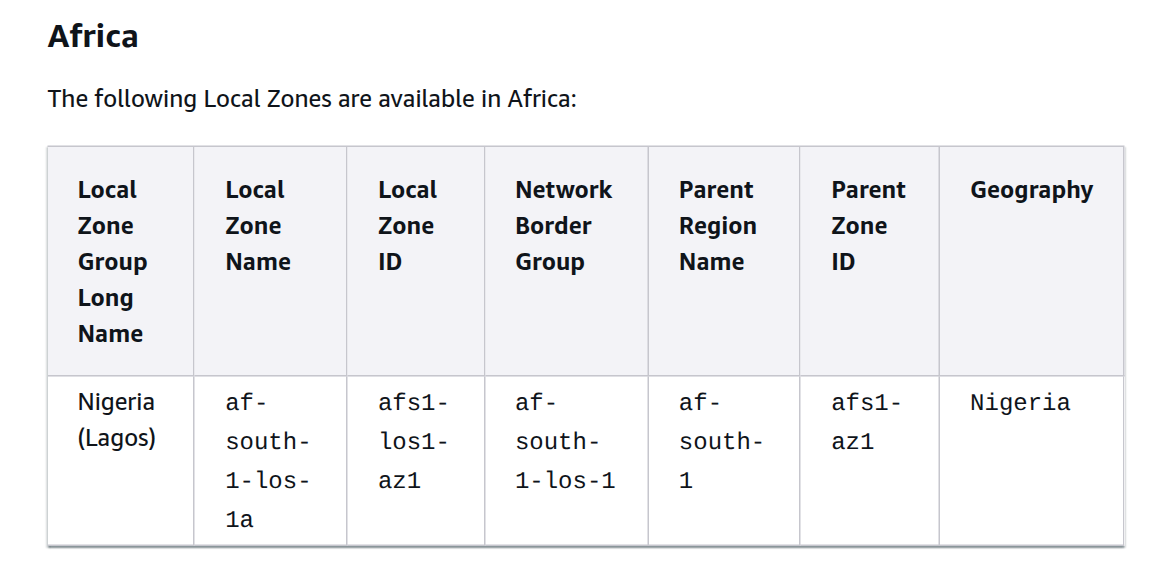
- What it is:
af-south-1-los-1a, network border groupaf-south-1-los-1, parent region af-south-1 (Cape Town). - What runs in Lagos: per AWS’s Local Zones features table: EC2 T3, C5, R5, G4dn and M5 instances; EBS gp2 volumes only; Application Load Balancer; ECS and EKS; VPC; Direct Connect; Shield Standard; Application Migration Service; Route 53 geoproximity routing; and Elastic Disaster Recovery.
- What doesn’t: S3, RDS, ElastiCache, FSx, EMR, GameLift and NAT Gateway aren’t offered in Lagos. So object storage, managed databases and NAT go through Cape Town. AWS’s FAQ says the parent zone “handles certain control plane operations for the Local Zone, such as API calls”.
- How you use it: enable Cape Town (itself an opt-in region), opt in to the Lagos zone group, then create a subnet in the Local Zone (getting started).
- Price: a t3.medium (2 vCPU, 4 GiB) is $0.0624 an hour, about $45.55 a month, and gp2 storage $0.197 per GB-month (AWS Price List, Lagos, 15 October 2026).
- Billing: AWS prices in dollars. Since January 2025 AWS Europe customers can pay in naira, by credit card only, at a rate AWS sets. As Okra’s CEO put it to TechCabal: “You are exchanging your USD bill at the going rate of naira.”
- What we measured: we pinged an address in the Lagos zone’s published range (96.0.36.0/22 in AWS’s ip-ranges.json, border group
af-south-1-los-1). The nine Nigerian probes answered in 7.6 to 41.3 ms (median 31.6 ms): never the 1 to 2 ms of the fastest local providers from Lagos, but never routed abroad either (AWS is at Rack Centre and on IXPN and AMS-IX Lagos). - Also in Lagos: a CloudFront edge location since June 2023 (several of our data-centre probes were served by LOS50) and Direct Connect at Rack Centre.
- Who it suits: teams already on AWS that need Lagos latency for EC2 and EKS, and can accept that S3, RDS and the control plane are in South Africa.
Huawei Cloud’s Lagos HomeZone
Huawei Cloud’s documentation says “an IEC HomeZone in the Huawei Cloud Africa region is named LOS1-AZ1. This HomeZone is located in Lagos, Nigeria”, with its parent region AF-Johannesburg (IEC product page). It offers a broader set than AWS Lagos: ECS virtual machines, CCE Turbo containers, EVS block storage, SFS Turbo file storage, OBS object storage, RDS, load balancing, NAT and VPN, among others.
- Huawei launched it in December 2024, saying OPay “reduced transaction latency from 130 ms to 15 ms”, and held its Agentic AI Cloud launch in Lagos in August 2026.
- PeeringDB lists Huawei Cloud (AS136907) at Digital Realty Lagos and on IXPN Lagos. Its Lagos address answered all nine Nigerian probes in 0.9 to 28.8 ms (median 17.6 ms): 0.9 ms from IXPN, 2.1 ms from MainOne, 13.4 to 13.5 ms from Abuja and 17.6 to 18.4 ms from Kano.
- We found no naira price list.
Microsoft Azure
Azure’s African regions are South Africa North (Johannesburg) and South Africa West (Cape Town). In Lagos it has an Azure Front Door edge (LOS), and Microsoft’s network (AS8075) is at Rack Centre and on IXPN Lagos. ExpressRoute has no Lagos peering location. Microsoft’s customer agreement bills Nigeria in US dollars (MCA FAQ). Azure Stack in Lagos is available through MainOne (above). Johannesburg answered Nigerian ISPs in 75.2 to 109.6 ms (median 87.8). Separately, Microsoft announced in May 2024 that it would close its Africa Development Centre in Lagos, an engineering office, not a data centre.
Google Cloud
Google’s only African region is africa-south1 in Johannesburg. Lagos is an edge location and a Cloud CDN location, and Google’s network (AS15169) is at Equinix Lagos and on IXPN. Cloud Interconnect has no Lagos colocation facility; the nearest are Johannesburg, Cape Town and Nairobi. Nigeria isn’t on Google’s billing currency list, so accounts are charged in USD.
Oracle, Alibaba, IBM and Tencent
Oracle’s region list shows Johannesburg live and Kenya “Coming soon”, with nothing in Nigeria. Alibaba Cloud has CDN nodes in Nigeria but no region. We found no Nigerian presence for IBM or Tencent. Oracle Johannesburg answered Nigerian ISPs in 77.6 to 280.5 ms (median 95.3).
CDN and edge networks
Cloudflare lists Lagos as its Nigerian city and is at Equinix Lagos; Akamai is at Digital Realty Lagos. From Nigerian ISPs, Google’s resolver (8.8.8.8) answered in 1.4 to 52.1 ms and CloudFront in 1.2 to 44.2 ms, but Cloudflare’s 1.1.1.1 was 1.5 ms from IXPN and 138 to 155 ms from MTN’s probe and two northern probes. HTTP checks from Globalping’s data-centre probes showed the same unevenness for websites: five of six reached Cloudflare’s site through Lisbon (LIS), and CloudFront served half of them from Cape Town (CPT51) in one round (details in the second view). A CDN with a Lagos point of presence doesn’t guarantee your users are served from it.
Hyperscaler footprint in Nigeria
| Provider | Nearest full region | In Nigeria | Naira billing | From Nigerian ISPs (median, range) |
|---|---|---|---|---|
| AWS | Cape Town | Lagos Local Zone (EC2, EBS, EKS, ALB), CloudFront, Direct Connect | Card payment in NGN, priced in USD | Lagos zone 31.6 ms (7.6–41.3); Cape Town 73.9 ms (56.2–83.1) |
| Huawei Cloud | Johannesburg | Lagos HomeZone LOS1-AZ1 (ECS, OBS, RDS and more) | Not found | Lagos 17.6 ms (0.9–28.8); Johannesburg 88.8 ms (74.3–184.3) |
| Microsoft Azure | Johannesburg | Front Door edge; Azure Stack via MainOne | No (USD) | Johannesburg 87.8 ms (75.2–109.6) |
| Google Cloud | Johannesburg | Edge and CDN | No (USD) | Not pingable |
| Oracle | Johannesburg | Nothing found | No | Johannesburg 95.3 ms (77.6–280.5) |
Regional African providers serving Nigeria
- HOSTAFRICA (South Africa) runs the Nigerian VPS range above and owns WhoGoHost/GO54, DomainKing and Web4Africa (HOSTAFRICA Nigeria’s about page).
- Truehost, a Kenyan host, sells in naira at truehost.com.ng; its VPS range is in Europe (see hosting).
- Lineserve belongs in the local group because LOS1 is in Lagos, but its other three regions, in Nairobi, Dar es Salaam and Kampala, sit under the same account at the same per-unit prices. That matters for a Nigerian company expanding into East Africa, or for one that wants a disaster-recovery copy in another country.
- Nobus added a Nairobi zone in September 2026.
Hosting companies and resellers
This section answers “best hosting company in Nigeria” and the desk question “who resells foreign capacity?”. Shared and WordPress hosting is a different product from a cloud server: you rent space on a server the host runs, often with cPanel, email and a domain bundled.
Reselling, in plain terms
Many Nigerian hosting brands rent servers in the US, Europe or South Africa, or resell a foreign host’s capacity, and sell it in naira. That’s legitimate, and for a brochure website it’s often fine. It isn’t local infrastructure. There are three common models:
- Licence or cloud resale: a partner invoices you for Microsoft, AWS or Google services that run in their regions.
- A managed service provider running a foreign cloud account for you.
- A white-label host that rents servers abroad and sells hosting under its own brand.
One group owns four of the “Nigerian” brands
HOSTAFRICA’s own history page lists the acquisitions: DomainKing (“a leading Nigerian hosting company”) in August 2021, then Web4Africa and GO54 (formerly WhoGoHost) in 2025. WhoGoHost’s footer reads “© 2026 HOSTAFRICA NIGERIA LIMITED”, DomainKing’s says it “is a brand of Host Africa (Pty) Ltd”, and web4africa.com now redirects to hostafrica.com. If you’re collecting quotes from these brands, you’re collecting one company’s quotes.
Hosting directory (19 October 2026)
| Host | Entry shared hosting | Entry VPS | Where the servers are, per its own pages | Payment |
|---|---|---|---|---|
| GO54 / WhoGoHost | ₦875/month first term, renews ₦2,500 (Premium) | ₦11,050 (1 vCPU, 1 GB); Windows from ₦54,400 | VPS “hosted locally in Nigeria”; shared not stated | NGN; Paystack, Rave, PayPal |
| HOSTAFRICA Nigeria | ₦4,500 (Starter, 20 GB) | ₦11,050 (C1) | VPS in Nigeria; shared not stated | NGN |
| DomainKing | ₦1,150 (1 GB), same at renewal | None | “Our servers are located in South Africa” | NGN; cards via Flutterwave, EFT, PayPal |
| Qservers | ₦1,850 (6 GB) | ₦10,000 (2 GB, 25 GB, no backups) | Not stated; its website is on Liquid Web (US) | NGN |
| Smartweb | ₦1,250/month or ₦15,000/year | ₦10,000 (1 core, 2 GB, 40 GB) | Not stated; its website is on a US network | Bank transfer, CashEnvoy, Quickteller |
| Truehost Nigeria | ₦2,500 (Starter) | ₦7,657 (Cloud VPS Elite, 1 GB) | VPS add-ons sold as “Extra IPv4 Address in Europe” | NGN |
| HostNowNow | ₦1,500 (10 GB NVMe) | None | “running on Microsoft Azure infrastructure”; region not named | NGN |
| Hostinger (Nigeria pages) | ₦990 on a 48-month term, renews ₦4,190 | ₦8,690 (KVM 1: 1 vCPU, 4 GB), renews ₦14,490 | Europe, Asia, US and Brazil; no African data centre | NGN display |
| Namecheap | $2.28/month (Stellar) | “Data center US” | USD only |
Each host’s own pages on 19 October 2026. First-term prices often depend on paying for one to four years upfront; compare renewal prices. Garanntor’s sites now redirect to Verpex, and Web4Africa’s to HOSTAFRICA.
For a WordPress site with Nigerian visitors, shared hosting abroad is usually adequate if it has a CDN in front. For a shop, an API or anything with personal data at scale, a VPS or cloud server in Lagos is the better base.
How to tell if a host resells foreign capacity
- The site never names a server country or data centre, or names one only for some products.
- Its own website and client area sit on a US or European network. Run
whois -h whois.cymru.com " -v <ip>"on the site’s address (commands below). - Prices track the dollar. Answering a customer’s complaint on Nairaland in 2017, before HOSTAFRICA bought it, DomainKing explained that “Our prices were updated due to high increase in exchange rates of Naira to USD”.
- Vague answers about the data centre when you ask which building.
- Domain transfers are restricted. After HOSTAFRICA bought Webmanager, users reported no self-serve EPP codes and higher domain renewals.
Questions to ask a reseller
Who owns the servers, and in which region? Is the cloud account in your name or theirs? Is this a resale invoice, and does it carry VAT? Who holds the root and admin credentials? Where are backups and logs kept? Can you leave with your data and your domain, and what does that cost? Do they mark up bandwidth?
Choosing a Nigerian web host
Look at the renewal price (not the first-term price), server location, control panel, resource limits, email limits, backups and whether restores cost extra, free SSL, who owns the domain, malware clean-up, support hours, free migration and the refund policy. Don’t rank a host on its introductory price.
Global VPS and developer clouds
None of the popular developer clouds has a Nigerian location:
- Vultr: Johannesburg is its only African location (Vultr regions); 1 vCPU / 1 GB is $5 a month, 2 vCPU / 4 GB $20. Johannesburg answered Nigerian ISPs in 73.8 to 302.7 ms (median 92.5).
- DigitalOcean: no African region (regional availability); the nearest is London. Droplets start at $4 a month (pricing).
- Akamai (Linode): no African region; London answered Nigerian ISPs in 106.4 to 204.7 ms (median 122.3). Nanode 1 GB is $5 a month.
- Hetzner: Germany, Finland, the US and Singapore (locations); Falkenstein answered in 104.1 to 187.7 ms (median 144.3).
- Contabo and OVHcloud: no Nigerian location found; Contabo’s site refused our requests, so we couldn’t check its prices.
Nigerian developers use them for price per spec, documentation and ecosystem. The trade-offs are latency, dollar billing on a card with a bank limit, and a cross-border transfer for any personal data.
Billing and payment: naira or dollars
Why it matters
Since 2023 the naira has moved from ₦471 to as far as ₦1,669 to the dollar and back to about ₦1,334. A dollar bill can rise by half without you adding a server. Banks have suspended and capped naira cards for foreign spending, and in 2023 a Nairaland user asking about paying Hostinger was told “Payment with your debit card will not go through as CBN has blocked payment to foreign account with naira card”. Limits have been raised since September 2026, but they still vary by bank and change often.
Five billing models
- Priced and billed in naira. Lineserve, MTN Cloud, Nobus, Layer3, HOSTAFRICA/WhoGoHost. The price you plan with is the price on the invoice.
- Priced in dollars, charged in naira. AWS’s NGN card payments: you still carry the exchange-rate risk. As Lynda Saint-Nwafor, MTN Nigeria’s Chief Enterprise Business Officer, told BusinessDay, “There is a difference between charging in naira and being priced in naira”.
- Dollars or euros only. Azure, Google, Oracle, DigitalOcean, Vultr, AFRICLOUD, Namecheap.
- Billed in naira through a reseller or partner. A local invoice for a foreign cloud; check whether the contract has an exchange-rate adjustment clause.
- Contract with an FX clause. Common in enterprise deals: the naira price moves with the rate.
Who bills in naira
| Provider | Naira billing | How you pay | Servers in Nigeria |
|---|---|---|---|
| Lineserve | Yes, priced per resource in naira | Card, bank transfer | Yes, Lagos (LOS1) |
| MTN Cloud | Yes, priced in naira | Monthly invoice (methods not published) | Yes, Lagos |
| Nobus | Yes, pre-billing | Naira | Yes, Lagos |
| Layer3 | Yes, prepaid wallet | Debit card, bank transfer | Yes, Lagos and Abuja |
| HOSTAFRICA / WhoGoHost | Yes | Paystack, Flutterwave, PayPal | VPS yes; shared not stated |
| CloudFlex | “No FX required” | By contract | Not confirmed for 2026 |
| AWS | Card charged in NGN, priced in USD | Credit card | Lagos Local Zone |
| Hostinger, Truehost, DomainKing | Yes | Card, transfer | No |
| Azure, Google, Oracle, DigitalOcean, Vultr | No | Card in USD | No |
Naira billing doesn’t mean local servers. Truehost, Hostinger and DomainKing all bill in naira from abroad. Check both.
Tax and procurement
VAT is 7.5% under the Nigeria Tax Act 2025, and foreign providers of digital services must register and charge it; for VAT-registered Nigerian businesses buying from abroad, the reverse charge applies (Mondaq). Lineserve shows the 7.5% separately at checkout; MTN Cloud’s calculator has an “Include VAT” toggle and handles withholding tax on the invoice. For procurement, ask for an invoice with your TIN, the provider’s TIN, and VAT on its own line.
Costs beyond the plan price
IPv4 addresses (AWS charges $0.005 an hour for each, Layer3 ₦1,162 a month), storage beyond the plan, snapshots and backups, data transfer out (AWS charges for it; Lineserve’s object storage doesn’t), cross-connects in a data centre, Windows licences, support tiers, setup fees (Lineserve’s dedicated servers carry one), and minimum commitments.
Data residency and regulation: what the 2026 rules actually say
Two policy documents from August 2026 are easy to confuse, and some sources still cite a superseded 2025 draft. Here’s how they fit, from the primary texts.
| Instrument | Issued by | Status | What it requires |
|---|---|---|---|
| Nigeria Data Protection Act 2023, ss. 41–43 | National Assembly; NDPC enforces | In force | Transfers abroad allowed with adequate protection or a s.43 exception, recorded. No general localisation |
| CBN circular PSS/DIR/PUB/CIR/001/004, 15 June 2026 | Central Bank of Nigeria | Binding on licensed institutions | “payments transaction data generated within Nigeria are stored and managed in Nigeria”, from 1 January 2027 |
| National Cloud Computing Guideline 2026 (NCCG) | NITDA | Signed 4 August 2026; “Mandatory”; effective 1 January 2027 per its document information | Binds federal public institutions and cloud providers serving them. Financial data of regulated financial institutions “primarily hosted, processed and stored” in Nigeria; Level 2 data and above in Nigeria by default |
| National Digital Infrastructure Assurance Framework 2026 (NDIAF) | NITDA | Approved 4 August 2026; effective 1 January 2027 | A national register of certified providers; certification required to serve public institutions and, where sector rules say so, regulated entities |
| National Digital Cloud Policy | Federal Ministry of Communications | Unveiled 17 August 2026; sovereignty part awaits presidential approval | “does not impose general data localisation requirements on commercial data” |
| National Cloud Policy 2025 | NITDA | Draft (“V 1.0 Oct, 2025”, “First Review”), superseded by the NCCG | Don’t cite as current |
What it means:
- For ordinary businesses, there’s no rule that everything must be hosted in Nigeria. Under the NDPA you can host personal data abroad with a documented transfer basis, such as contract clauses with the provider.
- For banks, fintechs and payment companies, the CBN circular applies from 1 January 2027, and the CBN said in October 2026 that “The compliance date hasn’t changed”. NITDA’s guideline goes further, to all financial data of regulated financial institutions. BusinessDay quotes industry estimates that more than 90% of regulated organisations host on foreign clouds.
- For government work and its suppliers, the NCCG keeps sovereign data at Level 2 and above in Nigeria, and the most sensitive levels in NITDA-certified clouds in Nigeria. The NDIAF wants the recovery copy for Level 3 and 4 workloads in “a different geopolitical zone” from the primary.
- A certified-provider register is coming. Press reports said regulated firms would source from it from October 2026 (MSME Africa), but the framework takes effect on 1 January 2027 and, as of 19 October 2026, we found no published register and no named certified provider.
Does the AWS Lagos Local Zone count as “in Nigeria”? The CBN circular doesn’t define “stored and managed in Nigeria”, and we found no CBN guidance on Local Zones. Data on EBS volumes in Lagos subnets is physically in Lagos. S3, RDS, snapshots that fall back to the region, and the control plane are in Cape Town. NITDA’s guideline adds that infrastructure “shall not be deemed sovereign solely on the basis of physical location”. Treat it as unresolved, and ask your regulator.
Questions buyers forget: where replicas, backups, snapshots, logs and object storage sit; where support staff export data from; where the DR site is; where keys and identity live; and which SaaS tools copy your data abroad.
Certifications to ask for: ISO 27001, PCI DSS (for card data), SOC 2, and the data centre’s Uptime Institute certificate, checking whether it’s for design only or for the constructed facility. Hosting in Lagos gives you data residency for the NDPA; it doesn’t make you compliant with it. This section is general information, not legal advice; for the detail, see our guide to data localisation in Nigeria.
Performance: what we measured from Nigerian networks
We pinged every provider’s network from every connected RIPE Atlas probe in Nigeria on 20 October 2026, 16 pings per probe, and ran traceroutes where a result needed explaining. Nine of the probes are on Nigerian-owned networks, in three parts of the country:
| City | Probes (network) |
|---|---|
| Lagos | IXPN (the exchange), MainOne, MTN, Tizeti |
| Abuja | MegaMore Wireless (two probes) |
| North | MegaMore Wireless in Kano (two probes) and one in central-north Nigeria, between Abuja and Kano |
The figures below are across those nine. The probes are where they say they are: the IXPN and MainOne probes reach Lagos addresses in 1 to 2 ms, the Abuja probes reach them in 10 to 13 ms and the Kano probes in 17 to 22 ms, which is what the distances allow. MTN’s and Tizeti’s probes sit behind a slower last mile: Google’s 8.8.8.8 is 11 ms from MTN’s and 52 ms from Tizeti’s, so everything they measure carries that much extra.
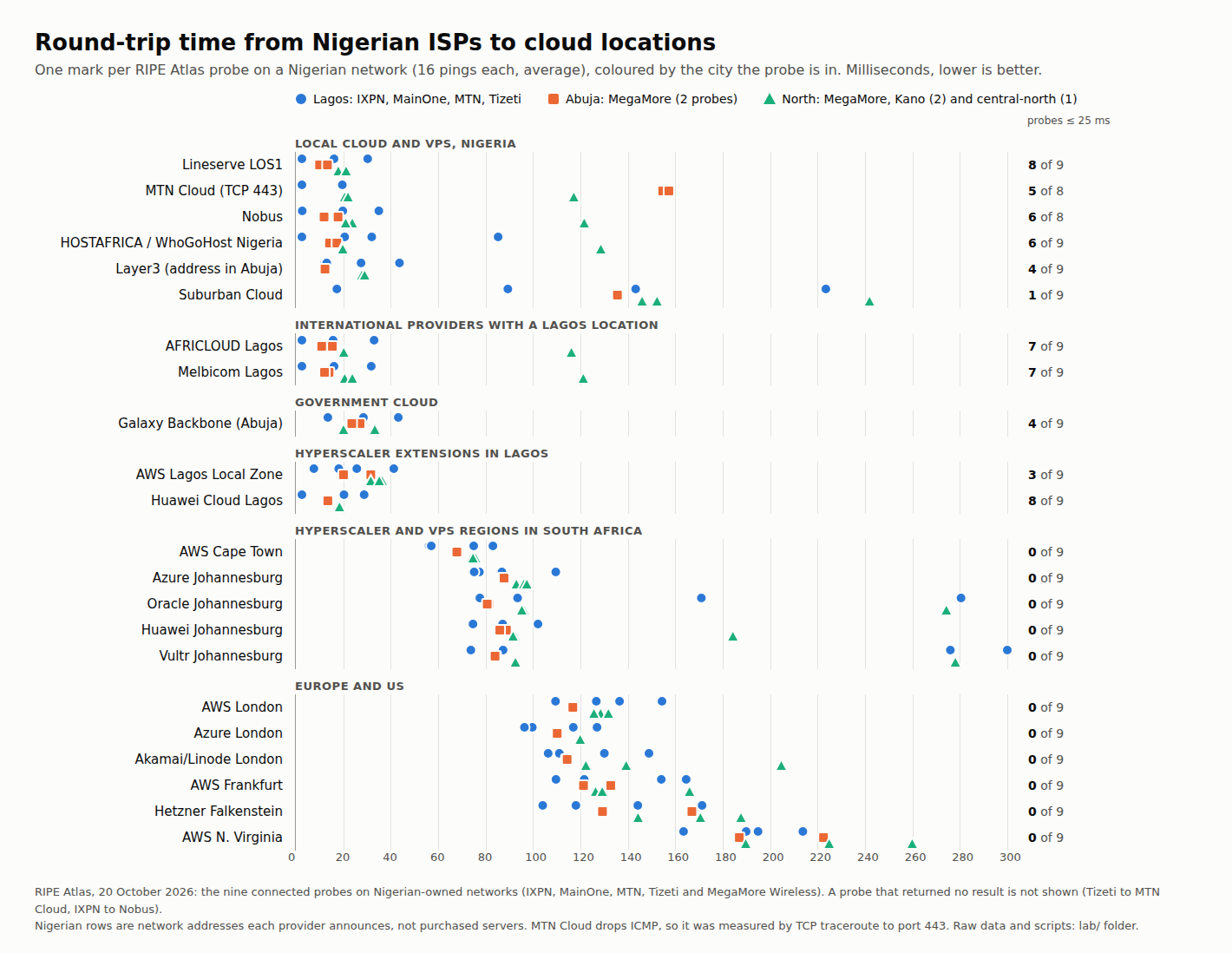
What the numbers show:
- Lineserve LOS1 was among the fastest and the most consistent. All nine Nigerian probes reached it, in 1.3 to 30.3 ms (median 16.1 ms): 1.3 ms from IXPN and 1.9 ms from MainOne in Lagos, 10.0 to 13.3 ms from Abuja, and 17.9 to 21.5 ms from Kano. None of its routes left Nigeria. Its median is the second-lowest of any Lagos provider (AFRICLOUD’s is 15.7 ms; Melbicom’s matches it), and only Huawei Lagos had a lower worst case (28.8 ms against 30.3).
- Huawei Cloud Lagos matched it: 0.9 to 28.8 ms, median 17.6 ms, eight of nine within 25 ms.
- For most other Lagos providers, one or two networks were routed the long way. AFRICLOUD and Melbicom were 1.0 and 1.3 ms from IXPN but about 120 ms from one Kano probe. HOSTAFRICA was 85 ms from MainOne and 129 ms from Kano. MTN Cloud was 1.5 ms from IXPN but 155 to 157 ms from both Abuja probes. Nobus was 2.7 ms from MainOne and 122 ms from one Kano probe.
- The AWS Lagos Local Zone was never under 7 ms but never far: 7.6 to 41.3 ms, median 31.6 ms.
- Abuja providers are about 12 to 30 ms from the rest of the country. Layer3’s tested address (in Abuja) was 11.8 to 43.7 ms and Galaxy Backbone 13.5 to 43.2 ms. Suburban Cloud’s address was 17.3 to 241.9 ms (median 143.3), so its traffic mostly left the country.
- South Africa is the floor for hyperscaler regions. AWS Cape Town was 56 to 83 ms (median 73.9), Azure Johannesburg 75 to 110 ms (median 87.8).
- Europe is 100 to 150 ms. AWS London 109.5 to 154.4 ms (median 126.7), Frankfurt 109.7 to 166.0 ms.
| Target | Probes ≤ 25 ms | Best | Median | Worst |
|---|---|---|---|---|
| Lineserve LOS1 | 8 of 9 | 1.3 | 16.1 | 30.3 |
| MTN Cloud (TCP 443) | 5 of 8 | 1.5 | 21.3 | 157.3 |
| Nobus | 6 of 8 | 2.7 | 20.4 | 121.6 |
| HOSTAFRICA / WhoGoHost Nigeria | 6 of 9 | 2.2 | 19.8 | 128.6 |
| Layer3 (Abuja address) | 4 of 9 | 11.8 | 27.5 | 43.7 |
| Suburban Cloud | 1 of 9 | 17.3 | 143.3 | 241.9 |
| AFRICLOUD Lagos | 7 of 9 | 1.0 | 15.7 | 116.2 |
| Melbicom Lagos | 7 of 9 | 1.3 | 16.1 | 121.2 |
| Galaxy Backbone (Abuja) | 4 of 9 | 13.5 | 27.1 | 43.2 |
| AWS Lagos Local Zone | 3 of 9 | 7.6 | 31.6 | 41.3 |
| Huawei Cloud Lagos | 8 of 9 | 0.9 | 17.6 | 28.8 |
| AWS Cape Town | 0 of 9 | 56.2 | 73.9 | 83.1 |
| Azure Johannesburg | 0 of 9 | 75.2 | 87.8 | 109.6 |
| Huawei Johannesburg | 0 of 9 | 74.3 | 88.8 | 184.3 |
| Vultr Johannesburg | 0 of 9 | 73.8 | 92.5 | 302.7 |
| Oracle Johannesburg | 0 of 9 | 77.6 | 95.3 | 280.5 |
| Azure London | 0 of 9 | 96.4 | 117.0 | 127.0 |
| Akamai (Linode) London | 0 of 9 | 106.4 | 122.3 | 204.7 |
| AWS London | 0 of 9 | 109.5 | 126.7 | 154.4 |
| AWS Frankfurt | 0 of 9 | 109.7 | 129.2 | 166.0 |
| Hetzner Falkenstein | 0 of 9 | 104.1 | 144.3 | 187.7 |
| AWS N. Virginia | 0 of 9 | 163.5 | 194.9 | 259.9 |
Milliseconds, RIPE Atlas, 20 October 2026: the nine probes on Nigerian networks. MTN Cloud drops ping, so it was measured by TCP traceroute to port 443 (no result from Tizeti); IXPN’s probe returned no result for Nobus. Atlas measurements are public: see Lineserve LOS1’s pings and traceroutes.
How the traffic gets there
Atlas traceroutes to Lineserve show the route staying in Nigeria. Lineserve’s upstreams, WIOCC (AS37662) and De Choicetech (AS328658), both have ports on the IXPN Lagos exchange (PeeringDB). From MTN’s Lagos probe, traffic goes from MTN’s network across IXPN to LOS1:
 8. 41.220.79.190     (MTN Nigeria, AS29465)       15.3 ms
 9. 196.216.148.87    (WIOCC's port on IXPN Lagos)    92.3 ms
12. 196.216.148.61    (De Choicetech's port on IXPN)  15.5 ms
13. 102.204.2.10      (Lineserve LOS1)             15.5 ms
From a MegaMore probe in Kano, it crosses Airtel Nigeria’s network and WIOCC to reach Lagos in 17.9 ms:
11. 105.112.207.40    (Airtel Nigeria, AS36873)    17.8 ms
13. 154.66.247.155    (WIOCC, AS37662)             18.7 ms
14. 196.216.148.61    (De Choicetech's port on IXPN)  17.4 ms
15. 102.204.2.10      (Lineserve LOS1)             17.9 ms
Excerpts. Intermediate routers often answer traceroutes slowly (the 92 ms at hop 9), so the time at the destination is the one that counts.
A second view: data-centre probes on foreign networks
We first tested from Globalping’s probes in Nigeria (19 October 2026). All nine are in Lagos data centres, and the six we used are on foreign hosting and carrier networks: Melbicom (Lithuania), Datacamp (UK), Misaka (US), Workonline (South Africa), and two on SiteHUB, which is registered in Nigeria but reaches the internet through Workonline. They show how a foreign carrier in a Lagos data centre routes, not what Nigerian ISP users see.
The lesson is that the network you test from decides the answer. Workonline handed Lagos-to-Lagos traffic to Hurricane Electric in London and Lisbon, so from Workonline and the SiteHUB probes behind it several Lagos providers, Lineserve among them, measured 100 to 206 ms. RIPE Atlas saw the same thing from those probes (Lineserve 206 ms from Workonline, 103 ms from SiteHUB). From Nigerian networks the same Lineserve address was 1.3 to 30.3 ms. From Melbicom and Datacamp, both in Lagos, Lineserve was 0.8 to 1.2 ms.
That round also gave the CDN checks, which Atlas didn’t run. Five of six Globalping probes reached Cloudflare’s site through Lisbon (LIS) and one through Lagos (LOS). CloudFront served three from Lagos (LOS50) and three from Cape Town (CPT51); an hour later every probe reached CloudFront in under a millisecond. A CDN with a Lagos point of presence doesn’t guarantee your users are served from it every time.
How to check a provider yourself
Tested on Ubuntu 24.04 on 19 October 2026. Ask the provider for a test IP, or use your trial server’s address.
- Who owns the address, and where is it registered?
$ whois -h whois.cymru.com " -v 102.204.2.10"

   AS      | IP               | BGP Prefix          | CC | Registry | Allocated  | AS Name

   329659  | 102.204.2.10     | 102.204.2.0/24      | KE | afrinic  | 2025-11-11 | Lineserve Limited - Lineserve Limited, KE
The CC column is the country of the organisation that holds the address, not where the server is. Look up the block itself (whois -h whois.afrinic.net 102.204.2.0, which for this block sayscountry: NG) and its geolocation on RIPEstat. - How far away is it from your users? Run
ping -c 20 <ip>from a machine on MTN, Airtel, Glo and your office fibre, at busy and quiet times. A Lagos server answering in under 5 ms from Lagos is in Lagos. 50 ms or more means either the server or the route is abroad. - Which way does the traffic go? Run
mtr -rwzc 20 <ip>. Hops throughlon,lis,mrsorfrain the hostnames mean your traffic is leaving Nigeria. - No machine on those networks? RIPE Atlas has probes on Nigerian ISPs (we used them); measurements need an account and credits. Globalping is free, but its Nigerian probes are in Lagos data centres on foreign networks, so treat it as a second view. Geolocation databases can be wrong; a ping can’t fake its speed.
Reliability and disaster recovery
- A Tier rating is not uptime for your app. Tier III and IV describe the building’s power and cooling redundancy. Your app’s availability depends on your architecture.
- One building is one failure domain. MTN Cloud has two live Lagos zones; Nobus, Lineserve and the AWS Local Zone are one site each in Lagos. A rack fault domain isn’t an availability zone.
- Backup isn’t DR. A backup is a copy; disaster recovery is a tested way to run somewhere else, with a target for how much data you can lose (RPO) and how long you can be down (RTO).
- Read the SLA’s exclusions. Lineserve credits 10% to 50% of the month’s fee below 99.9%; Nobus up to 100% below 95%; Layer3 states 99.9%. Credits rarely cover your losses.
- Will the provider last? Okra’s naira-billed Nebula cloud closed in 2025.
A sample architecture for a Nigerian SaaS:
- Primary: servers and database in Lagos.
- DR: a second Nigerian facility (for government Level 3 and 4 work, NDIAF asks for one in a different geopolitical zone, for example Abuja), or, where the law allows, another African region. With Lineserve, NBO1 in Nairobi is under the same account and API.
- Backup: an immutable copy in a separately controlled account or provider, such as S3-compatible object storage in Lagos, so a compromised admin account can’t delete both.
How to shortlist a provider
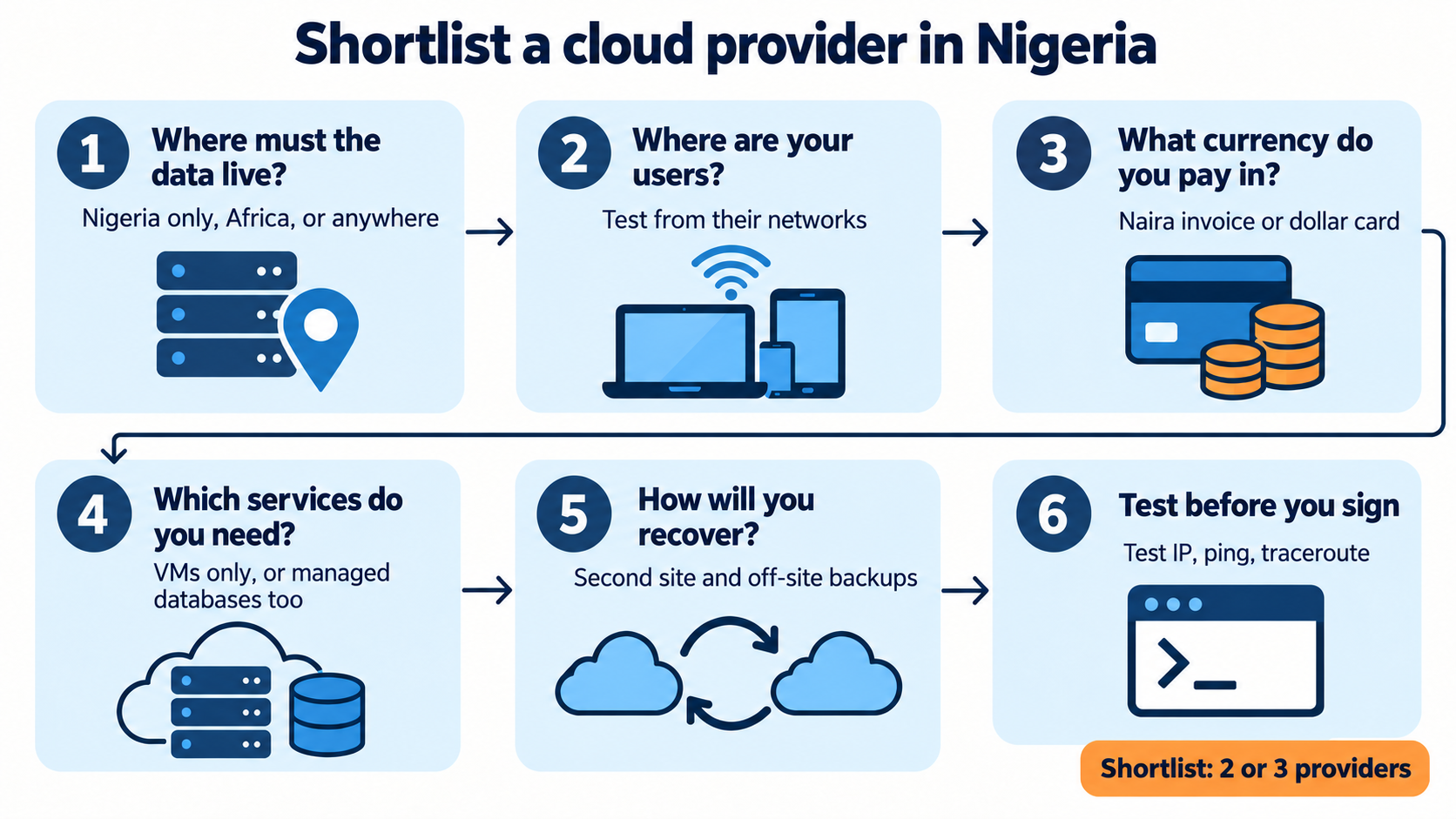
- Classify the workload. Is it regulated (payments, financial data, government, telecom subscriber data)? Is it latency-sensitive? Where are the users?
- Filter by location. Must it be in Nigeria, is Africa fine, or does it not matter? Drop any provider that can’t name the product’s location.
- Filter by billing. Naira invoice only, or are USD card payments acceptable? Is a reseller’s naira invoice the same to you as direct naira pricing?
- Match the services. Just VMs and storage, or managed databases, Kubernetes and load balancers? If you need the hyperscalers’ full catalogue, consider a hybrid: data and core services in Lagos, the rest in a region.
- Check operations. Support hours, SLA, facility redundancy, a second site.
- Plan the exit. Egress charges, snapshot export formats, who owns the IP addresses and the domain.
- Test. A test IP or a month’s server: ping and traceroute from your users’ networks, try the support desk, restore a backup.
- Only a website? Compare hosting companies instead.
Ten questions to ask any provider
- Which data centre is my server in, and where are its backups and replicas?
- Is there a second site in Nigeria, and can I use it?
- Do you peer at IXPN Lagos, and with which mobile networks?
- What currency is the invoice in, and is the price fixed in that currency?
- Is VAT included, and will the invoice show both TINs?
- Can I pay by bank transfer? Is unused credit refundable?
- What do IP addresses, data transfer out, snapshots and support cost?
- Which security certifications do you hold (ISO 27001, PCI DSS, SOC 2), and can I see them?
- Who on your side can access my servers, and how will you tell me about an incident?
- How do I export my data and leave, and what does it cost?
Best cloud provider in Nigeria for your use case
There is no single best provider; there’s a best fit for each kind of workload.
- Government and the public sector: Galaxy Backbone, and, from 2027, NITDA-certified providers in Nigeria. Check the NCCG level of your data first.
- Banks, fintech and payment data: an in-country cloud for the payment and financial data (MTN Cloud for two Lagos zones and managed databases, Nobus, or Lineserve for self-service servers), with DR planned. The AWS Lagos Local Zone if you’re on AWS and your regulator accepts it.
- Startups and developers on a naira budget: Lineserve LOS1, for published naira prices from ₦15,400 a month, self-service servers in Lagos that every Nigerian network we tested reached in 1.3 to 30.3 ms, card or transfer payment, and no foreign card limits. Nobus and Layer3 are the alternatives with Kubernetes today.
- Low-latency consumer apps: Lineserve LOS1 or the Huawei Lagos zone, the two Lagos providers every Nigerian network in our test reached in about 30 ms or less; MTN Cloud, Nobus or AFRICLOUD if your users’ networks reach them well (test it); or the AWS Lagos Local Zone (7.6 to 41.3 ms) if you’re on AWS.
- Teams already on AWS: the Lagos Local Zone for EC2 and EKS, with S3 and RDS in Cape Town.
- Enterprise VMware migrations: MainOne (Equinix) or CloudFlex.
- Small business websites and WordPress: shared hosting with a CDN (see the directory); a local VPS if the site handles orders or personal data.
- Best VPS in Nigeria: for a server in Lagos at the lowest published naira price for 2 vCPU / 4 GB in our table, Lineserve’s Linux VPS – 4 GB RAM at ₦33,600. For the lowest price regardless of location, Truehost’s Europe-hosted VPS or Vultr Johannesburg.
- Object storage and backups: Lineserve’s S3-compatible object storage in Lagos, from ₦18,742.50 per 200 GB with free transfer and API requests; Layer3 and MTN Cloud also sell local object storage.
- Several African countries from one account: Lineserve (Lagos, Nairobi, Dar es Salaam, Kampala); Nobus (Lagos, Nairobi).
- GPU and AI: Huawei Cloud’s Lagos zone, AWS G4dn instances in the Local Zone, or a region abroad.
Ready to test a Lagos server? Build a Cloud Server in Lineserve’s LOS1 region from ₦15,400 a month, or pick a ready-made Linux VPS from ₦16,800, both billed in naira. Then run the ping and traceroute checks above from your users’ networks.
Common mistakes Nigerian buyers make
- Assuming a .ng domain or a Lagos office means local servers. DomainKing (.ng) hosts in South Africa.
- Comparing first-term prices. Hostinger’s ₦990 renews at ₦4,190; GO54’s ₦875 renews at ₦2,500.
- Ignoring data transfer. AWS charges for data out; many local providers include it.
- One provider, one building, no DR.
- Putting a recurring cloud bill on a dollar card without checking your bank’s foreign spending limit.
- Assuming a Lagos provider is fast from every network. Test from your users’ ISPs.
What’s coming next
- MTN Cloud’s third Lagos zone (Lagos Mainland, “In Progress”).
- Nxtra by Airtel at Eko Atlantic, aimed at 2028.
- Equinix LG3, announced for Q1 2026; we found no opening announcement.
- Kasi’s Lekki campus, first phase open, 100 MW planned; Rack Centre’s LGS2.
- NITDA’s certified-provider register and the NCCG and NDIAF taking effect on 1 January 2027, alongside the CBN deadline.
- A hyperscaler region in Nigeria? We found no announcement from Microsoft, Google or Oracle as of October 2026.
FAQ
Which cloud providers have servers in Nigeria?
Lineserve (LOS1, Lagos), MTN Cloud (Lagos), Nobus (Lagos), Layer3 (Lagos and Abuja), HOSTAFRICA/WhoGoHost’s VPS range (Lagos), Suburban Cloud (Abuja), Galaxy Backbone (government, Abuja and Kano), MainOne/Equinix’s private clouds (Lagos), AFRICLOUD and Melbicom (Lagos), plus the AWS Lagos Local Zone and Huawei Cloud’s Lagos HomeZone, which are extensions of South African regions.
What is the best cloud provider in Nigeria?
It depends on the workload. For self-service servers in Lagos with published naira prices and consistent response times across Nigerian networks (1.3 to 30.3 ms in our test), Lineserve; for two Lagos zones and managed databases, MTN Cloud; for AWS-native teams, the AWS Lagos Local Zone; for government, Galaxy Backbone. See best for your use case.
What is the best VPS provider in Nigeria?
For a VPS in Lagos, compare Lineserve (₦33,600 for 2 vCPU / 4 GB), HOSTAFRICA/WhoGoHost (₦36,550) and Layer3 (₦37,621.45 plus IP). Cheaper VPS plans sold in naira, such as Truehost’s, run in Europe.
Which hosting companies in Nigeria have local servers?
For VPS, HOSTAFRICA and its WhoGoHost brand say their VPS are hosted in Nigeria. For shared hosting, most hosts don’t say where the servers are, and DomainKing says South Africa. For WordPress, a shared host with a CDN is usually fine; a Lagos VPS suits shops and apps.
Does AWS have a data centre or region in Nigeria?
No region. AWS has a Local Zone in Lagos (af-south-1-los-1a, parent Cape Town) running EC2, EBS gp2, EKS, ECS and load balancers, plus a CloudFront edge and Direct Connect at Rack Centre. S3, RDS and the control plane stay in Cape Town.
Do Azure or Google Cloud have a region in Nigeria?
No. Azure’s nearest regions are Johannesburg and Cape Town, and Google’s is Johannesburg. Both have edge and CDN points in Lagos.
Does Huawei Cloud have local infrastructure in Lagos?
Yes. Its IEC HomeZone LOS1-AZ1 is in Lagos, attached to the AF-Johannesburg region, and offers VMs, block, file and object storage, RDS and networking.
Which cloud providers bill in naira? Can I pay by bank transfer?
Lineserve, MTN Cloud, Nobus, Layer3 and HOSTAFRICA/WhoGoHost bill in naira. Lineserve and Layer3 accept bank transfer. AWS can charge your card in naira but prices in dollars.
What’s the difference between a Nigerian cloud provider and a reseller? Does a Nigerian office mean the servers are in Nigeria?
A cloud provider runs the servers; a reseller sells someone else’s, often abroad. An office, a phone number or a .ng domain says nothing about where the servers are. Ask for the facility and a test IP.
Is it legal to host Nigerian customer data abroad?
For ordinary personal data, yes, with a documented NDPA transfer basis. Payment transaction data must be stored and managed in Nigeria from 1 January 2027 (CBN); NITDA’s guideline adds regulated financial institutions’ financial data and government data; and telecom subscriber data needs the NCC’s consent to leave.
Which provider is best for Nigerian data residency?
One with compute, storage and backups all in Nigeria, ideally in two facilities. Lineserve LOS1 gives you data residency for the NDPA in Lagos for servers and object storage; MTN Cloud has two Lagos zones. With the AWS Local Zone, check which services fall back to Cape Town.
Are local cloud providers cheaper than AWS or Azure? How much does a VPS cost in Nigeria?
For a 2 vCPU / 4 GB server on 19 October 2026: Lineserve ₦33,600, HOSTAFRICA ₦36,550, Layer3 about ₦38,800 with an IP, AWS Lagos about ₦86,600, and MTN Cloud ₦134,553.60. Entry VPS plans start at about ₦11,000 to ₦17,000 in Lagos.
Is Lagos hosting faster for Nigerian users?
Usually. From Nigerian ISPs, Lagos servers answered in 1 to 2 ms within Lagos and 10 to 30 ms from Abuja and Kano, against 56 to 83 ms for AWS Cape Town and 110 to 154 ms for AWS London. But some Lagos providers were 85 to 160 ms from one or two Nigerian networks whose routes left the country, so test from your users’ networks.
Are Rack Centre and Equinix cloud providers?
No. They’re data centres that rent space, power and connectivity to clouds and businesses. MainOne, Equinix’s Nigerian arm, also sells managed private cloud.
Where are most Nigerian data centres?
In Lagos: Ikeja, Victoria Island, Lekki, Ibeju-Lekki and Eko Atlantic. Abuja is second.
What should a fintech ask before choosing a provider?
Where payment data, backups and logs will sit after 1 January 2027; whether the provider is or will be NITDA-certified; PCI DSS evidence; a second site; and exit terms.
Can I use a local provider and a hyperscaler together?
Yes. A common pattern keeps the database and regulated data in Lagos and uses a hyperscaler for analytics, email or AI services, with the transfers documented.
How can I verify where my VPS is physically hosted?
Look up the IP’s owner and block (whois), check its geolocation on RIPEstat, and ping and traceroute it from a Nigerian network. Under 5 ms from a Lagos network, or 10 to 25 ms from Abuja or Kano, means Lagos. The commands are in how to check a provider yourself.
Conclusion: build the shortlist around the workload
Nigeria has more than one kind of local cloud. Local providers, hyperscaler extensions, resellers and web hosts solve different problems, so check server location and billing currency separately. AWS Lagos and Huawei Lagos are extensions of South African regions, not Nigerian regions. Local providers offer real Lagos compute and naira billing, and from Nigerian ISPs the best of them answer in 1 to 30 ms, a fraction of the 56 ms or more to South Africa; but check that your users’ networks reach them directly.
The verdict by need:
- Regulated or government work: in-country providers, certified once NITDA’s register exists, with a second site.
- AWS-native teams that need Lagos latency: the AWS Lagos Local Zone.
- Self-service cloud in Lagos at naira prices: Lineserve LOS1 (1.3 to 30.3 ms from every Nigerian network we tested), alongside MTN Cloud, Nobus and Layer3.
- Websites only: a hosting company with a stated server location and a CDN.
Pick two or three candidates against your hard requirements, test them from your users’ networks, and get the location in writing. To start with a Lagos server billed in naira, configure one on Lineserve.
Sources were checked on 19 October 2026. Prices, policies and regions change; recheck before you buy. This article is general information, not legal advice.