Cloud Providers in Kenya: Who Operates Locally (2026)
A map of cloud providers serving Kenya: who runs infrastructure in-country, who resells, who serves from abroad, and how to choose.
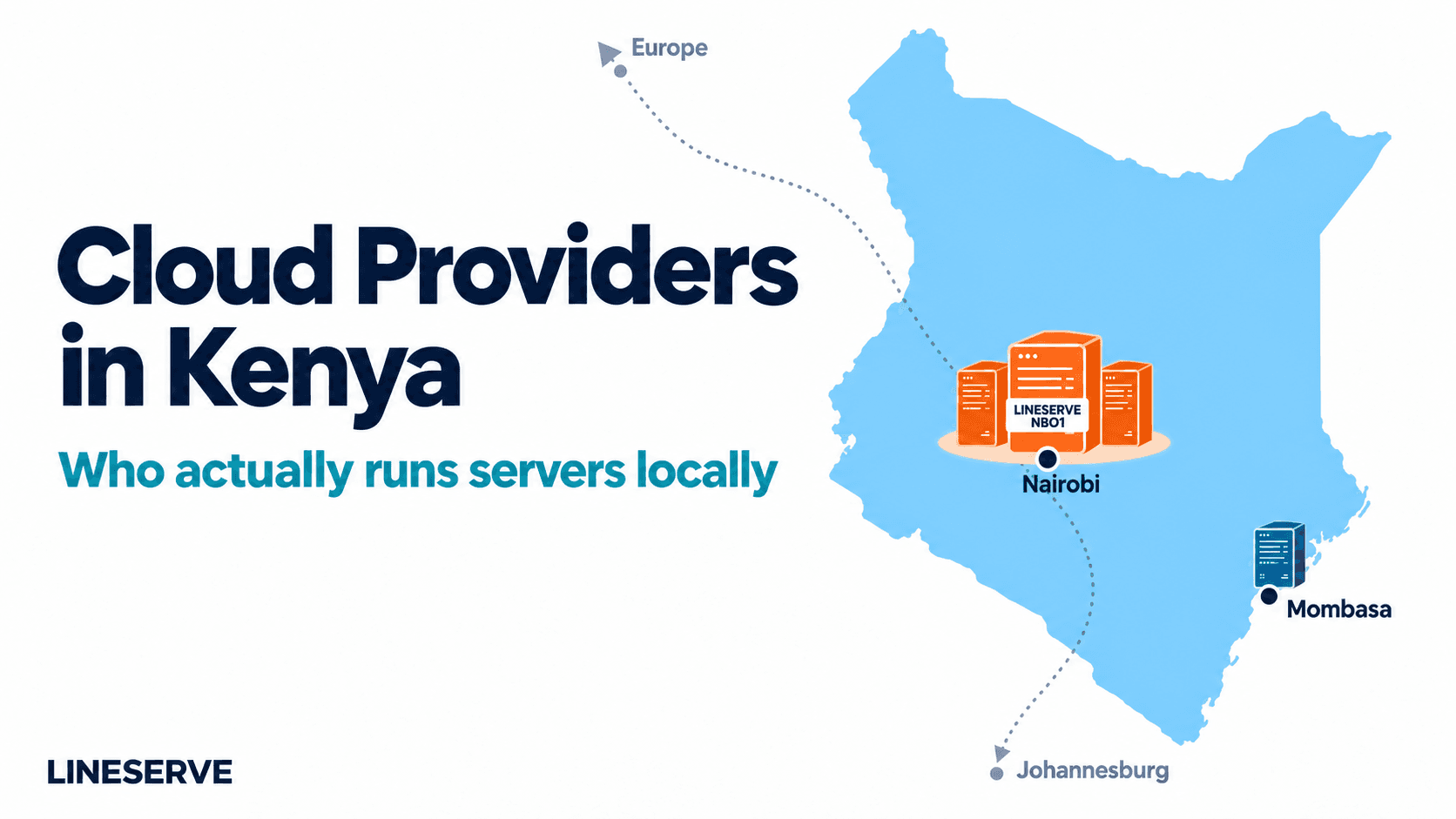
Checked 18 October 2026 (Lineserve’s product pages re-checked and captured 19 October 2026). Every provider below was checked against its own pages, the public routing and peering registries, and pings and traceroutes from five Kenyan networks on the same day. The scripts, raw results and saved pages are in the lab folder that goes with this article.
The short answer
Kenya’s cloud market has five kinds of seller, and only some of them have servers in the country:
- Local cloud operators with servers in Nairobi. Lineserve, Angani, Servercore, Truehost’s “Kenya VPS” range, HostAfrica’s Kenya location, Servernah (Atlancis) and GEWAPE Cloud. Their networks answered our Kenyan probes in roughly 3 to 9 ms (median), which only happens when the server is in Kenya.
- Telco clouds. Safaricom sells virtual servers from its own Kenyan data centres from KES 7,840 a month. Liquid runs Africa Data Centres and an Azure Stack Hub in Nairobi. Airtel is still building its data centre. Telkom and SEACOM sell connectivity and hosting around the clouds more than a cloud of their own.
- The government cloud. The Konza National Data Centre runs a Huawei Cloud Stack “sovereign cloud” for state bodies.
- International infrastructure companies with Nairobi hardware. NetActuate and Zenlayer have servers in Nairobi (3 to 8 ms in our test), but sell bare metal and colocation there, not self-service virtual machines.
- Hyperscalers, which still serve Kenya from abroad. AWS, Microsoft Azure, Google Cloud, Oracle and Huawei Cloud have no cloud region in Kenya. Their nearest regions are in Johannesburg and Cape Town, 58 to 70 ms from Kenyan networks. What they do have in Kenya is edge and on-ramp equipment: CDN caches, private-connection points and peering. Oracle lists a Kenya region as “Coming soon”, and AWS lists a Nairobi Local Zone as “Announced”.
On top of these sit Kenyan storefronts that sell servers hosted abroad. A Kenyan address, a .co.ke domain and M-Pesa checkout don’t tell you where the server is. On 18 October 2026 Truehost’s cheapest VPS range said “Europe/USA Data Centers”, and hosting.com’s Kenyan page said “running on global hosting infrastructure”.
The conclusion: if your data must stay in Kenya, or your users are in Kenya and latency matters, shortlist from the first three groups, and from the first one if you want self-service in shillings. For self-service servers with published shilling prices, M-Pesa billing and regions in four African countries under one account, start with Lineserve: its Nairobi region (NBO1, in the iColo and Africa Data Centres facilities) answered all five Kenyan probes in 0.8 to 15.5 ms, with no route abroad, and Cloud Servers start at KSh 1,485 a month plus VAT. If you need the full catalogue of managed services, the hyperscalers in South Africa are 58 to 70 ms away and fine for most web workloads, but they’re a cross-border transfer under Kenya’s data protection rules. Whoever you choose, verify the location yourself before you sign: ask for a test IP and ping it from Kenya. The steps are at the end.
How we sorted the providers
“Operates locally” is easy to claim and easy to check. For every provider we looked for four kinds of evidence:
| Evidence | What it proves | Where it came from |
|---|---|---|
| The provider’s own page | What it sells and where it says the servers are | Product, pricing and region pages, saved on 18 October 2026 |
| The routing registry | Whether the provider runs its own network (an ASN, or autonomous system number) and whether its IP addresses are registered and geolocated in Kenya | RIPEstat, Team Cymru whois |
| Data centre and exchange records | Which Kenyan buildings and internet exchanges the network says it’s in | PeeringDB, the shared database networks use to publish this |
| Measurement from Kenya | Whether the addresses are physically close to Kenyan users | Pings (16 per probe) and traceroutes from Globalping probes on Kenyan networks |
A provider counts as operating in Kenya when its own page says so and its addresses answer Kenyan networks in single-digit milliseconds. The nearest foreign cloud locations, in Johannesburg, never answered our Kenyan probes in less than 52 ms, so a sub-10 ms answer means a server in Kenya.
Limits of the method:
- We measured network addresses each provider announces, not servers we bought. A server you rent could sit in a different address block, so check your own IP.
- Globalping had six probes in Kenya on the day, on Jamii Telecommunications (Faiba), Wofbit Networks, Xcobean Systems, Imani Labs and Wavex in Nairobi, and Vijiji Connect in Ruiru. Wavex’s probe didn’t answer, so round 1 came from five probes; in the repeat round an hour later Vijiji Connect’s didn’t answer either, leaving four. None was on Safaricom or Airtel, so mobile users aren’t represented.
- An enterprise-only service with no public test address, such as Safaricom’s cloud, can’t be pinged from outside. For those we rely on the provider’s own statements, data centre records and press reports, and say so.
The landscape at a glance
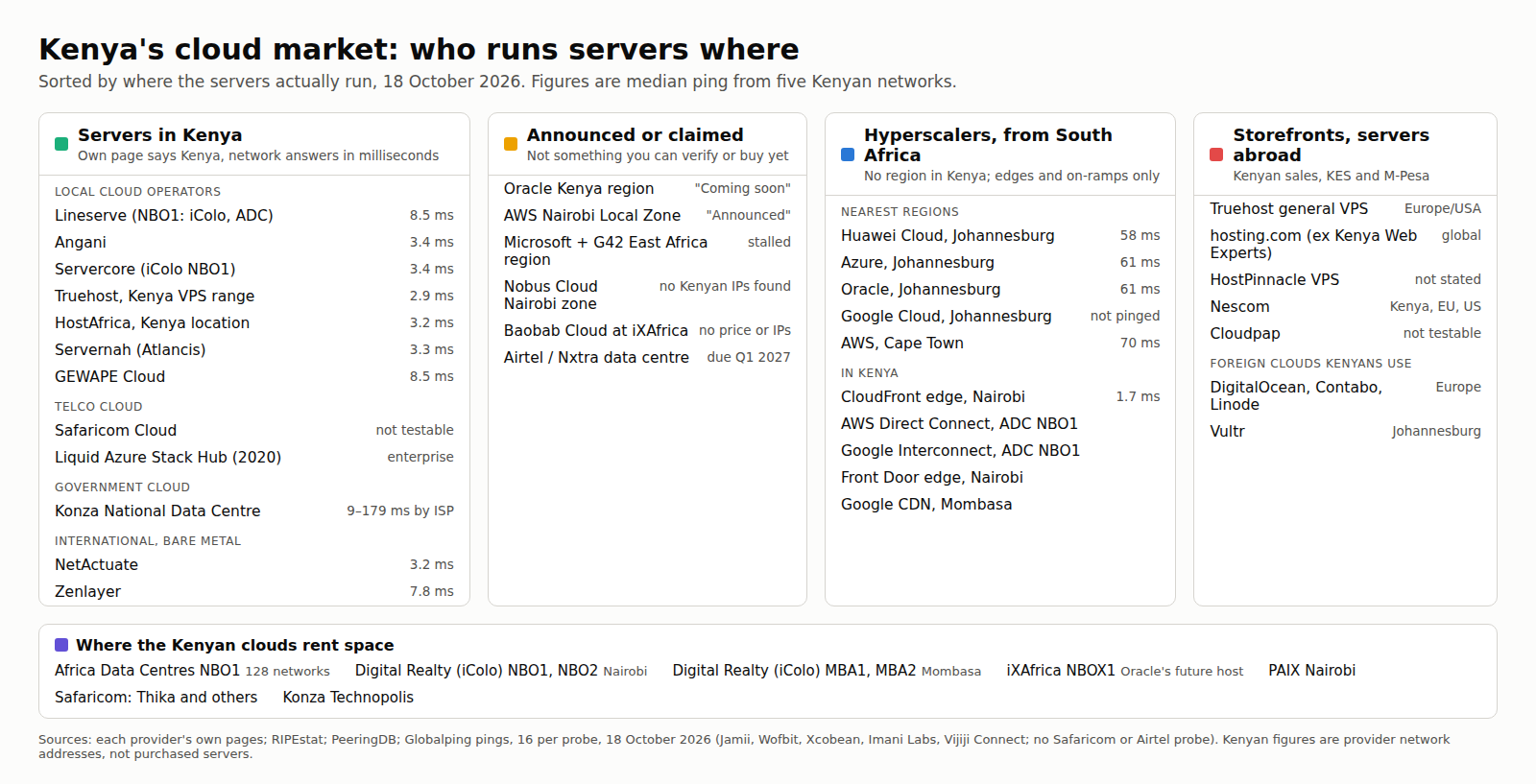
| Provider | Type | Where the servers are | How we verified it | Median from Kenyan networks | Entry price on the day |
|---|---|---|---|---|---|
| Lineserve | Local cloud (Lineserve Limited) | NBO1: iColo and Africa Data Centres, Nairobi | Own network AS329659 at ADC NBO1 and iColo NBO2; Kenyan block registered to Lineserve Limited; ping | 8.5 ms (all probes 0.8–15.5 ms) | KSh 1,485/month + VAT (Cloud Server, 1 vCPU, 1 GB, 20 GB, IPv4); Linux VPS KSh 1,620 + VAT (2 GB) |
| Angani | Local cloud | Two Nairobi data centres | Own network AS37684 at ADC NBO1, iColo NBO1, iXAfrica NBOX1; KIXP and LINX peering; ping | 3.4 ms | KSh 1,000/month + VAT (1 vCPU, 1 GB) |
| Servercore | Local cloud (Servercore Africa Ltd) | iColo NBO1, Nairobi | Own docs name the building; own network AS329272; ping | 3.4 ms | 4,876 KES/month for 1 vCPU, 2 GB, 100 GB (its own comparison) |
| Truehost, Kenya VPS range | Local VPS | “Datacenters in Nairobi Kenya” | Own network AS329278; Nairobi block answers in 0.4–8 ms | 2.9 ms | KSh 1,400/month (1 vCPU, 1 GB) |
| HostAfrica (Kenya location) | Regional host with Kenyan network | Kenya (plus South Africa, Nigeria, Ghana) | Web4Africa network AS327813 at ADC NBO1 and KIXP; ping | 3.2 ms | KSh 960/month (KSh 480 first month) |
| Servernah (Atlancis) | Local cloud | “Data Centers in Kenya”; launched at iXAfrica | Own network AS328296 at KIXP; website on it; ping | 3.3 ms | Not published |
| GEWAPE Cloud | Local cloud | “Nairobi, Kenya · 2 availability zones” | Own network AS203905 at iXAfrica NBOX1 and PAIX; ping | 8.5 ms (two ISPs 139–140 ms) | Not published for Kenya |
| Safaricom Cloud | Telco cloud | Safaricom’s own data centres | Own page; PeeringDB shows Safaricom at its Thika site and five others; no public test address | Not measurable | KES 7,840/month (2 vCPU, 8 GB) |
| Konza National Data Centre | Government cloud | Konza Technopolis | Treasury tender document; own network AS328847; ping | 9–11 ms from two ISPs, 161–179 ms from three | Government and approved users |
| NetActuate | International, bare metal and colocation | Sameer Industrial Park, Nairobi | Own network AS36236 at ADC NBO1, KIXP, LINX; ping | 3.2 ms | Quote |
| Zenlayer | International, bare metal on request | NBO1, Africa Data Centres | Own network AS21859; ping | 7.8 ms | Quote |
| AWS, Azure, Google, Oracle, Huawei | Hyperscaler | South Africa (no Kenyan region) | Each provider’s region list; ping to regional endpoints (Google not pinged) | 58–70 ms (Johannesburg, Cape Town) | Pay-as-you-go in USD |
Medians across five Kenyan Globalping probes, 16 pings each, 18 October 2026, round 1 (21:17–21:23 UTC); the repeat round matched within 4.1 ms per probe. Prices from each provider’s page that day; see each section for the source, and what VPS hosting costs in Kenya for a like-for-like price comparison. “ADC” is Africa Data Centres; “KIXP” is the Kenya Internet Exchange Point.
Local cloud operators with servers in Kenya
These are the providers whose own pages say Nairobi and whose networks answered Kenyan probes in single-digit milliseconds. Lineserve comes first for readers who want published shilling prices, M-Pesa billing and regions in four African countries under one account; the others are listed by how long they’ve been operating.
Lineserve (Nairobi, NBO1)
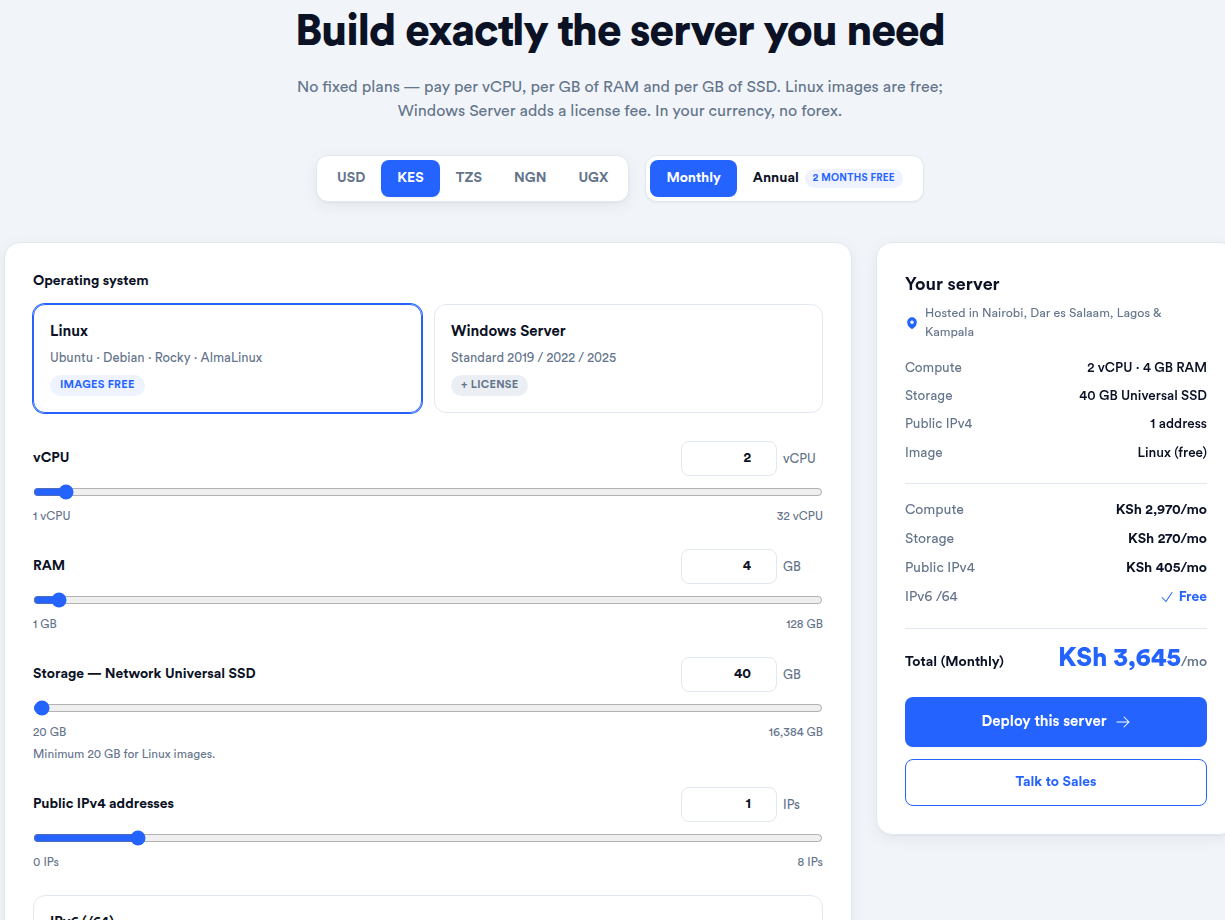
Lineserve is a Kenyan cloud provider (Lineserve Limited, View Park Towers, Nairobi) that sells Cloud Servers built resource by resource, ready-made Linux and Windows VPS plans, dedicated servers, S3-compatible object storage and colocation. It runs four African regions: Nairobi (NBO1), Dar es Salaam (DAR1), Lagos (LOS1) and Kampala (KLA1), with the same per-unit prices in each. NBO1 runs in the iColo and Africa Data Centres (ADC) facilities in Nairobi. ADC says four data halls in its NBO1 building are certified Uptime Institute Tier III; that rating belongs to ADC’s building. (Lineserve’s region code NBO1 isn’t iColo’s building of the same name.)
- Network evidence: Lineserve runs its own network, AS329659. PeeringDB lists it at Africa Data Centres NBO1 and iColo NBO2 in Nairobi, and at facilities in Lagos and Dar es Salaam. Its Kenyan block, 102.204.0.0/24, is registered with AfriNIC to Lineserve Limited, Kenya, and RIPEstat geolocates its address space to Nairobi, Dar es Salaam and Lagos.
- What we measured: 102.204.0.100 answered all five Kenyan probes at an 8.5 ms median, from 0.8 ms (Xcobean and Wofbit) to 15.5 ms (Vijiji Connect), with no packet loss. None of the five was routed abroad: the slowest answered in 15.5 ms. In the repeat round an hour later, every probe came back within 0.2 ms of its first result.
- Price: Cloud Servers are priced per resource: KSh 405 per vCPU, KSh 540 per GB of RAM, KSh 6.75 per GB of SSD and KSh 405 per IPv4 address a month. The smallest (1 vCPU, 1 GB, 20 GB SSD, one IPv4 address) is KSh 1,485 a month. The ready-made Linux VPS range starts at Linux VPS – 2 GB RAM (1 vCPU, 40 GB SSD, dedicated IPv4) at KSh 1,620. Its Cloud Servers page says “Prices exclude VAT and any applicable taxes”, so add Kenya’s 16%: KSh 1,722.60 and KSh 1,879.20 a month. Every server gets a 1 Gbps port with unlimited local traffic and a free /64 IPv6 block; annual billing charges 10 months for 12.
- Other services in NBO1: object storage sold in 200 GB blocks from KSh 1,580.25 a month (Starter tier), with transfer and API requests free. Lineserve also sells dedicated servers and Nairobi colocation. Managed Kubernetes, databases, load balancers and block storage are listed as launching soon.
- Payment: in shillings by M-Pesa and other mobile money, bank transfer or card, so no foreign card or forex conversion is needed.
- Support and SLA: signed-in tickets, phone and email in East Africa Time business hours, with cover for live incidents. The SLA promises 99.9% a month and credits 10% below 99.9%, 25% below 99.0% and 50% below 95.0%, claimed within 30 days. Fees are billed monthly in advance and are non-refundable under its terms.
- Data residency: a server in NBO1 sits in Nairobi, which is what regulation 26 asks for where it applies. That’s data residency for the Kenya Data Protection Act; your data-processing terms are still yours to put in place.
Angani
Angani is a Kenyan company and the oldest local cloud on this list. It sells virtual machines, dedicated servers, an enterprise cloud, storage, Veeam-based backup and disaster recovery, private cloud and managed services. Its virtual machine page says the cloud “is hosted in two redundant, secure and reliable datacenters in Nairobi”. It doesn’t name them, but its network does.
- Network evidence: Angani’s network, AS37684, lists itself in PeeringDB at Africa Data Centres NBO1, iColo NBO1, iXAfrica NBOX1 and iColo MBA2 in Mombasa, and peers at KIXP Nairobi, LINX Nairobi and LINX Mombasa. Its peering policy names the KIXP exchanges at ADC and iColo. RIPEstat geolocates its address blocks to Nairobi.
- What we measured: 62.12.112.101 answered all five Kenyan probes at a 3.4 ms median (0.9 to 9.2 ms). A second block, 41.242.2.100, was 4 to 10 ms from four networks but 161 ms from Wofbit, whose traffic took the long way round (see “What we measured”).
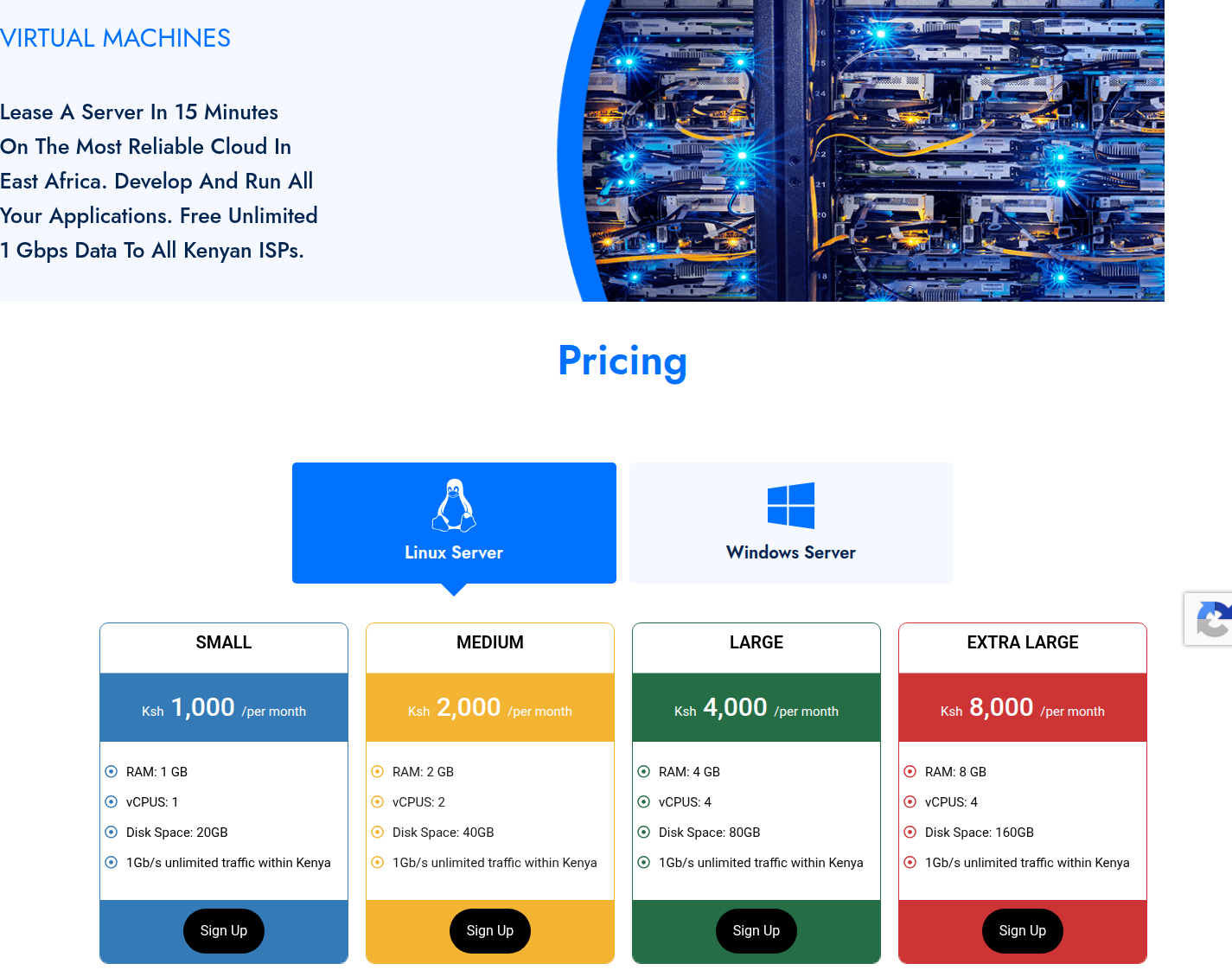
- Price: Small (1 vCPU, 1 GB, 20 GB) KSh 1,000 a month and Medium (2 vCPU, 2 GB, 40 GB) KSh 2,000, each with “1Gb/s unlimited traffic within Kenya”. The shop page says the price “is exclusive of VAT”.
- Support and uptime: the VM page promises “24/7 support” and “99.9% uptime”. Its terms promise “reasonable technical support by email… during… normal technical support hours”, so ask which applies to your contract.
- What users say: in an August 2026 r/nairobitechies thread from a company told to move data home, one developer said “Angani was pretty good last I checked.”
Servercore
Servercore runs a public cloud region in Nairobi through Servercore Africa Ltd. It’s the most cloud-like of the local operators: cloud servers, bare metal, GPU servers, managed Kubernetes, managed databases, backups and S3-compatible object storage, with an API and a control panel. Its locations documentation names the building: “iColo NBO1 Data Center, LRC Road off Langata South Road”, availability zone ke-1a.
- Network evidence: AS329272 announces several blocks, all geolocated to Kenya by RIPEstat. It isn’t listed in PeeringDB, so the facility comes from Servercore’s own docs.
- What we measured: 102.214.68.3 answered at a 3.4 ms median (1.1 to 8.3 ms) from all five probes.
- Price: its Kenya page compares a 1 vCPU, 2 GB server with a 100 GB disk and 1 TB of traffic at 4,876 KES a month, “fixed in KES”, and says prices “include all applicable taxes”. Billing is pay-as-you-go from a prepaid balance.
- Payment, support, SLA: “Billing in Kenyan shillings”, “Payment by MPesa or bank transfer”, “24/7 Free technical support”, and a 99.98% SLA for cloud servers, all on the same cloud servers page.
- What users say: a developer who tried several Kenyan hosts wrote in October 2025 that they “settled with Servercore as they’re the most stable and orderly”. In another 2026 thread, a buyer of health-data hosting said “I know about servercore but they don’t really seem cheap”.
Truehost: the “Kenya VPS” range only
Truehost sells two VPS ranges from one Kenyan website, and only one of them is in Kenya. Its Kenya VPS store says “Powered by Datacenters in Nairobi Kenya”, and each plan says “Data Centers: Kenya”. Its general VPS range is hosted in “Europe/USA Data Centers”.
- Network evidence: AS329278 (Truehost Cloud Limited) announces 102.212.244.0/22, which RIPEstat places in Nairobi.
- What we measured: 102.212.244.1 answered at a 2.9 ms median (0.4 to 8.3 ms), the fastest local result of the day.
- Price: Kenya Cloud VPS 1 (1 core, 1 GB, 25 GB SSD, 1 TB transfer) is KSh 1,400 a month; Cloud VPS 2 is KSh 2,800. The plans are unmanaged and Linux only.
- Payment and terms: Lipa na M-Pesa, PayPal, bank transfer and cards. The terms of service promise 99.95% uptime and 24-hour support, and rule out refunds except for overpayments.
HostAfrica (Kenya location)
HostAfrica is a South African host that has grown in Kenya by acquisition. Its about page lists Sasahost (Kenya) in 2023, and deepAfrica (Kenya) and Web4Africa in 2024. The VPS page offers hosting locations in South Africa, Kenya, Ghana and Nigeria.
- Network evidence: most of HostAfrica’s own address space geolocates to South Africa. The Web4Africa network it bought (AS327813) is the Kenyan part: PeeringDB lists it at Africa Data Centres NBO1 and KIXP Nairobi, and its 102.68.84.0/22 block geolocates to Nairobi.
- What we measured: 102.68.86.100 answered at a 3.2 ms median (0.6 to 8.7 ms). HostAfrica’s other blocks geolocate to South Africa, so check which block your server is on.
- Price: the C1 plan (1 vCPU, 1 GB, 20 GB NVMe) is KSh 960 a month, or KSh 480 for the first month. Payment is in shillings by “EFT, Debit Cards, Credit Cards and Mobile Payments”.
Servernah (Atlancis Technologies)
Servernah is the cloud platform of Atlancis Technologies, a Kenyan company. It sells virtual machines, block, object and file storage, backup-as-a-service and GPU capacity, and says its infrastructure is “Hosted across Data Centers in Kenya” in “Uptime Institute Tier III rated” facilities. iXAfrica announced its launch at its Nairobi campus on 11 March 2025, with AI services from EverseTech.
- Network evidence: the Servernah website sits on Atlancis’s own network, AS328296, in a block registered in Kenya. PeeringDB shows it peering at KIXP Nairobi but lists no facility.
- What we measured: the website’s address answered at a 3.3 ms median (0.7 to 9.7 ms). The Jamii traceroute went straight across the KIXP peering LAN.
- Price: not published; you sign up or ask for a quote.
GEWAPE Cloud
GEWAPE Cloud lists Nairobi as a live region with “2 availability zones”, alongside Rwanda, Nigeria, South Africa and others. iXAfrica announced on 22 April 2026 that GEWAPE had moved into its NBOX1 facility. It lists VMs, bare metal, GPUs, Kubernetes, storage and managed databases, and an SLA that “targets” 99.99%.
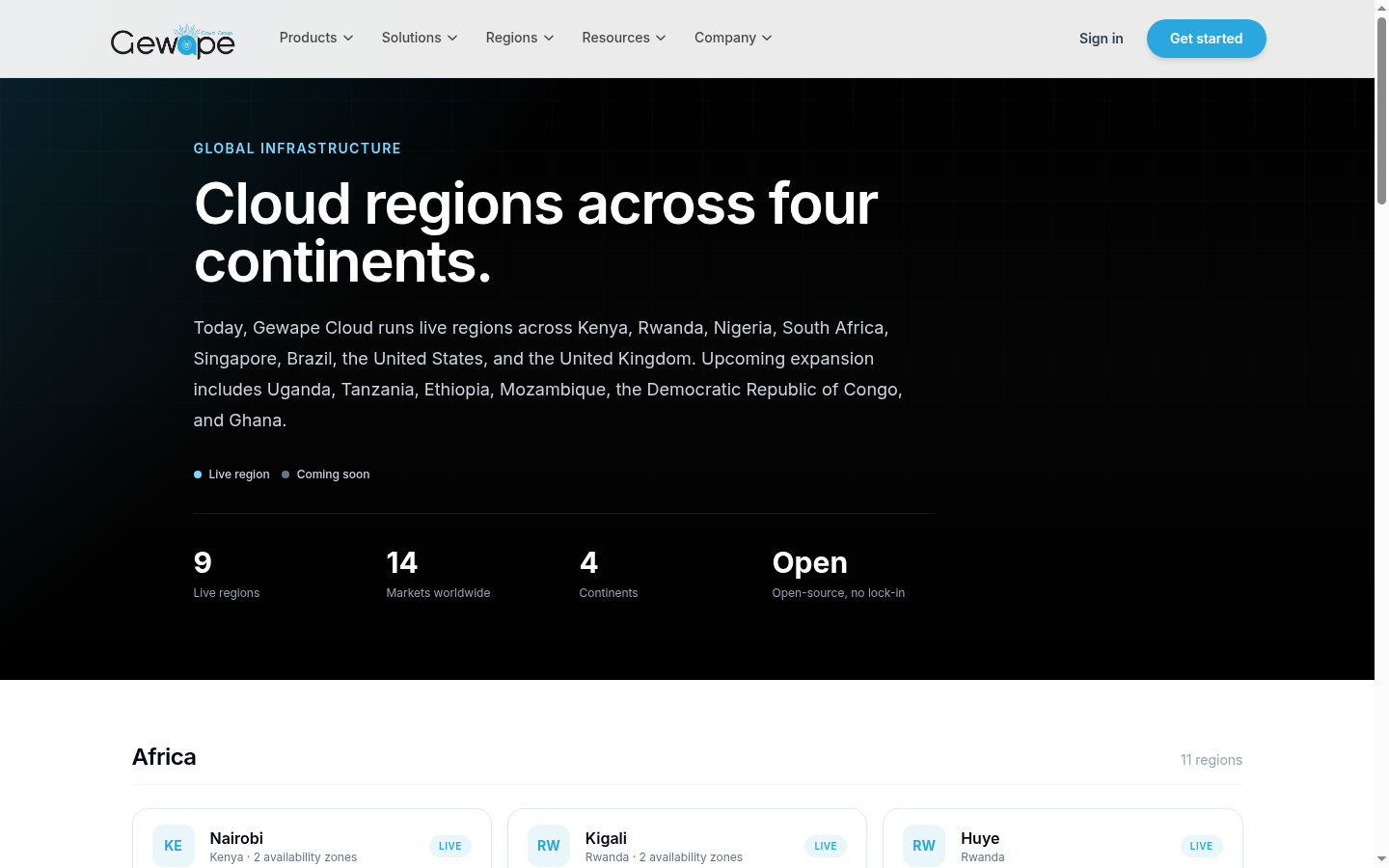
- Network evidence: AS203905 is registered to GEWAPE CLOUD (K) LIMITED. PeeringDB places it at iXAfrica NBOX1 and PAIX Nairobi, peering at LINX Nairobi, and two of its blocks geolocate to Nairobi.
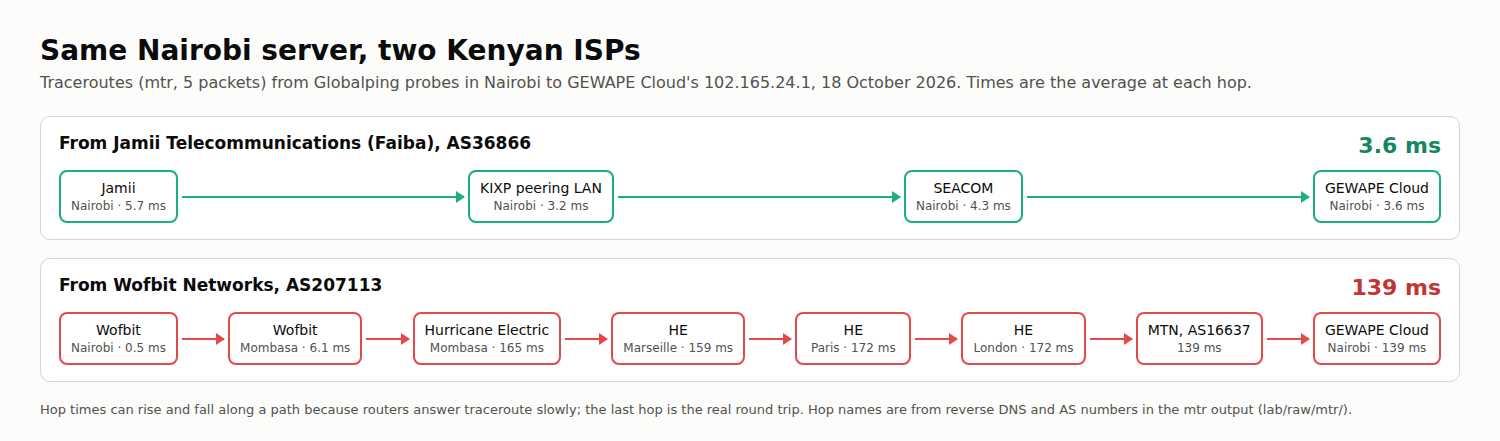
- What we measured: 102.165.24.1 answered at an 8.5 ms median, but 139 to 140 ms from Wofbit and Xcobean. Wofbit’s trace left Kenya through Hurricane Electric in Mombasa, went via Marseille, Paris and London, and came back through MTN’s network. From Jamii it was 3.6 ms through KIXP. The server is in Nairobi; some Kenyan ISPs just don’t have a local path to it yet.
- Price: none published for Kenya. Its budget brand, Megabit Cloud, shows only euro web hosting prices.
International companies with hardware in Nairobi
Two global infrastructure companies have their own equipment in Nairobi and answered like local providers:
- NetActuate opened Nairobi on 24 April 2023 at Sameer Industrial Park, its third African location. Its Nairobi page frames it around colocation and bare metal. PeeringDB lists AS36236 at ADC NBO1, KIXP and LINX Nairobi. Its Nairobi block answered at a 3.2 ms median.
- Zenlayer lists an NBO1 site at Africa Data Centres (PeeringDB lists its network at iXAfrica NBOX1) that “sells Bare Metal Servers and IP Transit”, and its Kenya page says “Public cloud instances are not offered from the Nairobi site”. Its cloud FAQ says bare metal there is “available on request”. Its Nairobi block answered at a 7.8 ms median.
Both are useful to a company that wants physical servers in Nairobi under a global contract. Neither is a self-service cloud in Kenya today.
Telco clouds
Kenya’s telecoms groups own much of the country’s data centre space and fibre, but only one of them sells a cloud server with a public price.
Safaricom
Safaricom Business sells virtual servers on what it calls Safaricom Cloud: “keep your data in-country, guaranteed integrity and security within our very own Data Centers”.
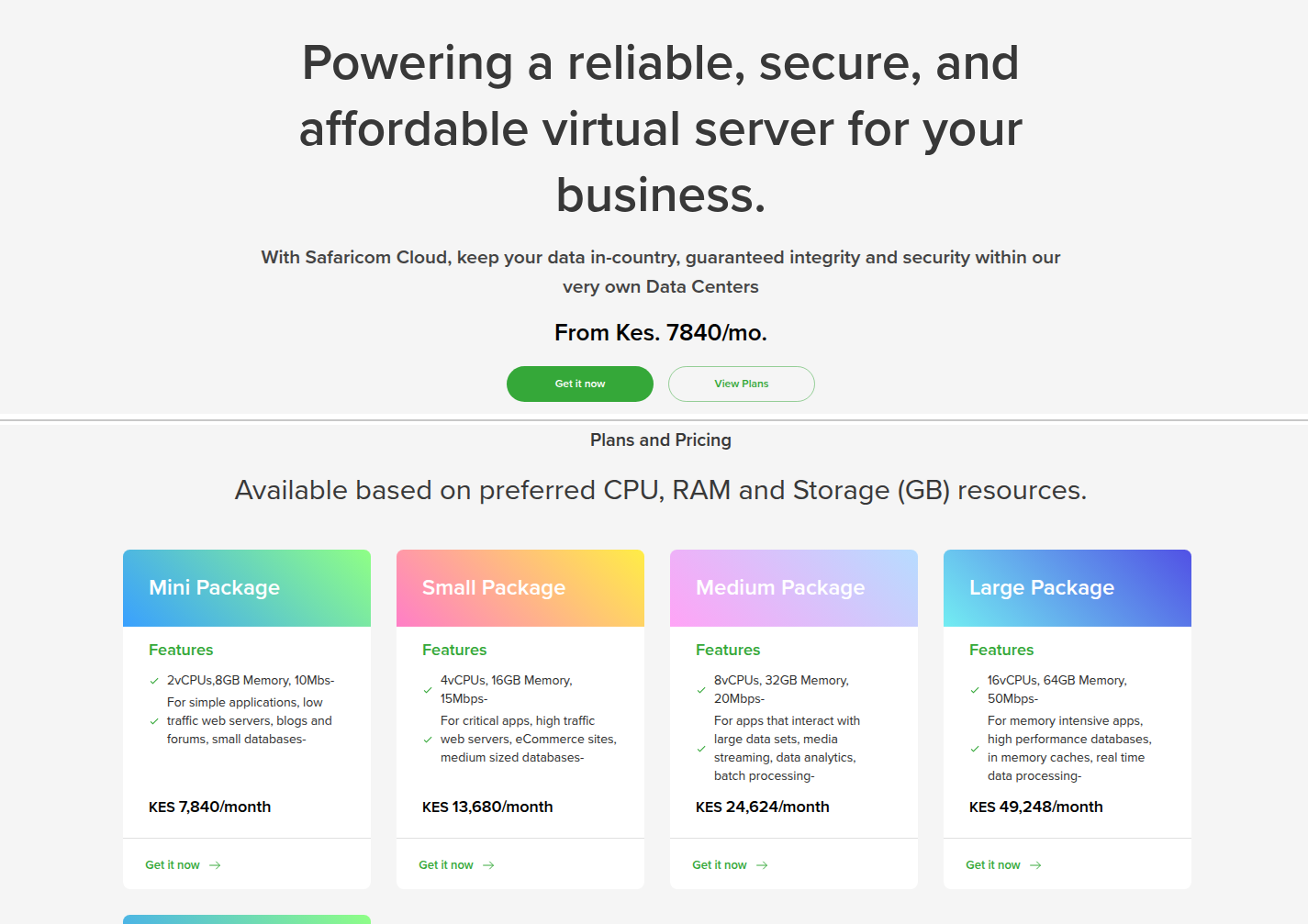
- Plans: Mini (2 vCPU, 8 GB, 10 Mbps) KES 7,840 a month; Small (4 vCPU, 16 GB, 15 Mbps) KES 13,680; Medium (8 vCPU, 32 GB) KES 24,624; Large (16 vCPU, 64 GB) KES 49,248; plus a custom package. Bandwidth is a committed rate, not a traffic allowance, and the page doesn’t give the disk size or say whether VAT is included.
- The platform: Safaricom relaunched its cloud on VMware in September 2023, “hosted in Nairobi and Kisumu”, Capital FM reported. The same report said Safaricom’s cloud had run since 2010 as “managed services as opposed to self-service”. Its main data centre in Thika has Uptime Institute Tier III design certification.
- Network evidence: PeeringDB lists Safaricom (AS33771) at its own Thika facility and at ADC NBO1, iColo NBO1, iXAfrica NBOX1 and both iColo Mombasa sites. Safaricom’s websites sit behind a US-registered security proxy, and its cloud has no public test address, so we couldn’t ping it.
- Also sold: AWS resale (Safaricom has been an AWS partner since 2020), cloud backup, and colocation in Thika, Athi River, Kiboswa and other sites. In May 2025 it partnered with iXAfrica to sell enterprise and cloud suites in iXAfrica’s Nairobi campus.
- Fit: larger businesses that want a Kenyan supplier they already buy connectivity from, and capacity in big blocks. It’s a poor fit for a 1 GB test server. Community comments are mostly about Safaricom’s shared web hosting, not this product, and mostly negative (“Don’t use safcom. It’s a headache”, June 2026).
Liquid Intelligent Technologies and Africa Data Centres (Cassava)
Africa Data Centres, part of the Cassava Technologies group with Liquid, runs the Nairobi NBO1 facility at Sameer Industrial Park, the busiest building in Kenya’s cloud market: PeeringDB lists 128 networks there, including Amazon, Microsoft, Huawei Cloud and NetActuate. Liquid itself announced an Azure Stack Hub in Nairobi in August 2020, so customers could run Azure services on hardware in Kenya. It’s sold as an enterprise service, with no public price, and we found no more recent product page. In a March 2026 interview its Kenya CEO described GPU-as-a-service capacity that includes Nairobi.
Airtel, Telkom and SEACOM
- Airtel Africa broke ground in September 2025 on a 44 MW Nxtra data centre at Tatu City, due to open in the first quarter of 2027. We found no Airtel cloud server product in Kenya today.
- Telkom Kenya opened a data centre at Milimani in Nairobi in 2018, offering colocation and cloud, Business Today reported at the time. We couldn’t load a current Telkom cloud product page on 18 October 2026.
- SEACOM launched private connections to Microsoft’s cloud for Kenyan businesses in 2018. Today it sells connectivity into clouds more than a cloud of its own. In August 2026 a company moving its data home found SEACOM’s process “very beuraucratic”.
The government cloud at Konza
The Konza National Data Centre is the state’s own cloud. Huawei built it on a Chinese concessional loan, and Huawei’s case study says it runs Huawei Cloud Stack as a “sovereign cloud” in a Tier III facility. A National Treasury tender addendum from April 2026 for its expansion (PDF) gives the clearest current picture:
- about 300 kW of IT load in use against a certified capacity of 706 kW;
- 144 racks, about 100 of them (roughly 70%) in active use;
- 145 of the government’s 451 institutions hosted, and 189 customers since it was opened to paying customers in 2021;
- an expansion of up to 288 racks planned as a public-private partnership.
Konza’s own address block (AS328847) answered from Jamii and Imani Labs in 9 to 11 ms, through SEACOM and a local carrier. From Wofbit, Xcobean and Vijiji Connect it took 161 to 179 ms, a detour abroad. For a state system whose users are on every Kenyan ISP, that route is worth fixing.
Under the Kenya Cloud Policy 2025, government cloud providers matter well beyond Konza (see “The rules” below).
Where the hyperscalers stand
No hyperscaler had a cloud region in Kenya on 18 October 2026. What each of them does have in the country is more useful than “nothing”, and easy to misread as a region:
| Provider | Region in Kenya? | Nearest region | What is in Kenya | Announced for Kenya |
|---|---|---|---|---|
| AWS | No | Cape Town (af-south-1) | CloudFront edge in Nairobi; Direct Connect at the ADC NBO1 building since September 2025; Outposts racks can be shipped to Kenya; peering at KIXP | Nairobi Local Zone af-south-1-nbo-1a, listed as “Announced” with only a “Request interest” button |
| Microsoft Azure | No | South Africa North (Johannesburg) | Azure Front Door edge in Nairobi; network at ADC NBO1; peering at KIXP and LINX Nairobi. No ExpressRoute location in Kenya | “East Africa Cloud Region” with G42 at Olkaria, announced May 2024, stalled in 2026 |
| Google Cloud | No | Johannesburg (africa-south1) | Cloud Interconnect at ADC NBO1; Cloud CDN in Mombasa; peering at KIXP Mombasa and LINX Mombasa | None found |
| Oracle Cloud | No | Johannesburg | Network at iXAfrica NBOX1 | Kenya region “Coming soon”, to be hosted by iXAfrica |
| Huawei Cloud | No | Johannesburg | A point of presence linked to South Africa; network at ADC NBO1 and KIXP | None found |
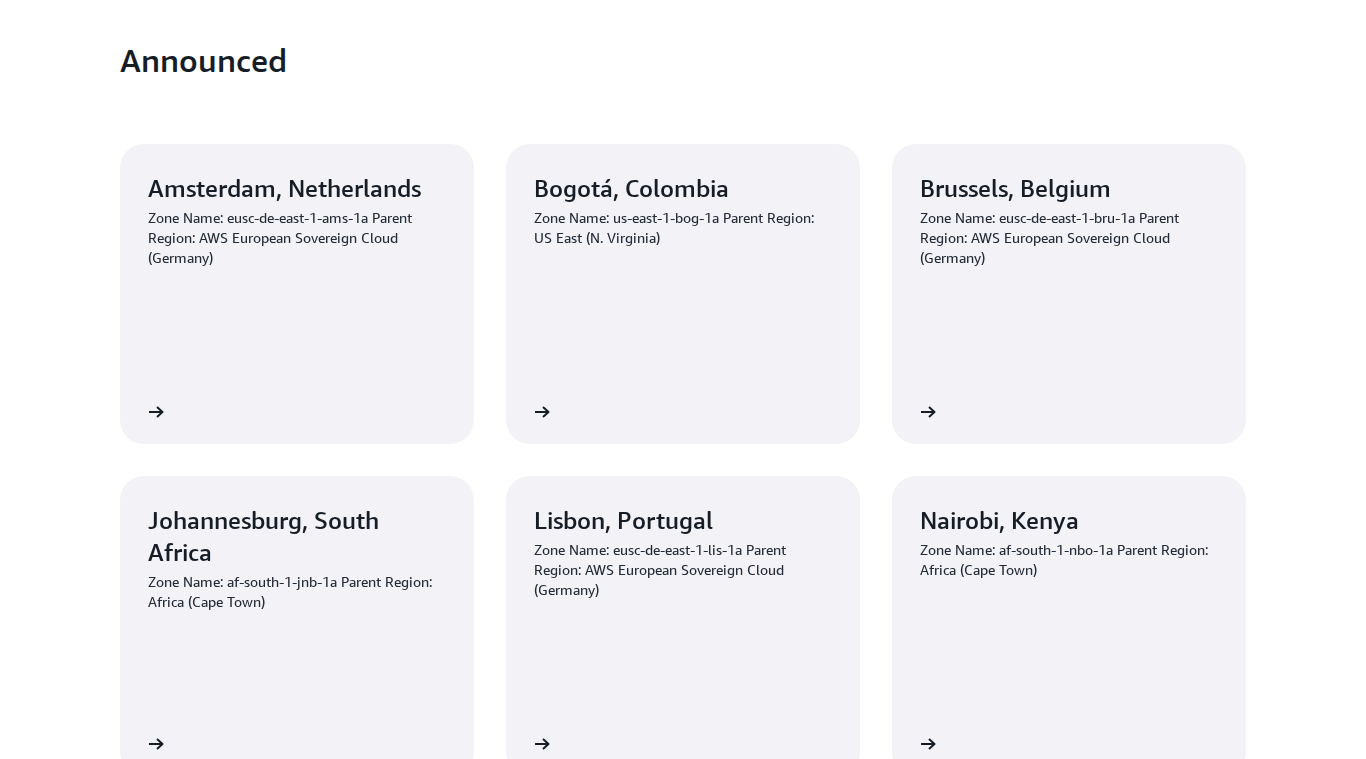
AWS. The Local Zones locations page lists Nairobi (af-south-1-nbo-1a, parent region Cape Town) among “Announced” zones, with a “Request interest” button rather than a launch option. AWS first announced a Kenyan Local Zone in April 2022. Meanwhile AWS opened its first Kenyan Direct Connect location on 3 September 2025 “within East African Data Centres NBO1”, with 10 and 100 Gbps private links to any AWS region. The Outposts rack FAQ lists Kenya as a country Outposts can ship to, and CloudFront lists a Nairobi edge. Every Kenyan probe we sent to a CloudFront address was answered by the Nairobi edge (NBO50) in 0.5 to 9 ms. The full history is in does AWS have a region in Kenya?
Microsoft. Azure’s geographies page lists South Africa North and South Africa West for Africa. The ExpressRoute locations list (updated 16 September 2026) has no Kenyan location; Front Door lists a Nairobi edge. In May 2024 Microsoft and G42 announced a $1 billion package including a geothermal-powered data centre at Olkaria for a “new East Africa Cloud Region”, to be operational “within 24 months of the signing of the definitive agreements”. In May 2026 DatacenterDynamics reported that the project had stalled, quoting President Ruto: “To switch on that one data center, we would need to shut off power for half the country.” Separately, on 13 October 2026 TechCabal reported that Microsoft is winding down its Africa Development Centre engineering office in Nairobi, with nearly 400 jobs at risk; Microsoft spoke of “proposed changes”.
Google. Google’s nearest region is africa-south1 in Johannesburg. In Kenya it offers Cloud Interconnect in two zones, both inside the Africa Data Centres NBO1 building, and a Cloud CDN location in Mombasa. In 2024 it announced Umoja, a fibre route “anchored in Kenya” that runs overland to South Africa. We found no announced Google Cloud region in Kenya.
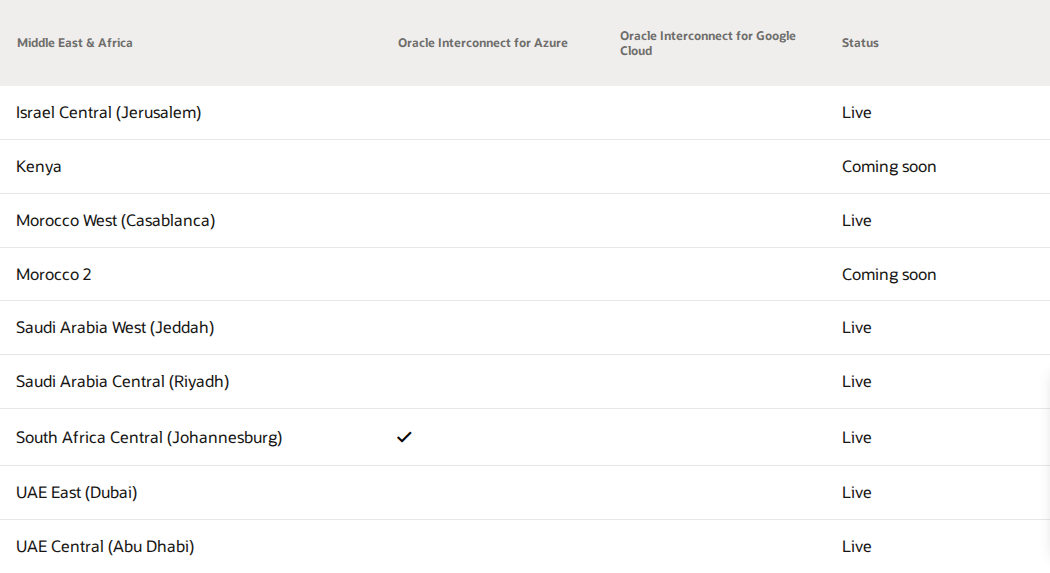
Oracle. Oracle’s public cloud regions page shows “Kenya — Coming soon”. On 27 January 2026 iXAfrica said it would be “the host partner for the OCI region in Nairobi”, with construction, power and connectivity “in advanced stages of deployment”. Neither company has given a launch date. PeeringDB already lists Oracle’s network at iXAfrica NBOX1.
Huawei Cloud. Huawei’s SDK region list has two African regions, af-south-1 and af-north-1, and none in Kenya. In 2024 Huawei told ITWeb it had “a point-of-presence site” in Kenya using a dedicated connection to South Africa. Its biggest Kenyan cloud is the one it built for the government at Konza.
Everyone else. Alibaba Cloud and IBM Cloud have no African region. DigitalOcean and Akamai/Linode have none in Africa; Vultr‘s only African location is Johannesburg. Cloudflare has points of presence in Nairobi and Mombasa, and Contabo says it serves “Europe, Africa & Middle East” from Germany.
Edges are not regions
A Nairobi CDN edge makes cached files and the first connection fast. It doesn’t run your database or your application, and your data lives in the region. Two practical consequences:
- Latency: a page served from CloudFront’s Nairobi edge still waits 70 ms for anything that has to come from Cape Town, on every request that isn’t cached.
- The law: the ODPC’s 2026 guidance says that processing personal data on cloud servers outside Kenya “constitutes a cross-border data transfer”. A Nairobi edge in front of a Johannesburg database doesn’t change that.
Even the edges depend on your ISP. When we asked Cloudflare which data centre answered each probe, Imani Labs got Nairobi, Xcobean got Mombasa, Jamii got Johannesburg and Wofbit got Marseille (in the cf-ray header). Pings to Cloudflare’s 1.1.1.1 were 2 to 9 ms from four networks and 217 ms from the fifth.
Announced, but not something you can buy yet
| Project | What was announced | Status on 18 October 2026 |
|---|---|---|
| Oracle Cloud region, Nairobi | January 2024 plan; iXAfrica named host in January 2026 | “Coming soon” on Oracle’s region list; no date |
| AWS Local Zone, Nairobi | April 2022 | “Announced”, request interest only |
| Microsoft and G42 East Africa region, Olkaria | May 2024, $1 billion, 24 months after definitive agreements | Stalled over power, DCD reported in May 2026 |
Nobus Cloud, Nairobi zone Nobus-EA-AZ1 |
September 2026, CIO Africa | Nobus’s site shows a “New Availability Zone – Kenya” banner; pricing in naira; no Kenyan address block found |
| Baobab Cloud (Mitsumi) at iXAfrica | May 2026, KES billing, “zero egress charges” (iXAfrica) | No Kenyan network, test address or price found |
| Airtel/Nxtra data centre, Tatu City | 44 MW, September 2025 | Due Q1 2027; a data centre, not a cloud |
Nobus is a Nigerian cloud whose operator, Nkponani (AS328668), is listed in PeeringDB at ADC NBO1, so it has equipment in the building. We found no address block of its geolocated in Kenya to test. Treat it, and Baobab, as “ask for a test IP” until they publish one.
Kenyan storefronts on servers abroad
These sell to Kenyans in shillings, often with M-Pesa, from servers that are elsewhere, or don’t say where:
- Truehost’s general VPS range: its VPS hosting page says “Europe/USA Data Centers” are included with every plan, and the store shows plans from KSh 617 a month with “Data Centers: Europe/USA”. Its Kenya VPS range is separate (see above).
- hosting.com, where Kenya Web Experts’ old domain now redirects: its Kenyan page says “Kenyan support and payment methods, running on global hosting infrastructure.”
- HostPinnacle: its data-zone page lists Dallas, Europe, South Africa and Kenya, but its VPS pages don’t say which plan runs where. We found no network of its own to test. In a June 2026 thread, two commenters answered “Resellers” when asked whether it runs its own servers.
- Nescom: VPS “provisioned on physical servers colocated in high-end data centers in Kenya, Europe, and the US” (its page), without saying which.
- Cloudpap: lists “KenyaCloud VPS” plans at $10 a month with “Data Centers: Kenya”, next to “Europe/USA” plans. We found no network to test.
Selling hosting abroad is legitimate when the page says so. The problem is the buyer who assumes “Kenyan company” means “Kenyan server”. As a Kenyan developer asked of one provider in August 2026: “Are their servers physically here?”
Where the clouds live: Kenya’s data centres
Most of the providers above rent space in the same handful of buildings, so knowing them helps you read a provider’s claims. For every facility, its operator and its certification, see the verified list of data centres in Kenya.
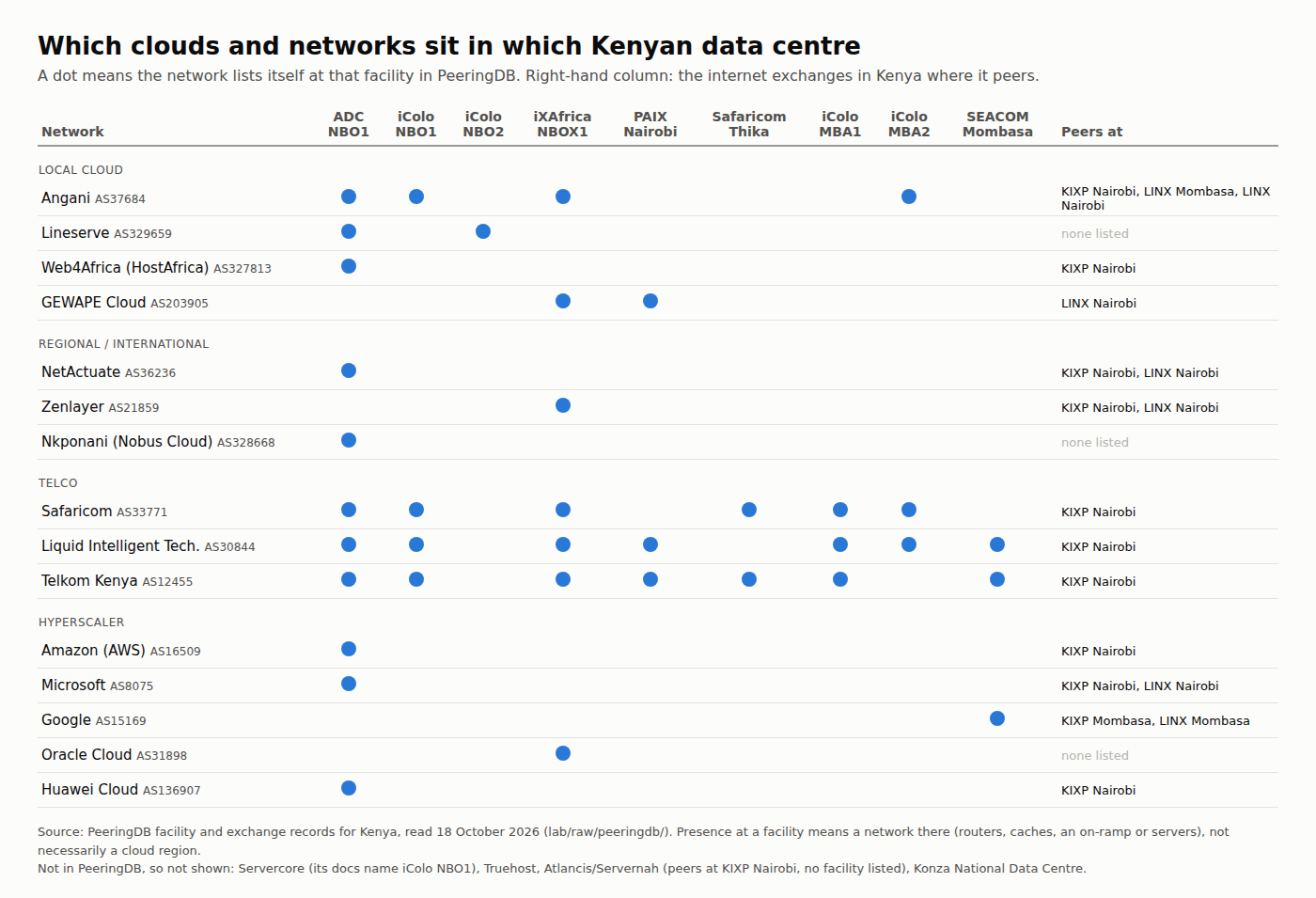
- Africa Data Centres NBO1 (Sameer Industrial Park, Cassava group): 128 networks in PeeringDB, the AWS Direct Connect and Google Cloud Interconnect locations, and Lineserve, Microsoft, Huawei and NetActuate equipment. Zenlayer’s own site also places its Nairobi servers here.
- Digital Realty, formerly iColo: NBO1 and NBO2 in Nairobi and MBA1 and MBA2 in Mombasa. Digital Realty opened NBO2 (6.4 MW) on 7 September 2026, when iColo moved to the Digital Realty brand. Servercore’s region is in NBO1, and PeeringDB lists Lineserve’s network in NBO2.
- iXAfrica (Mombasa Road): NBOX1.1 with 4.5 MW of IT load, of which its own site shows 2.25 MW as ready, and an 18 MW NBOX1.2. Oracle’s future region, GEWAPE, Zenlayer and the Servernah launch are all here.
- PAIX Nairobi, the Safaricom data centres (Thika and others) and Konza complete the list. EcoCloud’s geothermal campus at Olkaria, which was meant to host the Microsoft and G42 region, broke ground in 2023 and has not opened.
The two Nairobi internet exchanges are where providers meet ISPs. PeeringDB lists 144 networks at KIXP Nairobi and 63 at LINX Nairobi. A provider at both, with good transit, is reachable locally from most Kenyan ISPs. One at neither has to rely on its upstream carrier’s peering.
What we measured
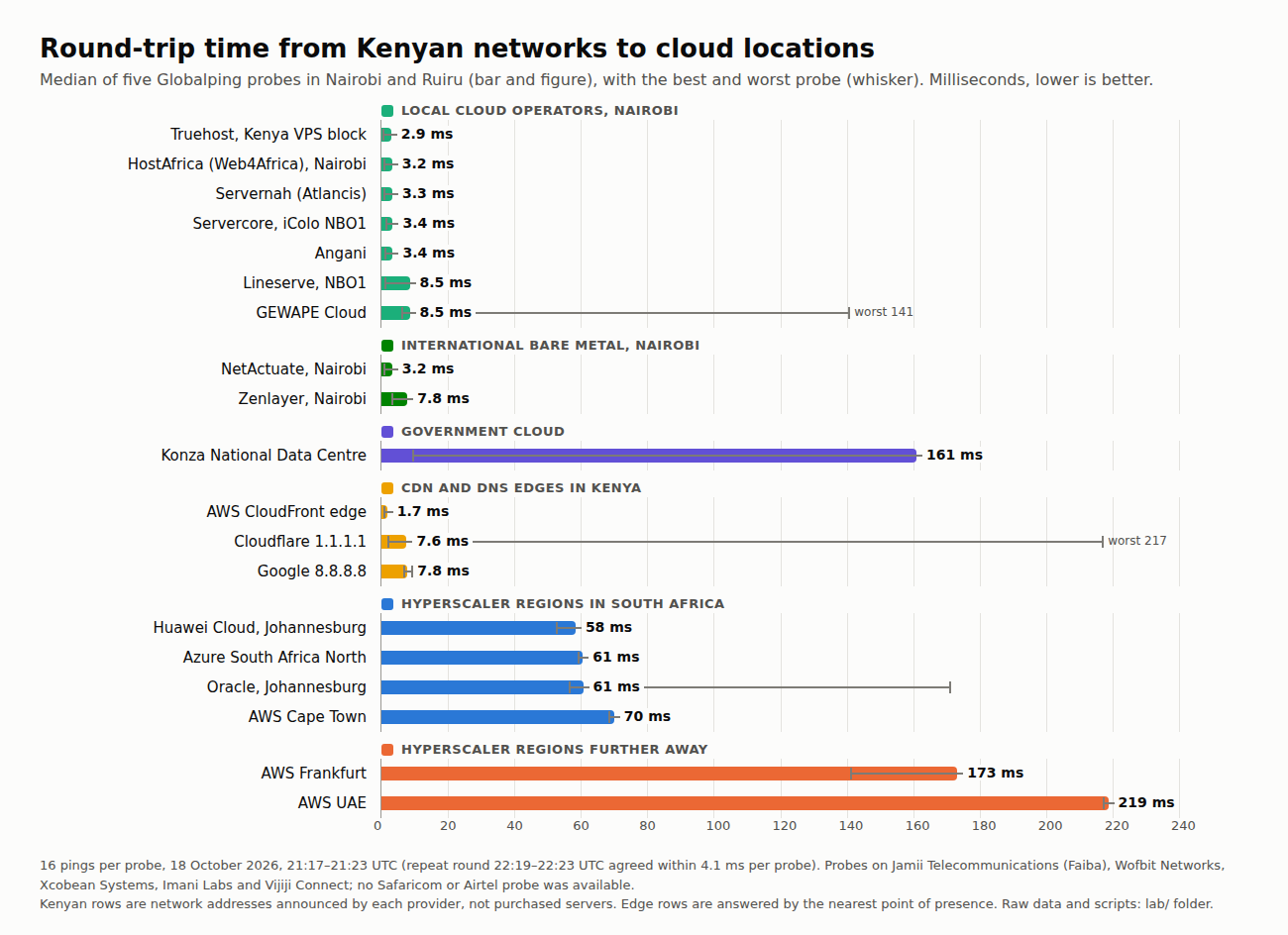
What the numbers say:
- Kenya: about 3 to 9 ms. Every local operator’s Kenyan block answered most probes in single digits. Truehost’s Kenya block, Web4Africa, NetActuate, Servernah, Servercore and Angani were all within 2.9 to 3.4 ms of each other at the median, and Lineserve’s NBO1 came in at 8.5 ms, with every one of the five probes between 0.8 and 15.5 ms.
- Johannesburg and Cape Town: 58 to 70 ms. Huawei, Azure and Oracle in Johannesburg sat at 58 to 61 ms; AWS Cape Town at 70 ms. That’s the price of a hyperscaler region today: fine for most websites and APIs, noticeable for chatty apps, voice and anything that makes many sequential calls.
- Further afield: 170 ms and up. AWS Frankfurt was 173 ms and AWS’s UAE region 219 ms from the same probes.
- The ISP matters as much as the provider. Konza, GEWAPE and one Angani block were 3 to 11 ms from some networks and 139 to 179 ms from others. The slow routes left Kenya and came back: Wofbit’s trace to GEWAPE went through Mombasa, Marseille, Paris and London, and Wofbit’s and Xcobean’s traces to Konza went through Marseille and Lisbon before returning over the WIOCC network (166 ms). Network engineers call this tromboning. It happens when your users’ ISP and your provider don’t exchange traffic in Kenya.
- The repeat run agreed. We pinged every target again at 22:19–22:23 UTC. Vijiji Connect’s probe didn’t answer that round, so it had four probes, but each probe that answered both rounds came back within 4.1 ms of its first result (79 of 83 within 3 ms). The slow routes to GEWAPE and Konza from Wofbit and Xcobean were still there.
The rules that decide whether “local” matters
Three sets of rules shape the choice. None of them requires most private companies to host in Kenya, but each makes the location a decision you have to document.
1. The Data Protection Act’s localisation rule. Section 50 of the Data Protection Act and regulation 26 of the Data Protection (General) Regulations 2021 require processing for “strategic interest of the state” purposes either to run “through a server and data centre located in Kenya” or to keep “at least one serving copy” in a Kenyan data centre. The purposes are civil registration and identity, elections, public finance systems, protected computer systems, early childhood and basic education, and primary or secondary health care. The ODPC’s own example is a hospital whose medical-records system runs in another country: it complies by keeping an up-to-date serving copy in Kenya.
2. The ODPC’s 2026 cross-border guidance. The Guidance Notes for Cross-border Data Transfers (published September 2026) say that processing personal data “in cloud environments with servers located outside Kenya constitutes a cross-border data transfer”. Before moving data to such a cloud, controllers should establish a lawful basis and meet the transfer conditions in the Act, sign data processing agreements, and run a data protection impact assessment where the processing is high risk. A Kenyan cloud doesn’t remove your other duties, but it takes the transfer paperwork off the table.
3. The Kenya Cloud Policy 2025. Gazetted in May 2025, it applies “cloud first” to public bodies, which had 12 months to comply. According to Bowmans’ summary, top secret government data must be hosted in a government-dedicated cloud in Kenya, restricted data with government cloud service providers in public cloud infrastructure in Kenya, and open data with a government cloud service provider. Private-sector compliance isn’t mandatory. Cloud providers selling to government are expected to follow it. (We couldn’t retrieve the gazetted text itself; this is the law firm’s reading.)
Sector rules can add to these. Health providers in particular are asking. “It’s health related which is why I need local storage options for DHA compliance,” one developer wrote in June 2026, and in August a company posted that “We have a new requirement by the ODPC and DHA to move our data locally.” Ask your regulator or lawyer what applies to you, and get your provider’s data centre named in the contract. The business case beyond compliance (latency, shilling billing, local support) is set out in why local cloud infrastructure matters for African businesses.
How the provider types differ
| Local cloud operators | Telco clouds | International bare metal in Nairobi | Hyperscalers (from South Africa) | Storefronts on servers abroad | |
|---|---|---|---|---|---|
| Servers in Kenya | Yes | Yes | Yes | No (edges and on-ramps only) | No, or not stated |
| Typical latency from Kenyan ISPs | 3–9 ms, with ISP exceptions | Not measurable from outside | 3–8 ms | 58–70 ms | 140 ms+ (Europe/US) |
| Billing | KES; M-Pesa common | KES, contract | USD, quote | USD, pay-as-you-go | KES; M-Pesa common |
| Ordering | Self-service sign-up | Sales-led, “Get it now” to a form | Sales-led | Self-service, card | Self-service |
| Smallest server | 1 GB from KSh 960–1,485 | 8 GB from KES 7,840 | Dedicated servers | Pay per hour | Often cheapest |
| Range of services | VMs, storage, backup; Kubernetes and databases at some | VMs, backup, colocation, connectivity | Servers, colocation, transit | Hundreds of managed services | VPS and shared hosting |
| Support | Local hours vary; ask for night cover in writing | Account manager | Global NOC | Paid support plans | Varies |
| Data protection position | No cross-border transfer | No cross-border transfer | No cross-border transfer for data on the server | Cross-border transfer; needs safeguards | Cross-border transfer |
How to shortlist
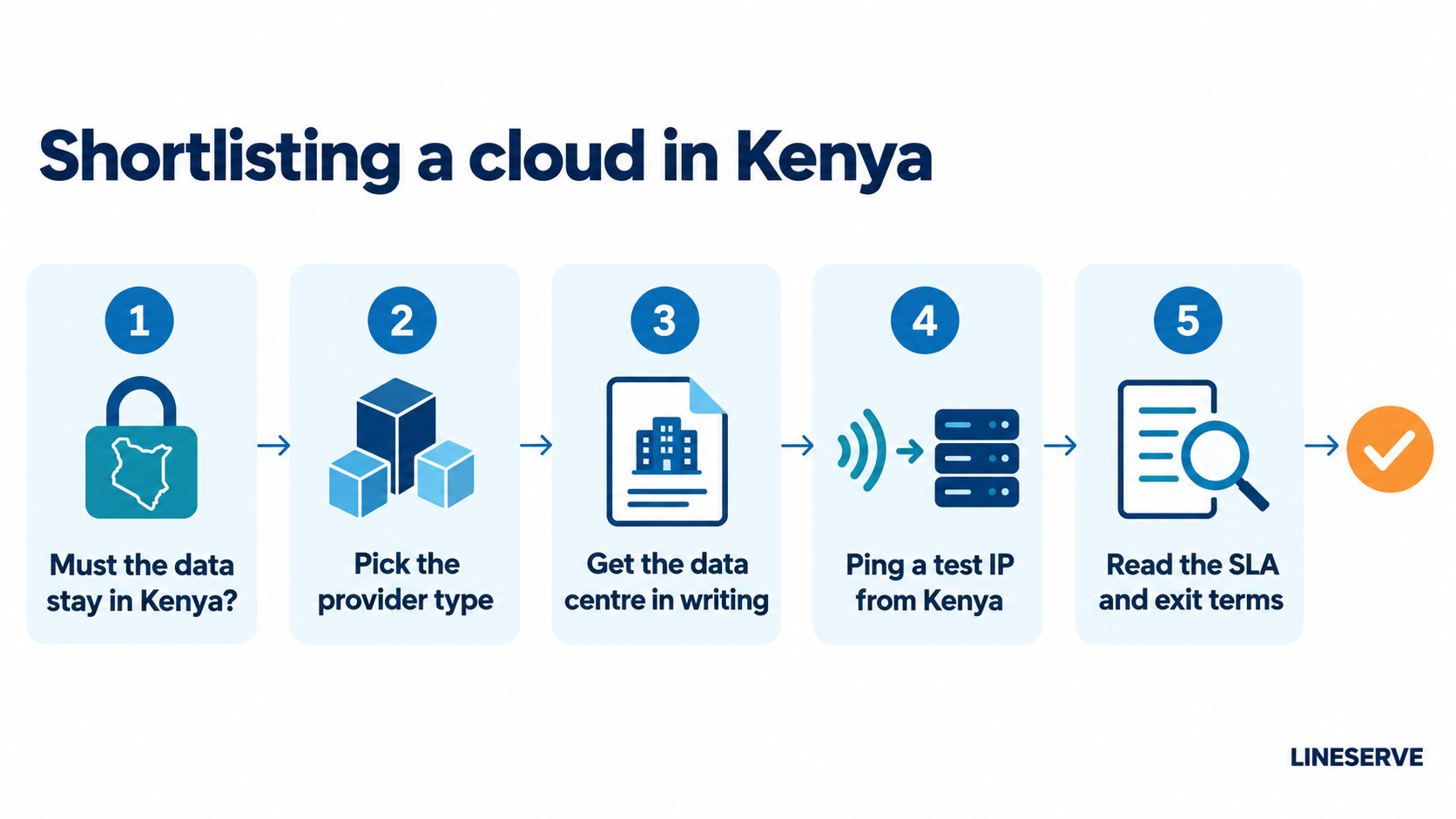
- Decide whether the data must be in Kenya. If your processing is on the regulation 26 list, or a regulator or client demands it, only the first three groups qualify. If not, the decision is about latency, price and services.
- Match the provider type to the job. Self-service VMs billed in shillings: local cloud operators such as Lineserve, Servercore, Angani or Truehost’s Kenya VPS. A large block of capacity under one telco contract: Safaricom. Physical servers in Nairobi from a global company: NetActuate or Zenlayer. Managed databases, queues, AI services and a big ecosystem: a hyperscaler in South Africa, plus a Kenyan backup copy if the law needs one.
- Get the data centre named in writing. “Kenya” isn’t an address. Servercore names iColo NBO1 in its docs. Lineserve’s NBO1 runs in iColo and ADC, and PeeringDB lists its network at ADC NBO1 and iColo NBO2. Most others name nothing on their pages, but will tell you if asked.
- Ask for a test IP and check it yourself. Run
whois -h whois.cymru.com " -v <ip>"to see the network and country, then ping it from your users’ ISPs. Anything under about 15 ms from a Kenyan connection is in Kenya; Johannesburg comes back at 55 to 75 ms; Europe at 140 ms or more. If you’re not in Kenya, Globalping’s free probes will do it:
bash

   curl -s -X POST https://api.globalping.io/v1/measurements -H 'Content-Type: application/json'

     -d '{"type":"ping","target":"<test-ip>","locations":[{"country":"KE","limit":6}],"measurementOptions":{"packets":16}}'

   # then read the result: curl -s https://api.globalping.io/v1/measurements/<id>
- Check the route from Safaricom and your other big ISPs. Our probes didn’t include Safaricom or Airtel, and they carry most Kenyan mobile users. Run
mtr -rwzc 50 <test-ip>from a phone hotspot on each. If Nairobi-to-Nairobi traffic goes via Europe, ask the provider which exchanges and carriers it connects to. - Read the contract, not the badge. The SLA percentage, the credit you get when it’s missed, the support hours, the refund terms and whether VAT is included. Local providers’ pages often disagree with their own terms; the terms win.
- Plan the exit. Can you export images or snapshots, or at least copy your data out over the network? Keep a backup with a second provider in a different building. Most local plans are unmanaged, so budget time for the security basics every production server needs.
Which to choose
- A Kenyan business with mostly Kenyan users, wanting self-service servers in shillings: a local cloud operator in Nairobi. Start with Lineserve if you want to size a server resource by resource, pay by M-Pesa and keep the option of Dar es Salaam, Lagos or Kampala on the same account (from KSh 1,485 plus VAT). Servercore if you want managed Kubernetes, managed databases and S3 today; Angani, Truehost’s Kenya VPS or HostAfrica’s Kenya location for simple VMs at KSh 960 to 1,400 a month. Test the route from Safaricom first.
- Health, education, identity or public-finance systems: a Kenyan data centre, named in the contract, for the system itself or at least a serving copy. Any of the local operators (Lineserve’s NBO1 runs in iColo and ADC), Safaricom, or Konza for state bodies.
- A government entity: the Cloud Policy 2025 points you at government cloud service providers and Kenyan hosting for restricted and secret data. Konza and approved providers first.
- A large enterprise already buying from Safaricom or Liquid: their clouds keep data in Kenya under one supplier, priced by the block.
- A startup that needs a broad managed platform: AWS Cape Town or Azure, Google, Oracle or Huawei in Johannesburg, about 60 to 70 ms away. Budget for USD billing and data-transfer charges, document the cross-border transfer, and use a Nairobi CDN edge for static content.
- Waiting for Oracle or AWS in Nairobi: don’t plan a launch around it. Neither had a date on 18 October 2026.
Shortlist a provider with servers in Nairobi. Lineserve’s NBO1 region runs in the iColo and Africa Data Centres facilities and answered every Kenyan probe locally, at an 8.5 ms median. Build a Cloud Server to the size of your workload, from KSh 1,485 a month plus VAT and paid by M-Pesa, or pick a ready-made Linux VPS plan from KSh 1,620. Then run the shortlist checks above on it alongside the others.
FAQ
Which cloud providers have data centres in Kenya?
With public evidence from their own pages and their networks, as of 18 October 2026: Lineserve (NBO1), Angani, Servercore, Truehost (Kenya VPS range), HostAfrica (Kenya location), Servernah (Atlancis), GEWAPE Cloud and Safaricom, plus the government’s Konza cloud. NetActuate and Zenlayer have servers in Nairobi but sell bare metal and colocation. Strictly, most of them rent space in someone else’s data centre, such as Africa Data Centres, Digital Realty (iColo) or iXAfrica.
Does AWS have a region in Kenya?
No. AWS’s nearest region is Cape Town. It has a Nairobi CloudFront edge, a Direct Connect location in the Africa Data Centres NBO1 building, and an announced Nairobi Local Zone that you can only register interest in.
Is Microsoft building an Azure region in Kenya?
Microsoft and G42 announced an “East Africa Cloud Region” at Olkaria in May 2024. By May 2026 it had stalled over power capacity, DatacenterDynamics reported. Azure’s nearest region is South Africa North.
When will Oracle’s Kenya region open?
Oracle lists Kenya as “Coming soon”, and iXAfrica says it will host it. Neither has published a date.
Is Johannesburg close enough for Kenyan users?
For most websites and APIs, yes: 58 to 61 ms from Kenyan networks in our test, against about 3 to 9 ms for a Nairobi server and 173 ms for Frankfurt. It doesn’t solve data residency.
Can I pay for a Kenyan cloud with M-Pesa?
Lineserve, Servercore, Truehost and HostAfrica (mobile payments) say so on their pages. If you’re wiring M-Pesa into your own app as well, see this guide to accepting payments in Africa with M-Pesa, Paystack and Flutterwave. Angani’s and Safaricom’s pages don’t say how you pay. No hyperscaler takes M-Pesa directly; they bill in US dollars.
Does hosting outside Kenya break the Data Protection Act?
Not by itself. Most personal data can go abroad under the Act’s transfer rules, with safeguards and documentation; the ODPC treats foreign cloud hosting as a cross-border transfer. Data processed for the regulation 26 purposes (identity, elections, public finance, protected systems, basic education and primary or secondary health care) must be processed in Kenya or keep a serving copy here.
How can I tell whether a “Kenyan” host is really in Kenya?
Ask for a test IP, look it up with whois -h whois.cymru.com " -v <ip>", and ping it from a Kenyan connection. Under about 15 ms means Kenya.
Checked on 18 October 2026. Latency figures are medians from five Kenyan Globalping probes (Jamii/Faiba, Wofbit, Xcobean, Imani Labs, Vijiji Connect) to provider network addresses, not to purchased servers, and exclude Safaricom and Airtel. Prices, plans and announcements change often, so recheck before you buy. Lineserve’s Nairobi Cloud Servers are priced in shillings on its site.