Best VPS Providers in Kenya: How They Compare (2026)
Comparing VPS providers that serve Kenya on server location, uptime, support, price and payment options, with criteria to choose your own.

Last checked: 18 October 2026. Prices, plans and test results below are from that date.
The short answer
The right choice depends on where your users are, how you need to pay and how much support you need. What you can check is where the server really sits, because that sets your latency. We measured it from five Kenyan networks:
- Servers in Nairobi (Servercore, Truehost’s “Kenya VPS” range, HostAfrica’s Kenya location, Angani and Lineserve): typically 1 to 10 ms from Kenyan networks. All five price in shillings; Truehost, Servercore and Lineserve name M-Pesa, and HostAfrica lists mobile payments.
- Johannesburg and Cape Town (Vultr, AWS, Azure, Oracle, Huawei): about 58 to 70 ms.
- Europe (Hetzner, DigitalOcean, Akamai/Linode, Contabo, Vultr Frankfurt): about 136 to 158 ms, sometimes cheaper. You pay in dollars or euros by card or PayPal, and some providers add 16% Kenyan VAT.
If your users are in Kenya, start with Lineserve. Its Nairobi region (NBO1), in the iColo and ADC facilities, answered our five Kenyan probes at 5.7 to 8.7 ms with no packet loss, and none of them was routed abroad to reach it. Prices are published in shillings (Linux VPS from KSh 1,620 a month plus VAT), you can pay by M-Pesa, and the 99.9% SLA pays credits when it’s missed. Support runs in East Africa Time business hours with live-incident cover. If you need 24/7 support or the lowest Nairobi price, compare Servercore and HostAfrica.
Two things surprised us. The cheapest plans on some Kenyan hosting sites run in Europe or the US. Separately, a server in Nairobi can still take 166 to 339 ms to reach a user on some other Kenyan ISPs, because their traffic goes through Europe or the Gulf first.
So shortlist on four things: where the plan is hosted (not where the company is registered), the total monthly price in KES with VAT, how you’ll pay, and the refund terms. Then buy one month and test it from your users’ networks before you commit. The checklist and test script are near the end.
Quick picks by need (all facts dated 18 October 2026, details below):
| If you need… | Look first at | Why |
|---|---|---|
| Published KES prices, M-Pesa and a Nairobi office | Lineserve (NBO1) | Linux VPS from KSh 1,620 + VAT, 5.7–8.7 ms median in our test; local routes via Wavex, which peers at KIXP; 99.9% SLA with credits |
| Lowest latency to Kenyan users, KES billing | Providers with verified Nairobi addresses: Servercore, Truehost Kenya VPS, HostAfrica (Kenya), Angani, Lineserve | 1–10 ms median from Kenyan networks in our test |
| Data that must stay in Kenya (e.g. health, public finance systems) | Same group, with a written statement of the data centre | Kenya’s Data Protection (General) Regulations 2021, regulation 26 |
| The cheapest capable box, users spread across Africa or Europe | Hetzner, Contabo, DigitalOcean, Vultr | Low euro/dollar prices, but card or PayPal only and ~140–150 ms from Kenya |
| A big-cloud ecosystem near Kenya | AWS Cape Town, Azure South Africa North, Oracle or Huawei Johannesburg | 58–70 ms, managed databases and the rest of the platform |
| Johannesburg location at budget price | Vultr Johannesburg | $5 a month entry plan, 59 ms median |
How we tested
We didn’t take location claims at face value. For each provider we:
- Read the plan’s own page for the stated location, price, billing period, VAT note, payment methods, support hours and uptime promise, and saved a screenshot.
- Looked up the provider’s network (its ASN, or autonomous system number, the ID a network uses on the internet) and the address blocks it announces, using RIPEstat and PeeringDB.
- Pinged a responding address in each block from five Kenyan networks using Globalping, a free service with volunteer probes. The probes were on Jamii Telecommunications (Faiba), Wofbit Networks, Xcobean Systems and Imani Labs in Nairobi, and Vijiji Connect in Ruiru. There was no Safaricom or Airtel probe, so users on those mobile networks aren’t represented.
- Ran traceroutes (mtr) from the Kenyan probes to see the path, and pinged from Servercore’s public looking glass inside a Nairobi data centre for contrast.
- Ran the benchmark script from the end of this article on an Ubuntu 24.04 server to make sure every command works.
Two limits. We measured provider network addresses, not a VPS we bought, so a real VPS could sit on a different block. And five probes are a sample, not every Kenyan ISP. The raw data, scripts and logs are saved alongside this article.
What actually matters when you choose
1. Where the server really is. Latency adds to every request, and a web page can make dozens. Our measured medians were about 3 ms in Nairobi, 59 ms to Johannesburg and 150 ms to Frankfurt. A WordPress admin, an API your mobile app calls, or an SSH session feels the difference; a static site behind a CDN mostly doesn’t.
2. The network, not just the city. Look for a provider that peers at the Kenya Internet Exchange Point (KIXP), the Nairobi exchange where Kenyan networks swap traffic locally. PeeringDB lists 144 networks at KIXP Nairobi. If your users’ ISP and your host don’t meet there or through a common local carrier, traffic can leave the country and come back.
3. The real monthly price. Compare the monthly-billed price, not a “per month” figure that needs a three-year prepayment. Add 16% VAT where it applies and convert at today’s rate. Note first-month discounts, renewal prices and what bandwidth is included.
4. How you pay. The local hosts we checked bill in KES, and most name M-Pesa or mobile money. Most foreign providers bill in USD or EUR by card or PayPal, and Kenyan developers report regular problems with card checks and account verification (see “Paying from Kenya”).
5. Support you can reach. Ticket, chat or phone, the hours, and whether someone technical answers at night. Test it before you rely on it.
6. Uptime promise and what backs it. A “99.9% uptime” badge is a marketing claim unless an SLA (service level agreement) says what credit you get when it’s missed.
7. Data rules. Kenya’s Data Protection (General) Regulations 2021, regulation 26, require processing for some “strategic interest of the state” purposes to run on a server and data centre in Kenya, or keep at least one serving copy here. The listed purposes include civil registration, elections, public finance systems, protected computer systems, basic education and primary or secondary health care. Most other personal data can be hosted abroad under the Data Protection Act’s transfer rules.
8. Platform features. Snapshots, backups, an API, a firewall, extra IPs, private networking and how quickly you can resize. Big clouds win here; small hosts vary.
Is the VPS really in Kenya? How to check
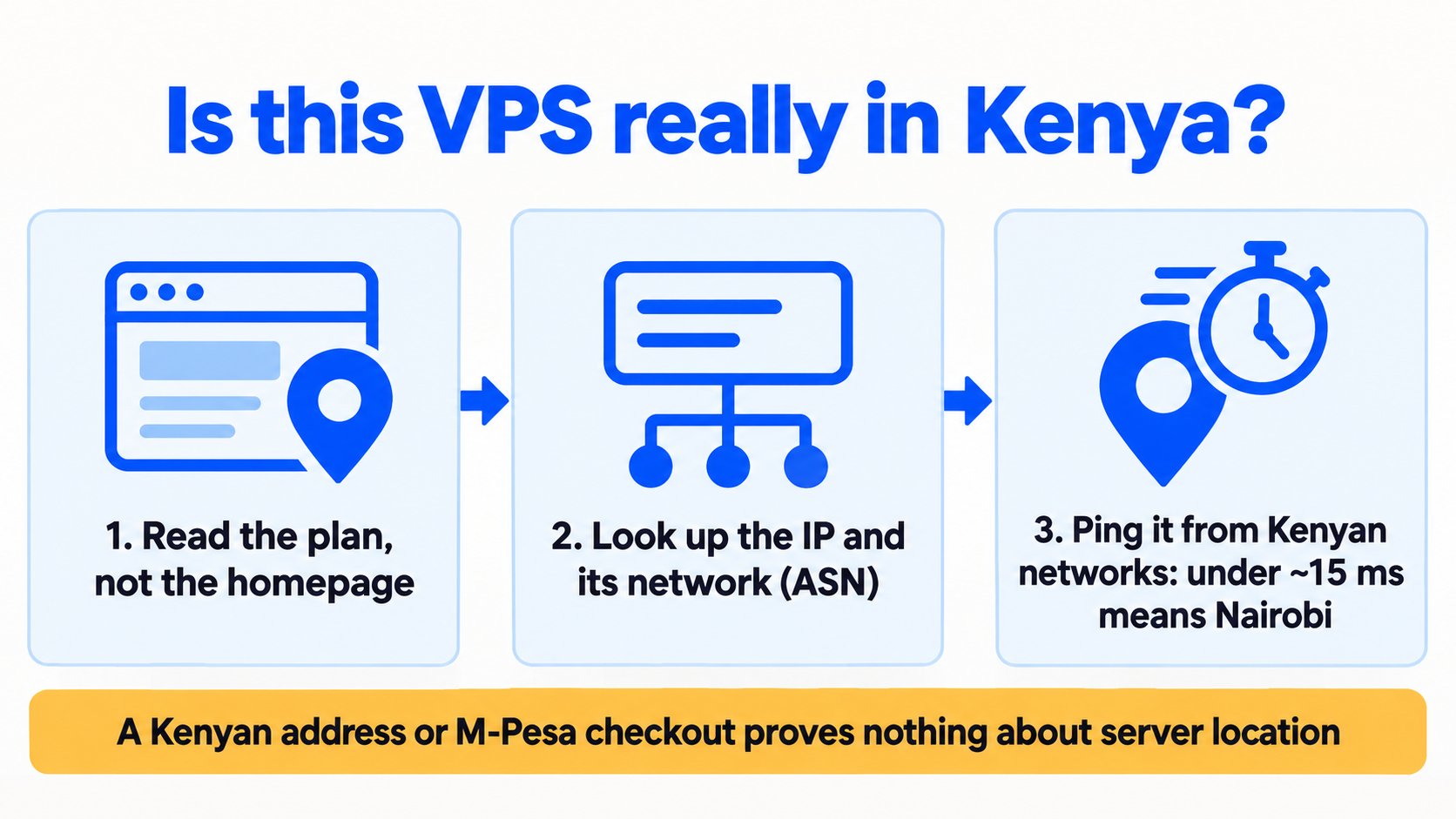
Kenyan commenters have been saying this for years. In a 2023 r/Kenya thread one user claimed “99.99% of ‘local’ web hosting companies are simply resellers”. That’s an exaggeration, but it points at a real pattern: a local storefront selling servers that sit abroad. In 2026 a LowEndTalk user asked why a Truehost brand was listed under Kenya when the order page said “Data Centers: Europe/USA”. That’s legitimate if the page is clear about it, and some are. You just have to read the plan.
The three checks:
- Read the plan, not the homepage. The location should be stated on the plan or at checkout.
- Ask for a test IP, or check the address after you buy.
whois -h whois.cymru.com " -v <ip>"returns the network’s ASN and the registry. A Kenyan-registered ASN can still have address blocks abroad, so this alone isn’t proof. - Ping it from Kenya. From a Kenyan connection, anything under about 15 ms is in Kenya. Johannesburg comes back at about 55–75 ms and Europe at 125 ms or more. If you’re not in Kenya, use Globalping’s Kenyan probes (see “How to test before you commit”).
Providers with servers in Kenya
These are the providers whose Nairobi location we could confirm by network data and ping, as of 18 October 2026. Lineserve comes first; the others are in no particular order.
Lineserve (Nairobi, NBO1)
Lineserve is a Kenyan company (Lineserve Limited, with an office at View Park Towers in Nairobi) that sells cloud servers and VPS plans in four regions: Nairobi (NBO1), Dar es Salaam (DAR1), Lagos (LOS1) and Kampala (KLA1). It runs its own network, AS329659. NBO1 runs in the iColo and Africa Data Centres (ADC) facilities in Nairobi, and PeeringDB lists the network at ADC’s NBO1 and at iColo’s NBO2 in Karen. Lineserve’s region code NBO1 isn’t iColo’s building of the same name. Tier ratings belong to the facility operators, not to Lineserve, and Uptime Institute’s directory lists ADC Nairobi and iColo NBO1 with Tier III Design certifications only, not Constructed Facility.
- What we measured: two addresses in Lineserve’s Kenyan block (102.204.0.0/24) answered all five Kenyan probes with no packet loss, at medians of 8.7 ms and 5.7 ms. The best probe was 0.6 ms (Xcobean) and the worst 20.2 ms (Vijiji Connect, pushed up by one 90 ms spike). The mtr traces stayed in Kenya: 0.8 ms from Wofbit and 5.2 ms from Vijiji Connect, both through Lineserve’s Kenyan upstream Wavex (AS328977). From Jamii, the route crossed the KIXP peering LAN into Wavex and arrived in 8.6 ms. PeeringDB lists no exchange for Lineserve’s own network, so its local reach depends on Wavex’s peering for now. That puts Lineserve in the 1–10 ms Nairobi group, a few milliseconds behind Servercore and Truehost’s Kenyan block from Jamii. None of our probes reached it by a detour abroad, unlike some routes to Angani and HostAfrica addresses.
- Pricing: published in shillings. The Linux VPS range starts at Linux VPS – 2 GB RAM: 1 vCPU, 2 GB, 40 GB SSD and one dedicated IPv4 address for KSh 1,620 a month. Linux VPS – 4 GB RAM (2 vCPU, 80 GB SSD) is KSh 3,240. Anything smaller is a Cloud Server you size yourself: 1 vCPU, 1 GB, 20 GB SSD and an IPv4 address comes to KSh 1,485 a month. These prices exclude VAT: 16% is added at checkout, so the 2 GB plan comes to KSh 1,879.20.
- Included: a free /64 IPv6 block, and “1 Gbps, unlimited local traffic” on every VPS plan. As with Angani’s “within Kenya” wording, Lineserve doesn’t publish terms for international traffic, so ask how it’s treated.
- Payment: “Pay in your local currency using M-Pesa and other mobile money, bank transfer, or card. No foreign card or forex conversion is required.”
- Uptime: a 99.9% monthly uptime SLA. Its SLA gives a 10% credit below 99.9%, 25% below 99.0% and 50% below 95.0%. You claim the credit within 30 days, and it’s capped at that month’s fee for the affected service.
- Support and billing: Lineserve’s support answers by signed-in ticket, phone (+254 119 039 063) and email in East Africa Time business hours, with cover for live incidents outside those hours and technical response times set by the plan’s SLA. Billing is monthly in advance, and per the terms fees are non-refundable.
- Data in Kenya: servers in NBO1 sit in Nairobi, which is what regulation 26 asks for where it applies. That’s data residency for the Kenya Data Protection Act, not a compliance certificate, so you still need your own data-processing terms.
Servercore (Nairobi, iColo NBO1)
Servercore runs a public cloud region in Nairobi. Its locations page names the facility as the iColo NBO1 data centre on LRC Road off Langata South Road, with one availability zone (pool ke-1a). Its other regions are in Kazakhstan, Uzbekistan and Russia. Both address blocks we tested answered from all five Kenyan probes in 1.2 to 15 ms. The mtr trace from Jamii went straight across the KIXP peering LAN.
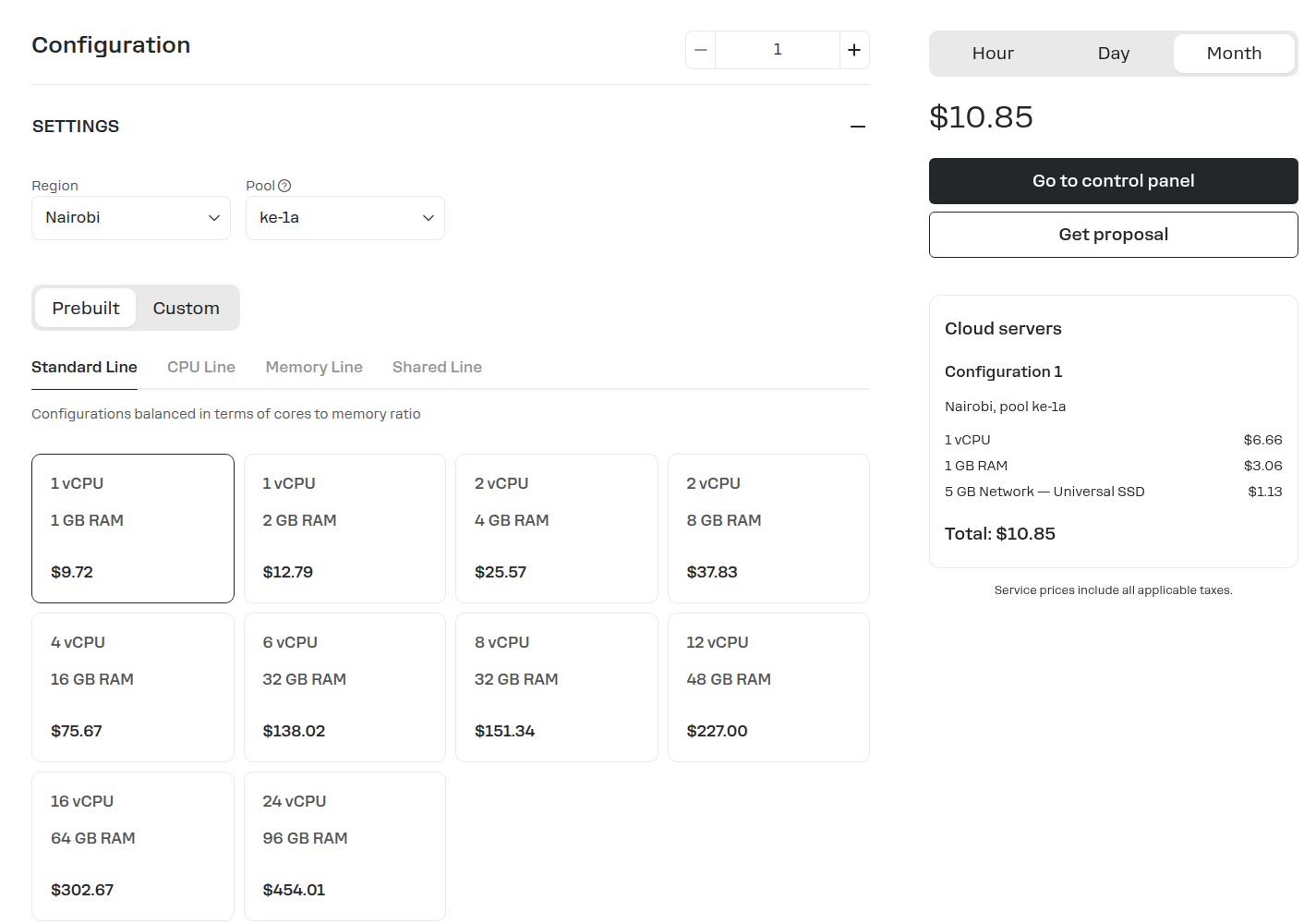
- Pricing: pay-as-you-go, charged hourly from a prepaid balance. The smallest Standard Line server (1 vCPU, 1 GB) came to $10.85 a month with a 5 GB disk, “including all applicable taxes”, before a public IP. The page says Kenyan customers are billed in shillings and can pay by M-Pesa or bank transfer.
- Included: 3 TB of free outbound traffic a month per account, then metered.
- Support and SLA: the Kenya page advertises 24/7 free technical support and a 99.98% uptime SLA.
- Fit: developers who want cloud-style tooling (API, private networks, load balancers, managed databases and Kubernetes are listed) in Nairobi. Expect to spend some time on the calculator. In a June 2026 r/nairobitechies thread, a developer called the pricing page confusing. A Servercore staff member replied that the smallest package cost about KSh 1,347, but that’s the vendor speaking.
Truehost: “Kenya VPS”, not the cheapest plans
Truehost sells two different VPS ranges from the same Kenyan site, and the difference is easy to miss.
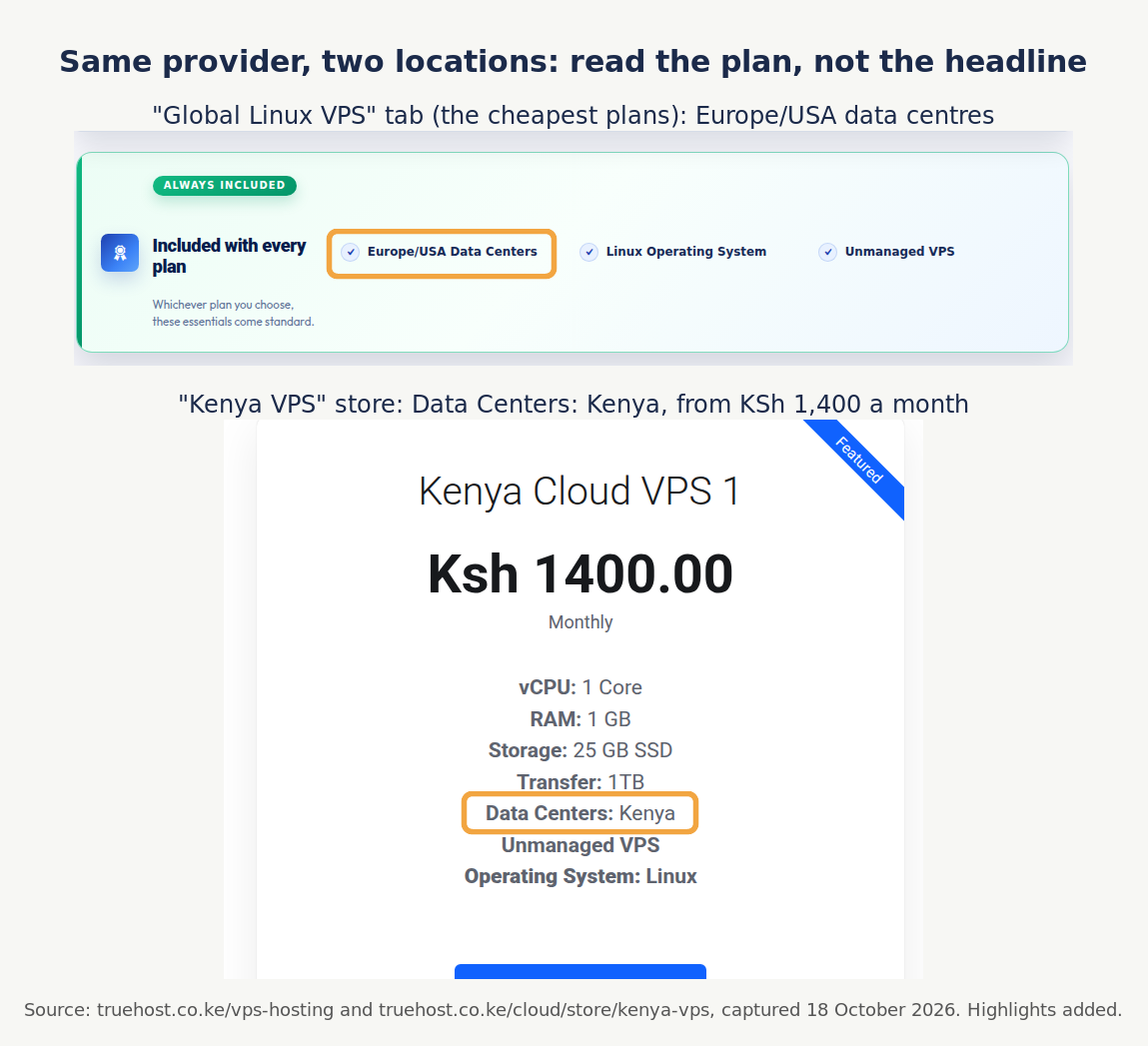
- Global Linux VPS (from KSh 579.64 a month on a three-year term): the page says “Europe/USA Data Centers” are included with every plan.
- Kenya VPS store: “Powered by Datacenters in Nairobi Kenya”. Kenya Cloud VPS 1 is 1 vCPU, 1 GB, 25 GB SSD and 1 TB of transfer for KSh 1,400 a month. Cloud VPS 2 (2 GB) is KSh 2,800 and Cloud VPS 3 (2 vCPU, 4 GB) is KSh 5,600. The plans are unmanaged and Linux only.
Truehost’s network (AS329278, Truehost Cloud Limited) announces several blocks. One, 102.212.244.0/24, answered our Kenyan probes in 0.4 to 20 ms (median 3.2 ms), through KIXP. Another block answered in 236 to 300 ms from Kenya, and its trace ended in Dallas. That fits the two product lines.
- Payment: KES prices, with M-Pesa, cards and others listed in the site footer.
- Terms: the terms of service promise 99.95% uptime and 24-hour support by phone, live chat, email and ticket. They say VPS servers are usually activated within 2 hours. They also say: “Truehost Do NOT offer refund for any services Offered”, except for overpayments or payment for services not provided. That’s worth knowing before you prepay a year.
- Community view: mixed. Praise for fast replies (“Guys even respond to you 4am”) sits next to complaints about slow sites. One January 2026 commenter found it fine for WordPress “But would not recommend for a node js app or their VPS.” Trustpilot showed 3.5 stars from 62 reviews on 18 October 2026, split almost evenly between 5-star and 1-star.
HostAfrica (Kenya location)
HostAfrica, a South African company, sells Linux VPS plans with a country selector: Kenya, Nigeria, South Africa or Ghana. Sasahost’s old domain now redirects to HostAfrica’s Kenyan site.
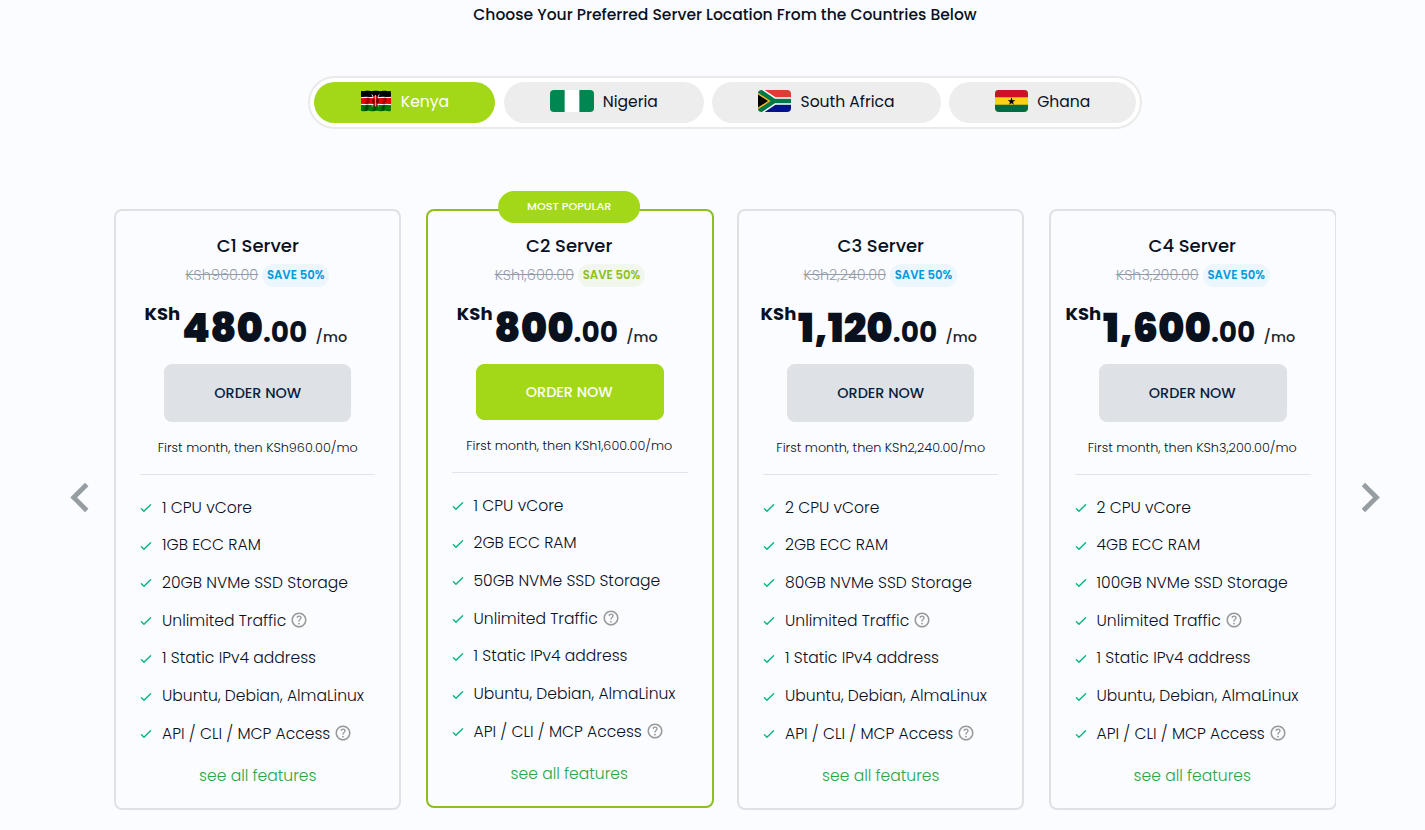
- Pricing: on the Linux VPS page, the C1 plan is 1 vCPU, 1 GB, 20 GB NVMe and unlimited traffic (fair use, 1 Gbps port) at KSh 960 a month, or KSh 480 for the first month. The C2 plan (2 GB, 50 GB) is KSh 1,600 a month, and C4 (2 vCPU, 4 GB, 100 GB) is KSh 3,200. Billing is monthly and you can cancel any time. The page doesn’t say whether VAT is included.
- Network evidence: HostAfrica’s main blocks (AS328364 and AS329184) answered from Kenya in 54 to 104 ms, which means South Africa. The network listed in PeeringDB as Web4Africa (AS327813, registered to Host Africa) sits at Africa Data Centres NBO1 and KIXP. Several of its blocks answered in under 1 ms to 13 ms. We can’t confirm which block a Kenya VPS gets until you order one, so check the IP.
- Uptime: the page says “99.9% uptime guarantee” at the top and “99% uptime guaranteed” in each plan’s feature list. Ask which applies.
- Payment and support: “KSH billing & regional payment options”. The page lists EFT, cards and mobile payments, and says technical staff are available every day of the year. It shows a Trustpilot score of 4.9 from about 2,800 reviews. HostAfrica invites customers to review, which pushes the score up.
Angani (Nairobi)
Angani is a Kenyan cloud company that runs its own network (AS37684). PeeringDB lists it at KIXP and LINX Nairobi, and in the iColo, Africa Data Centres and iXAfrica facilities in Nairobi.
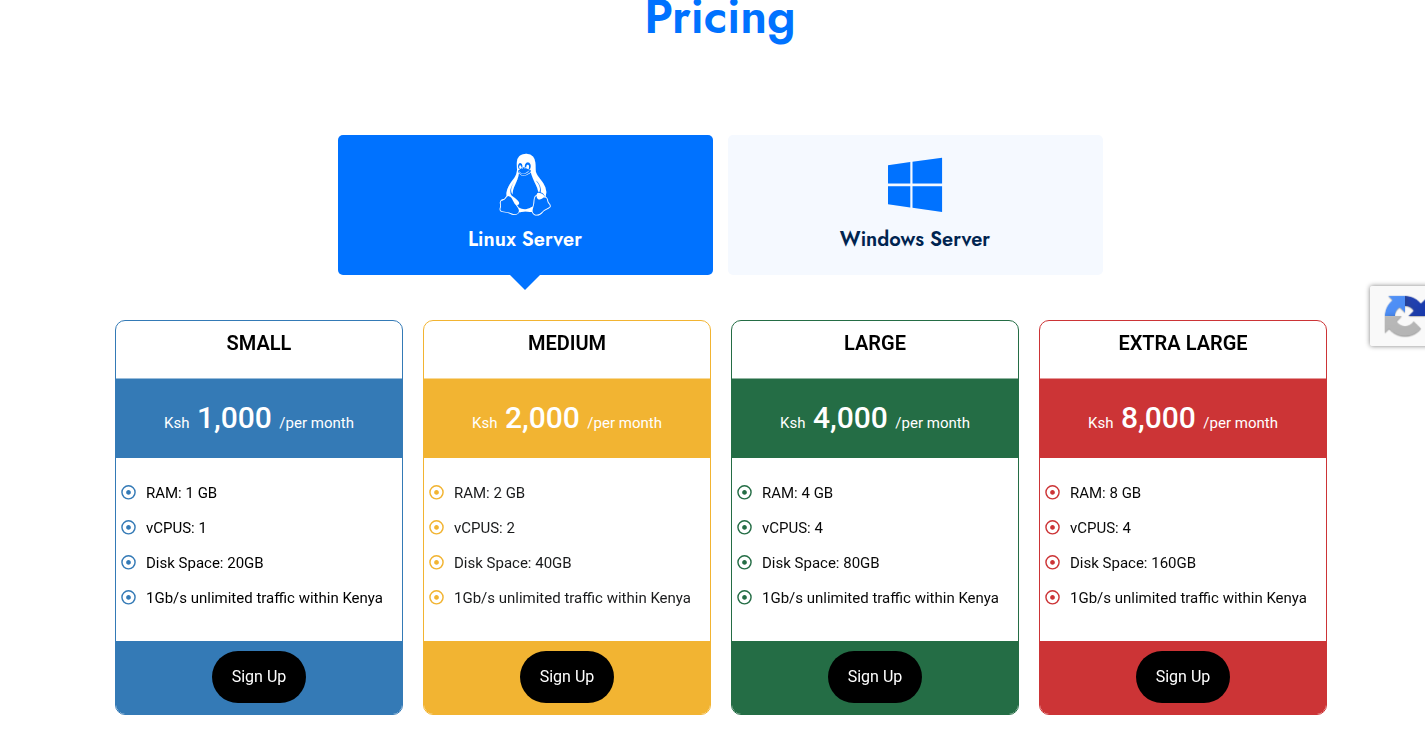
- Pricing: Small (1 vCPU, 1 GB, 20 GB) is KSh 1,000 a month and Medium (2 vCPU, 2 GB, 40 GB) is KSh 2,000. Every plan includes “1Gb/s unlimited traffic within Kenya”. The page doesn’t mention VAT or international bandwidth.
- Infrastructure: “two redundant, secure and reliable datacenters in Nairobi”. The page promises 99.9% uptime and 24/7 support.
- What we measured: Angani’s blocks answered most Kenyan probes in 1 to 14 ms. But from some networks, two of its three blocks took 165 to 170 ms, because the route went through Hurricane Electric via Djibouti, Marseille and Lisbon before coming back to Nairobi. That’s a peering issue between particular networks, not a fault in the data centre (see “The latency results”). The same address answered in 1.6 ms from inside another Nairobi data centre.
Safaricom (enterprise cloud)
Safaricom relaunched an in-country cloud on VMware in September 2023, hosted in Nairobi and Kisumu according to a Capital FM report at the time. We found no self-service VPS with a public price on Safaricom Business’s site on 18 October 2026, so treat it as a sales-led, quote-based enterprise product. In ~10 community threads about Safaricom’s shared hosting, 8 were negative, mostly about support. That’s shared hosting, not this cloud.
Kenyan storefronts whose server location we couldn’t verify
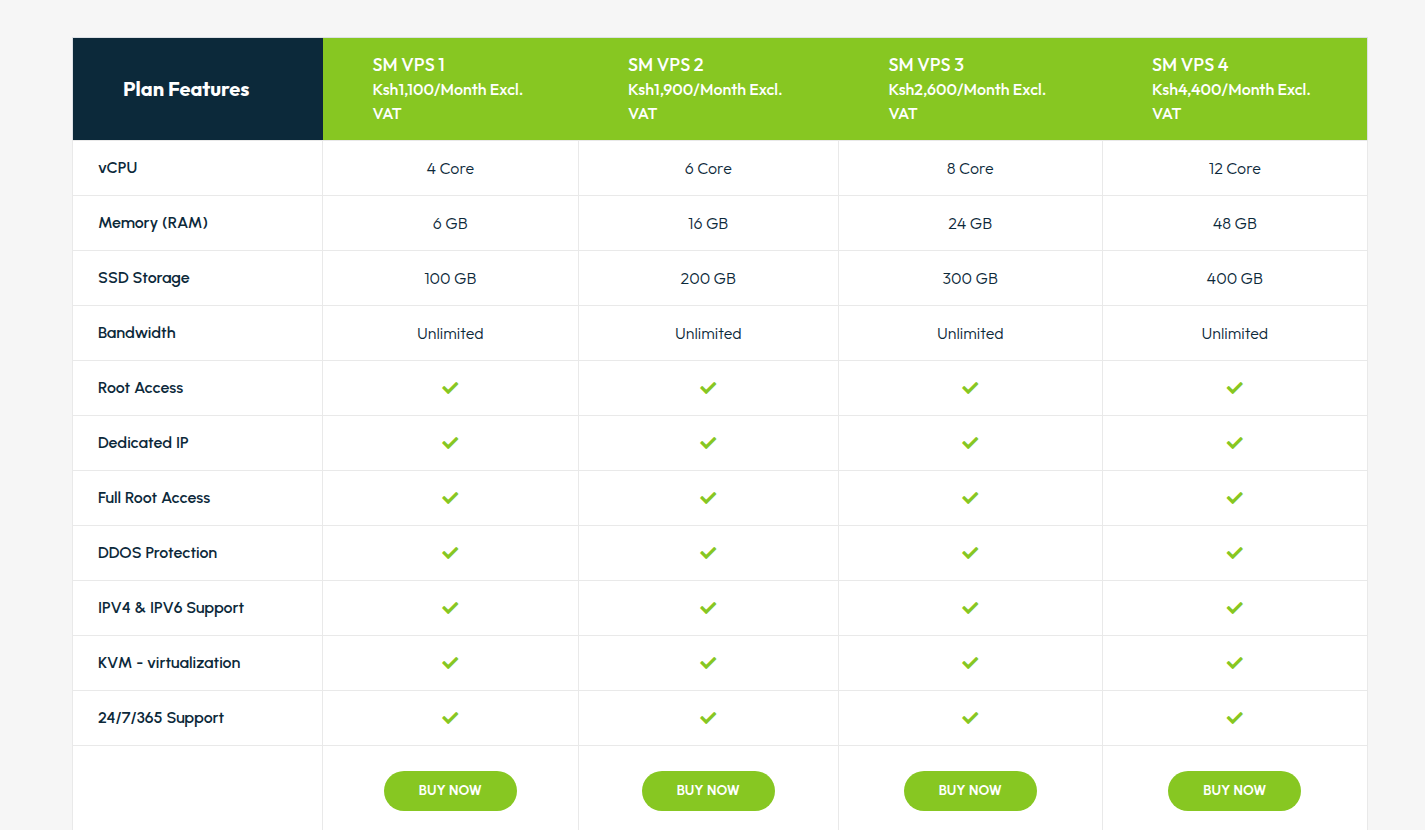
- HostPinnacle advertises self-managed VPS from KSh 1,100 a month excluding VAT for 4 cores, 6 GB of RAM, 100 GB NVMe and unlimited bandwidth. That’s a lot of server for the price. Its data-zone page lists Dallas, London, Cape Town and Nairobi, but the VPS page doesn’t say where these plans run. The site is behind Cloudflare and we found no ASN for HostPinnacle, so we couldn’t test it. The refund policy offers a 30-day money-back guarantee “for hosting services only”; ask whether that covers VPS. On r/nairobitechies, HostPinnacle’s shared hosting gets regular praise, while VPS users are split. One October 2025 reviewer wrote “expect downtime if you’re running critical services”. Another said they got “so much more for the same amount” after moving from DigitalOcean.
- Nescom lists VPS from KSh 3,500 a month (4 vCore, 8 GB, 200 GB SSD, 200 Mbit/s port). It says servers are “colocated in high-end data centers in Kenya, Europe, and the US” without saying which plan is where.
- Kenya Web Experts now redirects to hosting.com, which bought it. The VPS page we saw doesn’t list Nairobi among its locations. Kenyan customers on Reddit reported losing access to domains and getting invoices with no Paybill during the migration in 2025.
The big clouds and Kenya
None of the big three has a full cloud region in Kenya as of 18 October 2026:
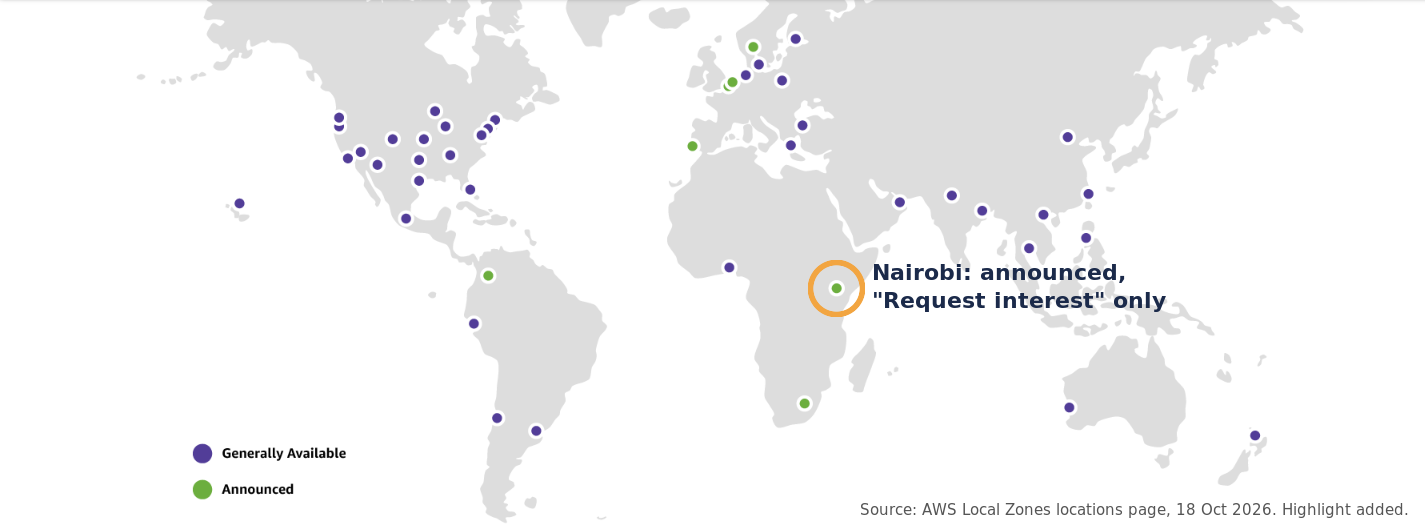
- AWS: a Nairobi Local Zone (
af-south-1-nbo-1a) appears on AWS’s Local Zones locations page with a “Request interest” button, so it isn’t open yet. AWS has a Direct Connect location in Nairobi, and Outposts racks can be installed in Kenya. The nearest region is Cape Town (af-south-1). Lightsail isn’t offered there. - Microsoft: Kenya isn’t on Azure’s list of geographies. The planned Microsoft and G42 data centre at Olkaria stalled over power capacity, DCD reported in May 2026. It quoted President Ruto: “To switch on that one data center, we would need to shut off power for half the country.” The nearest region is South Africa North (Johannesburg).
- Oracle: iXAfrica will host Oracle’s Nairobi cloud region (January 2026), with no launch date. Johannesburg is live.
- Google: the nearest region is Johannesburg (africa-south1). We found no Kenyan region announced.
The latency results
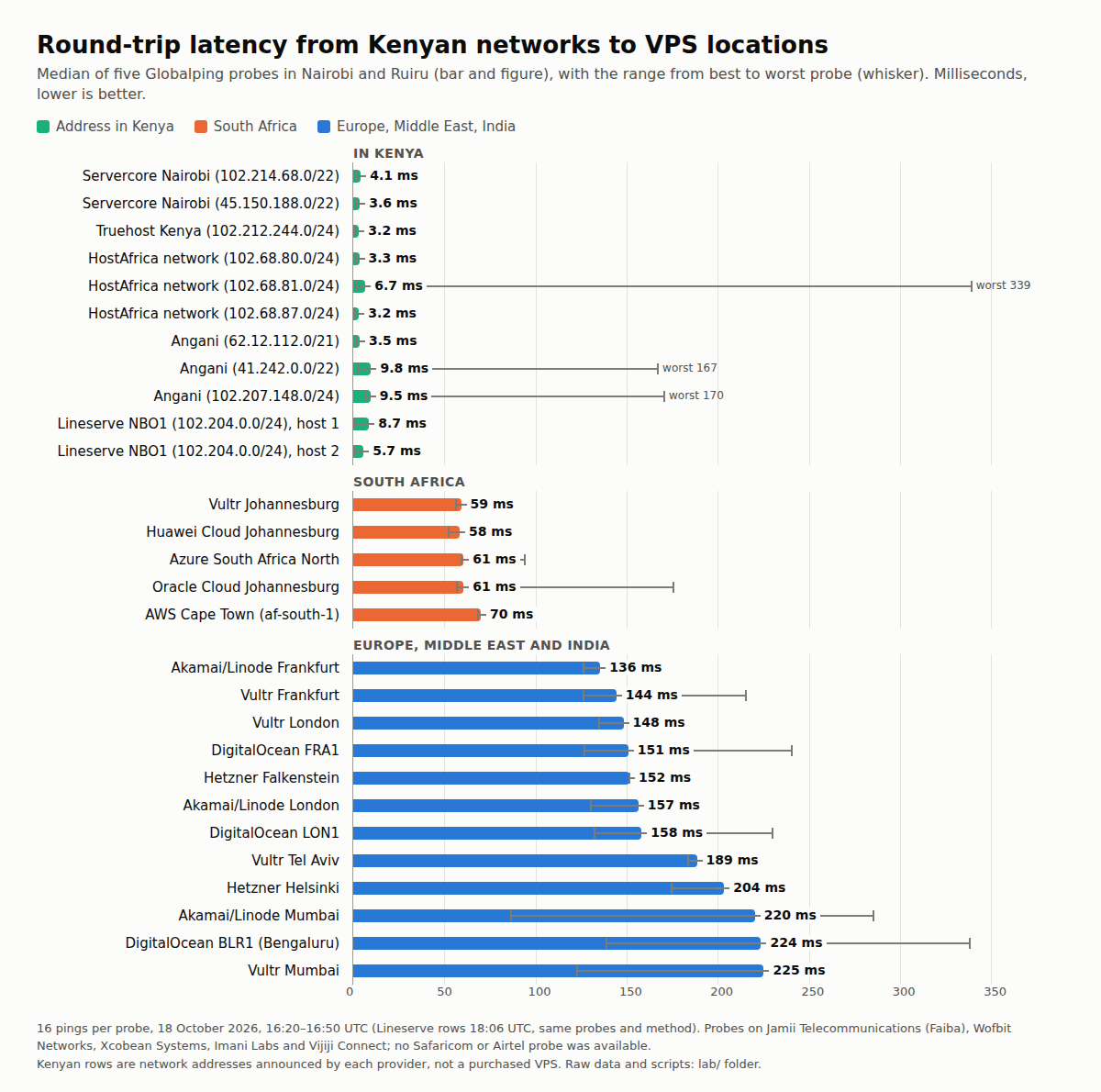
What the numbers say:
- Nairobi is about 1–10 ms from Kenyan networks when the route stays local. Most of our Nairobi addresses did. Lineserve’s two NBO1 addresses came in at 8.7 and 5.7 ms.
- South Africa is a solid middle ground at 58–70 ms. Vultr, Huawei, Azure and Oracle in Johannesburg all sat around 58–61 ms. AWS Cape Town was 70 ms. LowEndTalk users have posted similar figures: Johannesburg to Nairobi at 55 ms over Airtel Kenya.
- Western Europe is 136–158 ms, depending on provider and ISP. Frankfurt was a little faster than London. Helsinki (204 ms) and Indian locations (220–225 ms) were slower. Mumbai, the obvious “next door” by map, was one of the worst from most Kenyan networks.
- The spread between ISPs matters as much as the city. DigitalOcean Bengaluru ranged from 138 ms (Jamii) to 338 ms (Vijiji Connect).
- A repeat run gave the same picture. We pinged every target again between 16:46 and 17:32 UTC. Medians moved by 3 ms or less for every Nairobi and South African target, and by up to 10 ms for European ones (Linode London rose from 157 to 166 ms). The slow routes to some Nairobi addresses showed up again, at 161 to 339 ms from the same ISPs. Lineserve’s two addresses, re-pinged at 18:23 UTC, came back at 6.0 and 8.5 ms, within 3 ms of the first run.
Why a Nairobi server can be slow from Nairobi
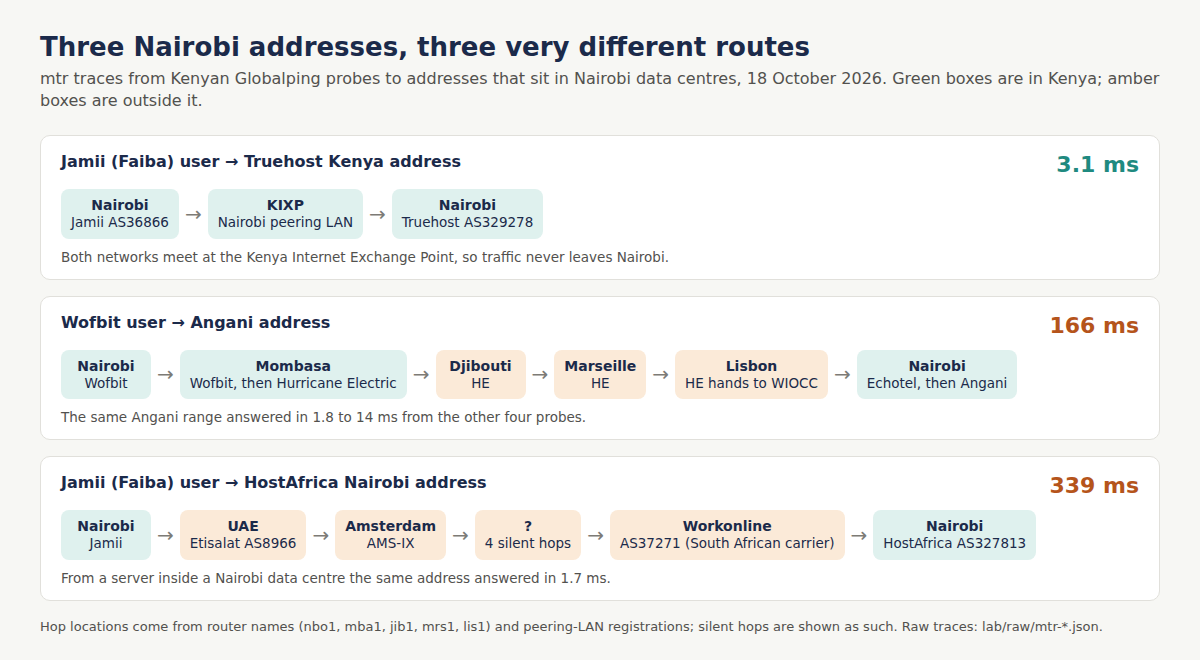
Network engineers call this tromboning. When two networks don’t exchange traffic in Kenya, it goes to wherever they do meet, sometimes Marseille, Lisbon, Dubai or Amsterdam, and comes back. In 2019 a Kenyan gamer on Reddit noticed the same thing: if traffic “is not from the same ISP you will see pings of up to 300+”. Seven years later, our traces still showed it on some routes.
It goes the other way too. From Servercore’s looking glass inside iColo, Truehost’s Kenyan address took 120 ms, while Kenyan home networks reached it in about 3 ms. If your app talks to another server in Kenya, such as a payments partner or a database at another host, test that route too.
What to do about it:
- Ask a shortlisted host which carriers and exchanges it connects to (KIXP, LINX Nairobi, Safaricom, Airtel, Liquid, Jamii), and get a test IP.
- Test from the ISPs your users actually use. For a consumer app in Kenya, that usually means Safaricom first.
- If your audience spans East Africa or several ISPs, put a CDN in front of the static parts.
International providers Kenyans use
Most Kenyan developers on Reddit host abroad. In about 30 Kenya-related threads we read, roughly 18 recommended a foreign provider, and about 10 explicitly said to avoid local hosts. Contabo came up most (about 13 threads), then DigitalOcean and Hetzner (8 each). Here’s what each offers as of 18 October 2026.
Hetzner (Germany, Finland, US, Singapore)
Hetzner has no African location. Its Falkenstein site was 152 ms from Kenya in our test. A Hetzner user wrote on r/hetzner in 2024 that the German sites have the lowest latency, “below 200 ms for Nairobi”, and that a CDN works around the rest.
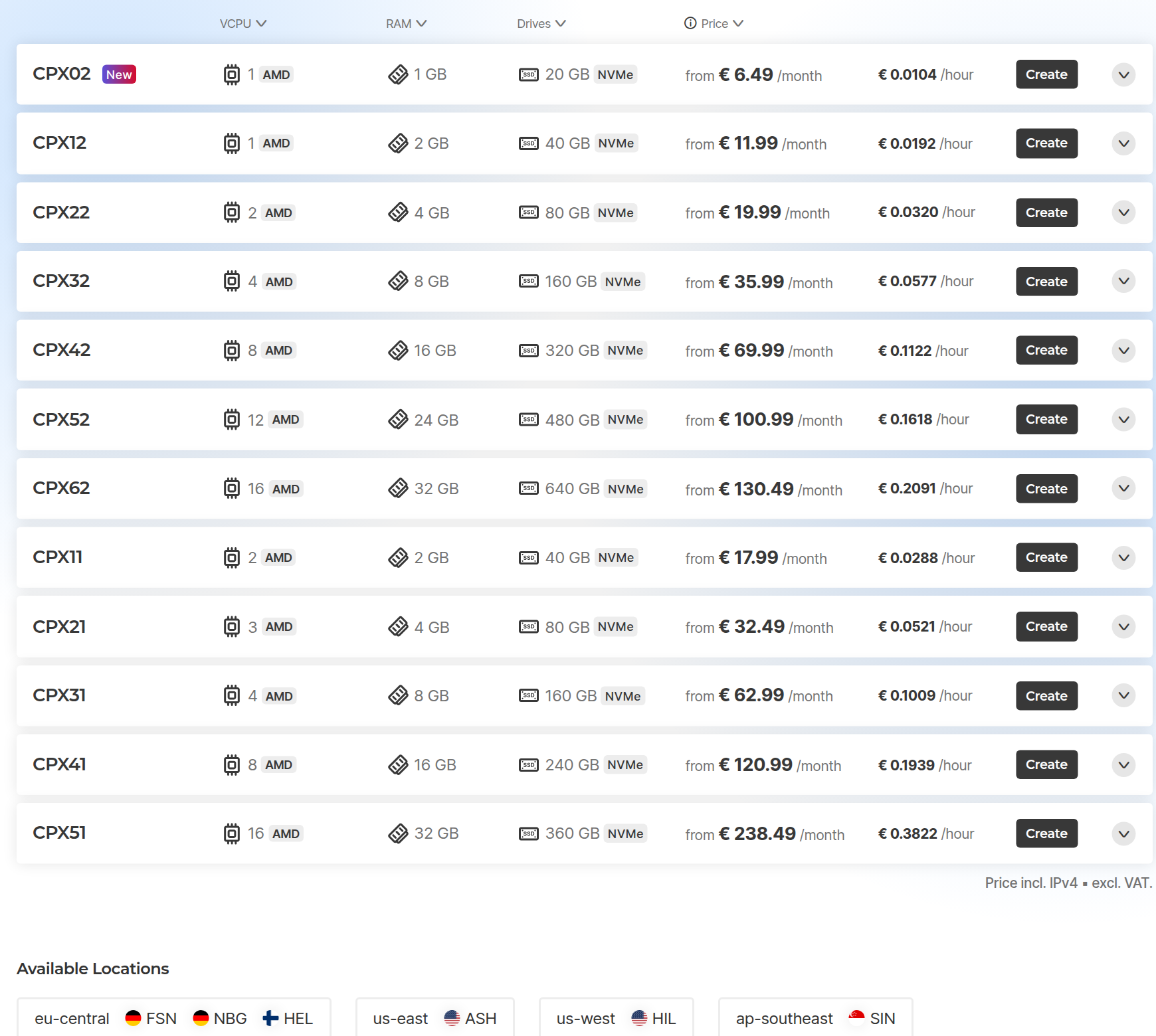
- Prices went up on 15 June 2026. Hetzner’s price adjustment notice lists rises across the range. On 18 October, CX23 (2 vCPU, 4 GB, 40 GB) was €5.99 a month including IPv4, CPX12 (1 vCPU, 2 GB) €11.99 and CPX22 €19.99. Many cost-optimised plans showed as “not available”. Older “Hetzner is €4” advice is out of date.
- VAT: Kenya isn’t on Hetzner’s list of non-EU countries where it charges VAT, so Kenyan customers aren’t charged VAT.
- Payment and sign-up: Hetzner accepts cards, PayPal and bank transfer. But Kenyans report trouble. One HN commenter said their account was “blocked 5 minutes after creation with zero explanation”, twice. On r/nairobitechies, a 2026 thread reports PayPal as the only option offered, with “No card payment option”. In other threads, people who used a passport rather than a national ID say they got through.
- SLA and support: 99.9% monthly per cloud server, and 24/7 tickets.
DigitalOcean (Frankfurt, Amsterdam, London, Bengaluru)
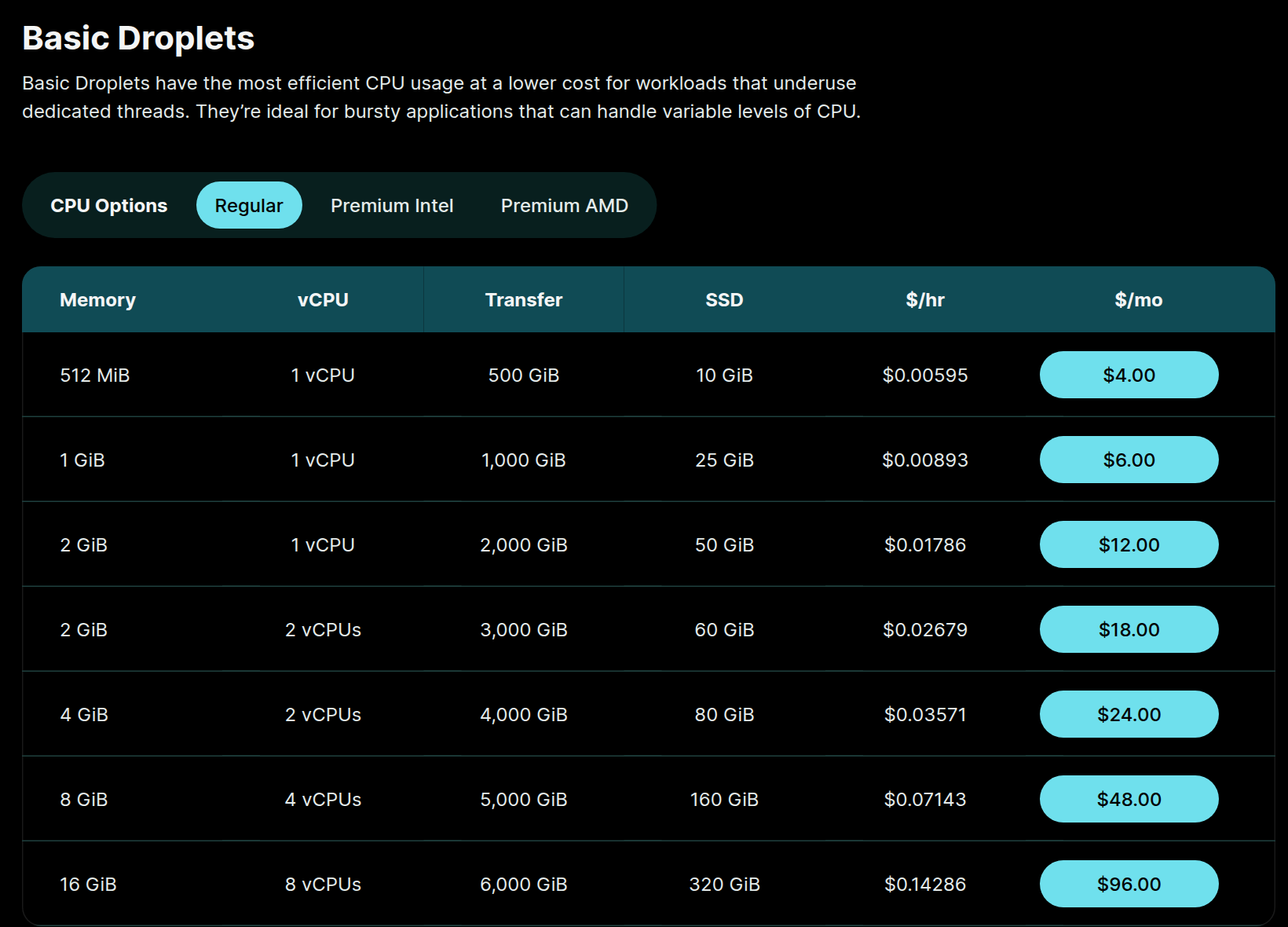
- Pricing: from $4 a month (512 MiB). $6 buys 1 GiB and $12 buys 2 GiB with 50 GiB SSD and 2 TB of transfer. Billing is per second since January 2026, in USD only.
- VAT: DigitalOcean’s Kenya tax page says it charges 16% VAT to customers in Kenya, businesses included since 1 September 2022.
- SLA and support: 99.99% per Droplet. Free tickets are answered within 24 hours, and paid plans add faster response.
- Payment: cards, PayPal, Google Pay, Apple Pay and others. No M-Pesa. Users warn about runaway bills. One r/nairobitechies commenter: “you’ll wake up one day with a $800 bill coz bots decided to scrap your website.” Set a billing alert.
Vultr (Johannesburg)
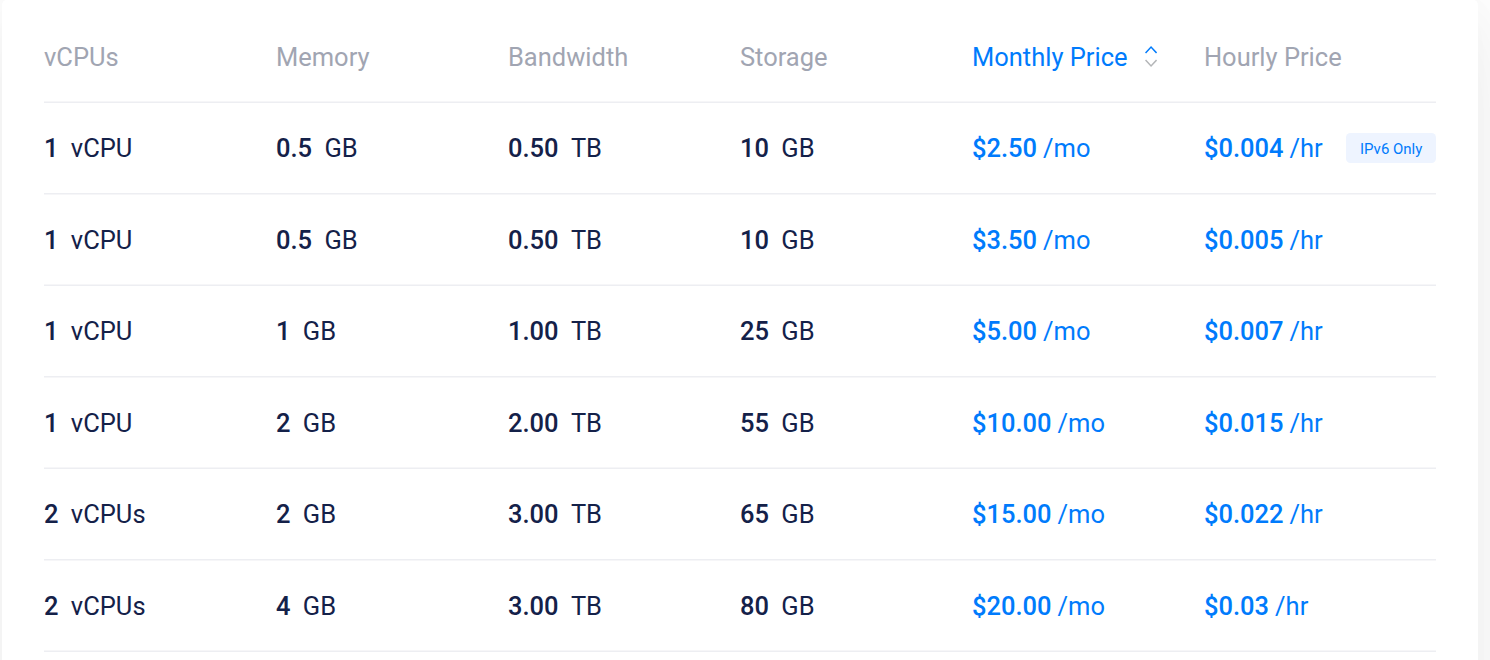
Vultr is the budget option that’s closest to Kenya. Its Johannesburg location was 59 ms in our test. The smallest plan there is 1 vCPU, 1 GB, 25 GB and 1 TB for $5 a month, the same price as its other locations (the $2.50 and $3.50 plans aren’t offered in Johannesburg). The 2 GB plan is $10. Vultr invoices in USD, takes cards, PayPal, crypto and others, and its SLA page (last read from an archived June 2026 copy) promises 100% uptime. We couldn’t confirm whether it charges Kenyan VAT.
Akamai (Linode), Contabo, OVHcloud
- Akamai/Linode has no African region; Frankfurt was 136 ms. The 1 GB Nanode is $5, and 2 GB is $12. Its tax page says it charges Kenyan VAT at 16% since June 2023. The SLA is 99.99%.
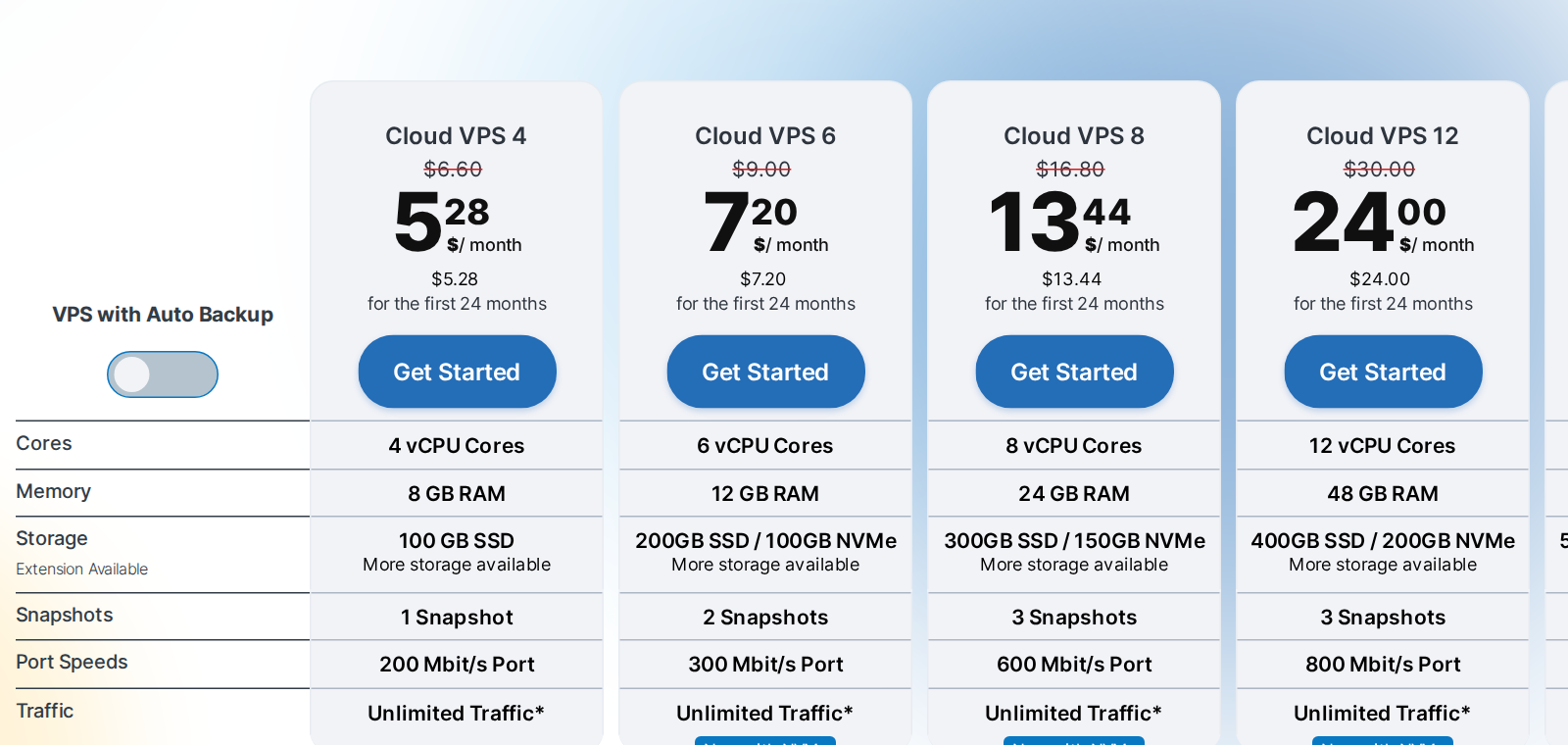
- Contabo says it serves “Europe, Africa & Middle East” from its German data centres. Cloud VPS 4 (4 vCPU, 8 GB, 100 GB SSD, 200 Mbit/s port, “unlimited” traffic under fair use) is $5.28 a month for the first 24 months, with $6.60 shown crossed out. Contabo is the most-recommended budget host in Kenyan threads. In a July 2026 review from a Kenyan user, nine months ran with no downtime, but the user saw “latency spikes, TCP ping timeouts” and rated it 3.5/5. Another user complained that “CPU steal is way too much.”
- OVHcloud has no African region. Its VPS-1 (2 vCores, 4 GB, 40 GB NVMe) is from $4.54 a month.
AWS, Azure, Oracle, Huawei and Google in South Africa
- AWS Cape Town (EC2): a t4g.nano is about $3.94 a month and a t3.micro about $9.93 (Linux, on-demand), plus storage at $0.1047 per GB-month. Internet egress is $0.154 per GB, which adds up quickly for a busy site. AWS charges VAT to Kenyan accounts. Kenyan users report Equity, KCB, Barclays and M-Pesa virtual cards being declined at sign-up. One wrote: “all my cards decline”. Another said “AWS could not process the transaction, u had to use a physical card”.
- Azure South Africa North: a B2ats v2 (2 vCPU, 1 GiB) costs about $8.91 a month at 730 hours, before disks. The first 100 GB of egress each month is free. Azure takes credit and debit cards and wire transfer, but not prepaid or virtual cards.
- Oracle Cloud Johannesburg: the Always Free tier includes two small AMD VMs and Arm capacity, and the first 10 TB a month of egress is free. A useful sandbox if your card is accepted.
- Huawei Cloud Johannesburg: 58 ms in our test. We couldn’t load its pricing without an account.
- Google Cloud Johannesburg: a region exists (africa-south1). We couldn’t capture its VM prices.
Side-by-side comparison
All facts from each provider’s own page or our tests, 18 October 2026. “Kenya latency” is the median from five Kenyan probes to the provider’s network in that location. KES conversions use the Central Bank of Kenya’s indicative rate shown that day: USD 1 = KSh 129.81, EUR 1 = KSh 144.43.
| Provider (plan) | Server location, how verified | Entry plan as listed | Approx. KSh/month | Billing | M-Pesa / KES | Support (as stated) | Uptime (as stated) | Kenya latency |
|---|---|---|---|---|---|---|---|---|
| Servercore (Standard Line) | Nairobi, iColo NBO1; own network, ping 1–15 ms | 1 vCPU, 1 GB, 5 GB disk: $10.85 incl. taxes, IP extra | ~1,410 + public IP | Hourly, prepaid balance | Yes / Yes | 24/7 | 99.98% (cloud servers page) | 3.6–4.1 ms |
| Truehost (Kenya Cloud VPS 1) | Nairobi; AS329278 block answers in 0.4–20 ms | 1 vCPU, 1 GB, 25 GB, 1 TB | 1,400 (VAT not stated) | Monthly | Yes / Yes | 24 h: phone, chat, email, ticket | 99.95% (terms) | 3.2 ms |
| HostAfrica (C1, Kenya) | Kenya per page; HostAfrica network has Nairobi blocks at 0.6–13 ms | 1 vCPU, 1 GB, 20 GB NVMe, unmetered | 960 (480 first month; VAT not stated) | Monthly, cancel any time | Mobile payments / Yes | Every day of the year | 99.9% and 99% both shown | 3.3 ms |
| Angani (Small) | Nairobi, two DCs; own network at KIXP | 1 vCPU, 1 GB, 20 GB, unmetered within Kenya | 1,000 (VAT not stated) | Monthly | Not stated / Yes | 24/7 | 99.9% | 3.5–9.8 ms (some ISPs 165+) |
| Lineserve (Linux VPS – 2 GB RAM) | Nairobi NBO1 (iColo and ADC); own network AS329659, ping 0.6–20 ms | 1 vCPU, 2 GB, 40 GB SSD, 1 IPv4, unlimited local traffic | 1,620 + 16% VAT = 1,879.20 | Monthly, prepaid, non-refundable | Yes / Yes | EAT business hours: ticket, phone, email; live incidents covered | 99.9% (credits 10–50%) | 5.7–8.7 ms |
| HostPinnacle (SM VPS 1) | Not stated on plan; not testable | 4 cores, 6 GB, 100 GB NVMe | 1,100 + VAT = 1,276 | Monthly | Not stated / Yes | 24/7/365 | 99.9% | Not measured |
| Vultr Johannesburg | Johannesburg; looking-glass host | 1 vCPU, 1 GB, 25 GB, 1 TB: $5 | ~649 (tax not confirmed) | Hourly | No / USD | Tickets | 100% (SLA page, archived June 2026) | 59 ms |
| AWS EC2 Cape Town | Cape Town region | t4g.nano ~$3.94 + disk + egress | ~511 + disk, egress, VAT | Hourly | No / USD | Paid plans for faster help | 99.5% single instance | 70 ms |
| Azure South Africa North | Johannesburg region | B2ats v2 ~$8.91 + disk | ~1,157 + disk | Hourly | No / USD | Paid plans for faster help | 95–99.9% single VM, by disk type | 61 ms |
| Hetzner (CPX12) | Germany/Finland | 1 vCPU, 2 GB, 40 GB, 20 TB: €11.99 | ~1,732, no VAT charged | Hourly, monthly cap | No / EUR or USD | 24/7 tickets | 99.9% | 152 ms (Falkenstein) |
| DigitalOcean (1 GiB) | Frankfurt, London, Amsterdam | 1 vCPU, 1 GiB, 25 GiB, 1 TB: $6 | ~903 incl. 16% VAT | Per second | No / USD | Tickets, 24 h response (free) | 99.99% | 151 ms (FRA1) |
| Akamai/Linode (Nanode) | Frankfurt, London | 1 vCPU, 1 GB, 25 GB, 1 TB: $5 | ~753 incl. 16% VAT | Hourly | No / USD | Tickets | 99.99% | 136 ms (FRA) |
| Contabo (Cloud VPS 4) | Germany | 4 vCPU, 8 GB, 100 GB, 200 Mbit/s: $5.28 for 24 months | ~685 incl. taxes as listed | Monthly, term discounts | No / EUR, USD, GBP | Tickets | 99.9% annual | Not measured (Germany ~150) |
SLA percentages are as stated; check the SLA document for what credit you get. “Not stated” means the plan page we read didn’t say. Prices change often, so re-check before you buy.
What it really costs in shillings
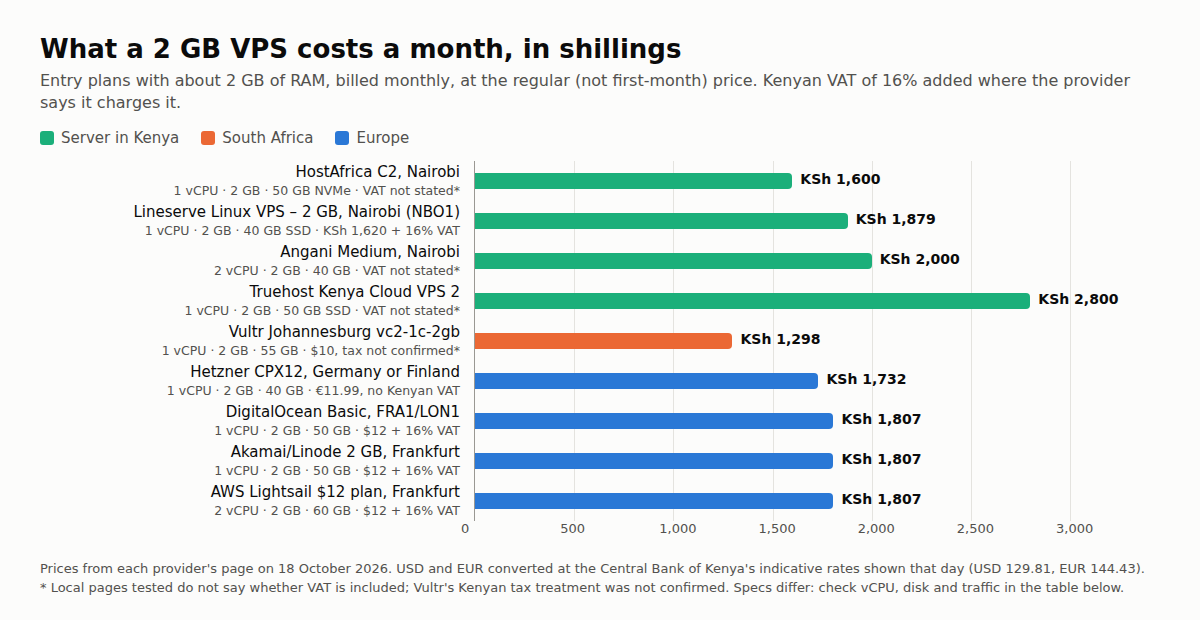
For small servers, local and foreign prices now overlap. A 2 GB server costs KSh 1,600 to 2,800 a month in Nairobi, against about KSh 1,300 in Johannesburg and KSh 1,730 to 1,810 in Europe with VAT where charged. One founder claimed on r/Kenya in 2025 that a 64 GB server costs about KES 7,000 at Hetzner and around KES 75,000 in Kenya. They were promoting their own product, and Hetzner’s prices have risen since, so treat that as a rough, dated comparison. Our own price checks didn’t cover servers that large.
A worked example: a small business API on 2 GB of RAM for a year.
- HostAfrica C2 (Nairobi): KSh 800 for the first month plus 11 × 1,600 = KSh 18,400, plus VAT if it isn’t included.
- Lineserve Linux VPS – 2 GB RAM (Nairobi, NBO1): 12 × KSh 1,620 = KSh 19,440, plus 16% VAT = KSh 22,550.40.
- DigitalOcean 2 GiB (Frankfurt): $12 × 12 = $144, plus 16% VAT = $167.04, about KSh 21,680 at today’s rate. The figure moves with the exchange rate, and your bank may add a card FX fee.
- Hetzner CPX12 (Germany): €11.99 × 12 = €143.88, about KSh 20,780 with no VAT, if Hetzner accepts your account.
- Vultr Johannesburg 2 GB: $10 × 12 = $120, about KSh 15,580 before any tax.
Hidden costs to check:
- Egress (outbound data). It’s included up to a cap on most VPS plans (1–20 TB), but metered on AWS ($0.154/GB from Cape Town) and on Azure after 100 GB.
- Public IPv4. Usually included, but some cloud calculators list it separately.
- Licences and backups. For example, Truehost’s cPanel licence is KSh 2,380 a month on its Global VPS, and snapshots or backups often cost extra.
- Long terms. A “per month” price that requires paying three years upfront isn’t a monthly price.
Paying from Kenya: M-Pesa, cards and account checks
The Kenyan providers we checked bill in KES. Truehost and Servercore name M-Pesa; HostAfrica says “mobile payments”; Angani’s page doesn’t say. Lineserve bills in KES and lists “M-Pesa and other mobile money, bank transfer, or card”. None of the international providers we checked takes M-Pesa directly or bills in shillings:
- DigitalOcean, Linode and Vultr bill in USD.
- Hetzner bills in EUR or USD.
- Contabo bills in EUR, USD or GBP.
The community reports are consistent. Out of about 30 Kenyan threads, 7 reported Hetzner rejecting Kenyan sign-ups, 4 people said they got approved (mostly with a passport), and 3 said Hetzner card payments failed, leaving only PayPal. Another 4 threads reported AWS, Oracle or M-Pesa virtual card failures. One developer said IONOS took a site down after its systems “detected I signed in from Kenya.”
If you go international:
- Use a physical debit or credit card with international payments switched on, or PayPal. Many people say virtual cards fail.
- Use your passport for identity checks.
- Set billing alerts. Hourly billing in dollars means a mistake grows overnight.
- Budget for exchange-rate moves. A dollar price isn’t fixed in shillings.
What Kenyan developers report: the patterns
We read about 30 Kenya-specific threads on Reddit (r/Kenya, r/nairobitechies, r/webhosting, r/hetzner), plus LowEndTalk, Hacker News and five Trustpilot profiles. These are anecdotes, not measurements, but the patterns repeat:
- “Local” often means a local storefront. Five sources said Kenyan hosts resell or host abroad. One 2025 commenter said “most of the web hosting in Kenya top ranking companies were hosting from Europe or South Africa.” Our network checks found real Nairobi infrastructure at several providers, and Europe/US hosting behind some “Kenya” pages.
- Foreign providers are the default for developers. Contabo, DigitalOcean and Hetzner come up most, mainly on price and tooling. AWS Cape Town plus Cloudflare is a common “serious project” choice.
- Payment and account friction is the top complaint about foreign providers. See the section above.
- Support is the top complaint about local providers. It’s mixed for Truehost and HostPinnacle VPS, mostly negative for Safaricom’s shared hosting, and negative for Kenya Web Experts during its move to hosting.com.
- Data rules are starting to push work home. Threads in 2026 asked where to host data under the Data Protection Act. One answer said national ID and health data must stay in Kenya. That broadly matches regulation 26’s list, though the regulation also allows keeping a serving copy in Kenya instead of processing only here.
- We found no recent community posts with measured latency from a Kenyan VPS. That gap is why we measured.
Red flags
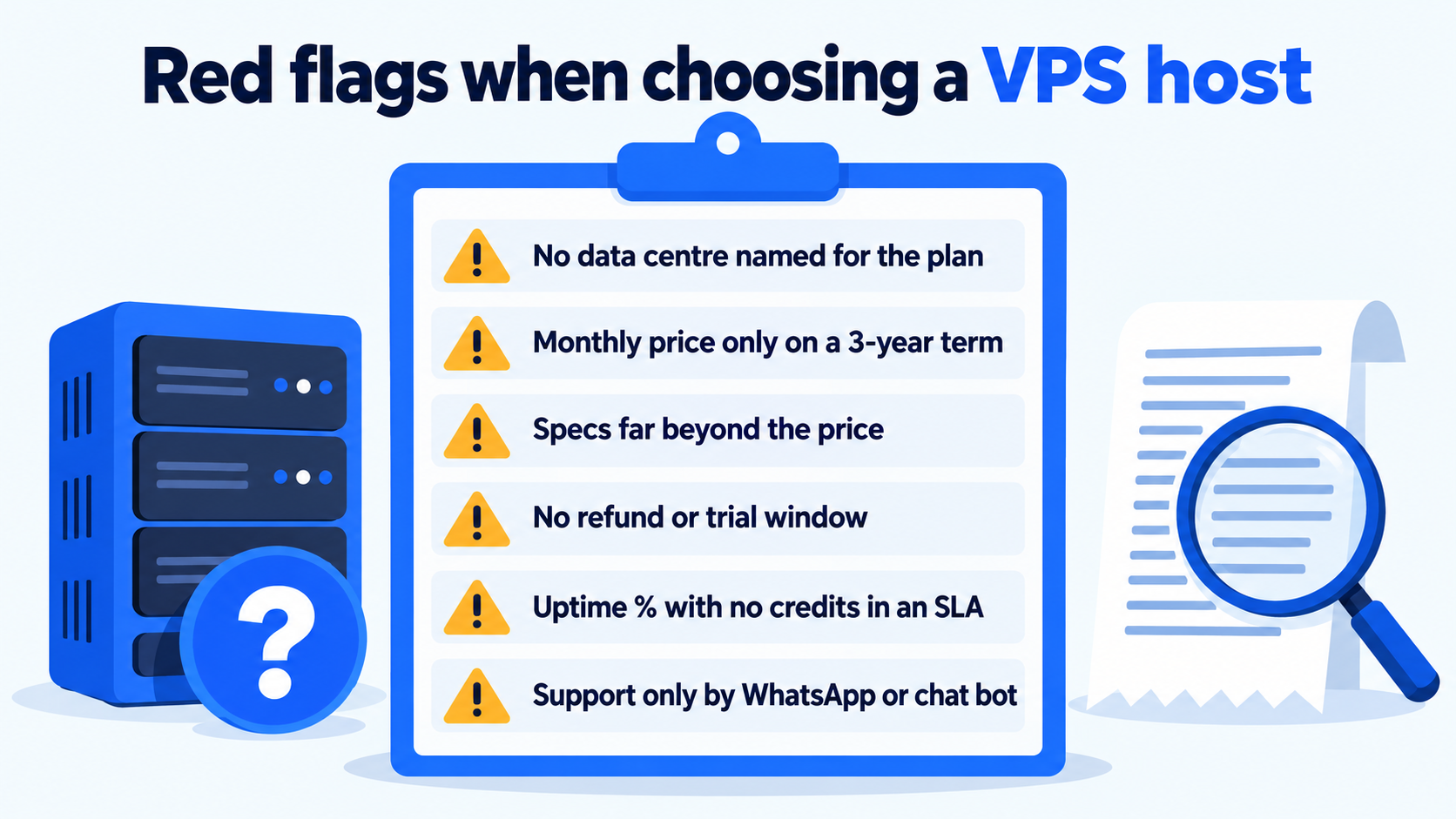
- No data centre named for the plan you’re buying, or a location only on the homepage.
- The “per month” price only applies to a 2- or 3-year term, and the monthly price is hidden or much higher.
- Specs far beyond the price. Eight cores for a few hundred shillings usually means heavily shared CPU. Test for CPU steal (below).
- No refund window and no monthly option. For example, Truehost’s terms rule out refunds except for overpayments.
- Different uptime numbers on the same page, or a percentage with no SLA document or credit terms.
- First-month discounts presented as the price.
- Unlimited bandwidth with no fair-use policy you can read.
- No test IP, no looking glass, no ASN you can look up.
- Support only through WhatsApp or a chatbot, with no ticket history.
- Recent, repeated reviews about lost domains, unauthorised renewals or blocked accounts. On Trustpilot, Truehost had a September 2026 complaint about an “Unauthorized renewal charge”. Read the dates: one bad review isn’t a pattern.
How to test before you commit
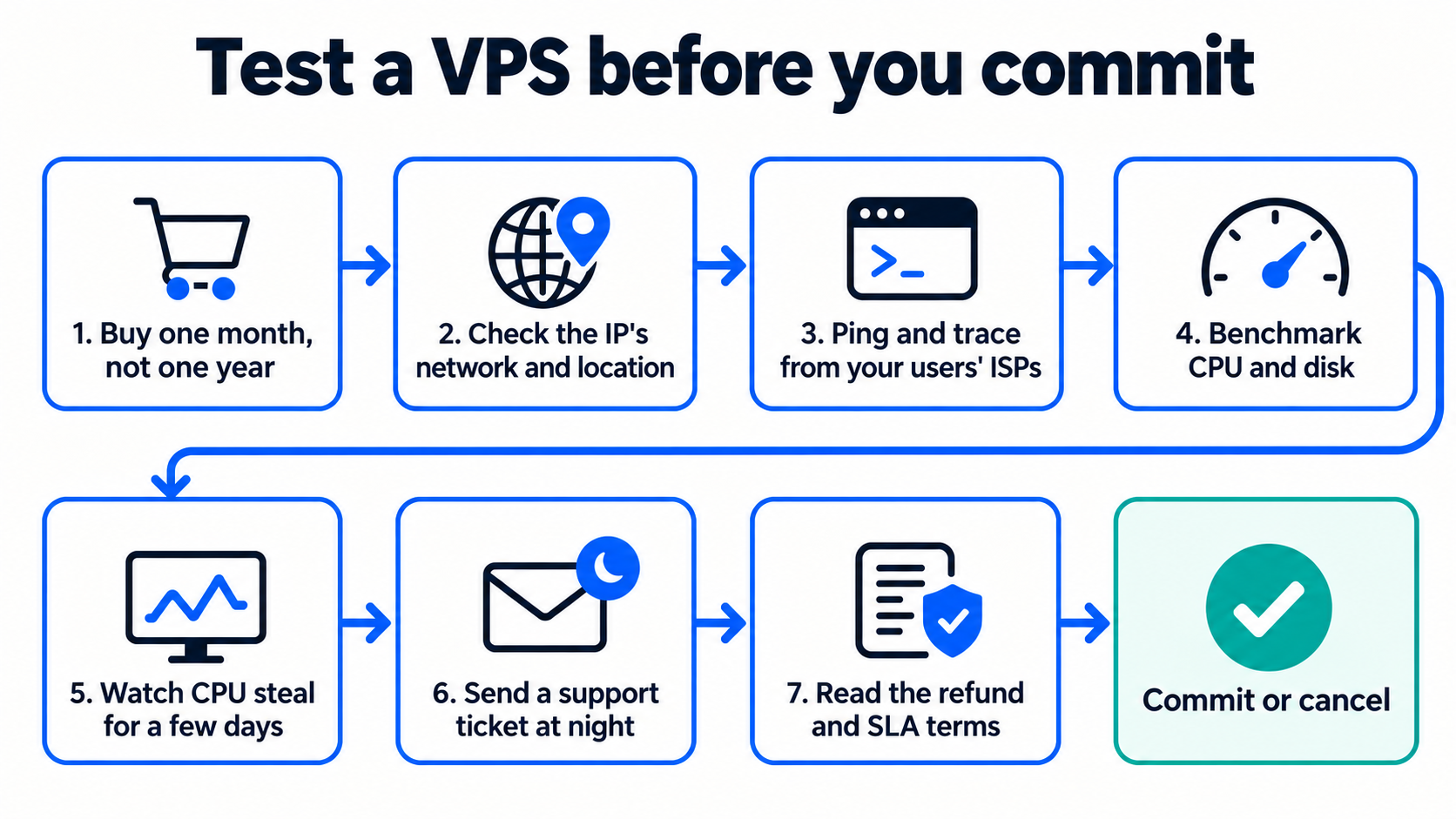
1. Buy the shortest term. Monthly, or hourly on clouds. Avoid annual prepayment until the server has passed these checks.
2. Check where the IP really is. On the server:
IP=$(curl -4 -s https://icanhazip.com)
whois -h whois.cymru.com " -v $IP"
This prints the ASN, the address block, the registry and the network name. Then ping the IP from Kenya. If you’re in Kenya, use your own connection. If not, use Globalping’s free CLI or API with Kenyan probes. For example, from any machine:
curl -s -X POST https://api.globalping.io/v1/measurements -H 'Content-Type: application/json'
  -d '{"type":"ping","target":"<your-server-ip>","locations":[{"country":"KE","limit":5}],"measurementOptions":{"packets":16}}'
# then fetch the result: curl -s https://api.globalping.io/v1/measurements/<id>
A Nairobi server should come back in single-digit milliseconds from most probes.
3. Trace the route from your users’ ISPs. mtr -rwzc 50 <your-server-ip> from a Safaricom line, a Faiba or Zuku line and a mobile hotspot. If Nairobi-to-Nairobi traffic goes through Marseille or Amsterdam, ask the host about it, or pick another.
4. Benchmark CPU, disk and network. Run the same script on each trial server and compare. We ran this on Ubuntu 24.04 (2 vCPU / 2 GB, 18 October 2026). Install the tools with sudo apt-get install -y sysbench fio mtr-tiny whois:
nproc; free -h | head -2; grep -m1 'model name' /proc/cpuinfo
vmstat 1 10 | sed -n '1,2p;8,12p'          # 'st' column = CPU steal; should stay near 0
sysbench cpu --threads="$(nproc)" --time=20 run | grep -E 'events per second'
fio --name=randrw --filename=/tmp/fio.test --rw=randrw --bs=4k --size=512M --iodepth=32 --direct=1
    --runtime=30 --time_based --ioengine=libaio --group_reporting | grep -E 'read:|write:'
rm -f /tmp/fio.test
curl -s -o /dev/null -w '%{speed_download} bytes/sn' https://fsn1-speed.hetzner.com/100MB.bin
mtr -rwzc 20 jnb-za-ping.vultr.com
Our run on a 2 vCPU / 2 GB lab server (the lab’s IP is masked; your numbers will differ, so compare trial servers with the same script):
== 1. What you actually got
2
               total        used        free      shared  buff/cache   available
Mem:           1.9Gi       416Mi       886Mi       2.7Mi       774Mi       1.5Gi
NAME     SIZE ROTA TYPE
nvme0n1    8G    0 disk
model name : Intel(R) Xeon(R) Platinum 8175M CPU @ 2.50GHz
== 2. Where the server really is (public IP -> ASN, prefix, registry country)
14618   | <your-ip>     | 54.242.0.0/15       | US | arin     | 2012-03-01 | AMAZON-AES - Amazon.com, Inc., US
== 3. CPU steal: the 'st' column should stay near 0
procs -----------memory---------- ---swap-- -----io---- -system-- -------cpu-------
 r  b   swpd   free   buff  cache   si   so    bi    bo   in   cs us sy id wa st gu
 0  0      0 907452  24784 768252    0    0     0     0   33   31  0  0 100  0  0  0
 0  0      0 907452  24784 768252    0    0     0     4   84   67  0  0 100  0  0  0
 0  0      0 907452  24784 768252    0    0     0     0   56   49  0  0 100  0  0  0
 0  0      0 907452  24784 768252    0    0     0     0   63   54  0  0 100  0  0  0
 0  0      0 907452  24784 768252    0    0     0     0   35   33  0  0 100  0  0  0
== 4. CPU benchmark (compare the events/s figure between trial servers)
    events per second:  1644.23
    total number of events:              32888
== 5. Disk: 4k random read/write, the number databases care about
  read: IOPS=1552, BW=6211KiB/s (6360kB/s)(182MiB/30011msec)
  write: IOPS=1542, BW=6169KiB/s (6317kB/s)(181MiB/30011msec); 0 zone resets
== 6. Download speed from a far-away test file
downloaded 104857600 bytes at 20870236 bytes/s
== 7. Path and latency to a target that matters to you (here: a Johannesburg test host)
  5. AS1299   ash-b2-link.ip.twelve99.net                85.0%    20    1.6   1.6   1.6   1.7   0.1
  6. AS1299   pccwglobal-ic-386370.ip.twelve99-cust.net   0.0%    20    1.6   1.7   1.5   2.0   0.1
  7. AS3491 31713Hu0-0-0-20.br03.jnb01.as3491.net            0.0%    20  253.6 253.6 253.2 254.9   0.4
  8. AS3491 3171363.218.151.30                               0.0%    20  252.4 251.4 251.1 252.4   0.3
  9. AS???    ???                                        100.0    20    0.0   0.0   0.0   0.0   0.0
 10. AS???    ???                                        100.0    20    0.0   0.0   0.0   0.0   0.0
 11. AS???    ???                                        100.0    20    0.0   0.0   0.0   0.0   0.0
 12. AS20473  139.84.226.78.vultrusercontent.com          0.0%    20  266.7 266.8 266.7 267.2   0.1
The first time we ran it, the vmstat line hid its own column headers, so we couldn’t tell which column was steal. The version above keeps the header lines.
5. Watch CPU steal for a few days. Run vmstat 5 (or sar -u from the sysstat package) at your busy hours. Steal above a few percent means other customers are using “your” CPU. That’s the “over provision” complaint from the Contabo threads.
While you’re at it, point a free external uptime monitor at the server (an HTTP check every minute from outside Kenya and, if the service offers it, from an African location). Two weeks of your own uptime log is better evidence than any badge.
6. Test support. Open a technical ticket late in the evening (“my reverse DNS isn’t set”, “how do I mount an ISO?”) and time the reply, and judge whether it actually answers you.
7. Read the refund policy and the SLA before day 30. Know how to cancel, whether unused time is refunded, what counts as downtime and how you claim credit. Also check that you can take your data with you: snapshots, image export or at least rsync access.
Put a Nairobi server in your shortlist test. Lineserve’s NBO1 region answered our Kenyan probes at 5.7 to 8.7 ms (median), bills in shillings and takes M-Pesa. Configure a Cloud Server to match the other servers on your shortlist, or pick a ready-made Linux VPS plan from KSh 1,620 a month plus VAT. Start with one month and run the seven checks above on it.
Which option fits which project
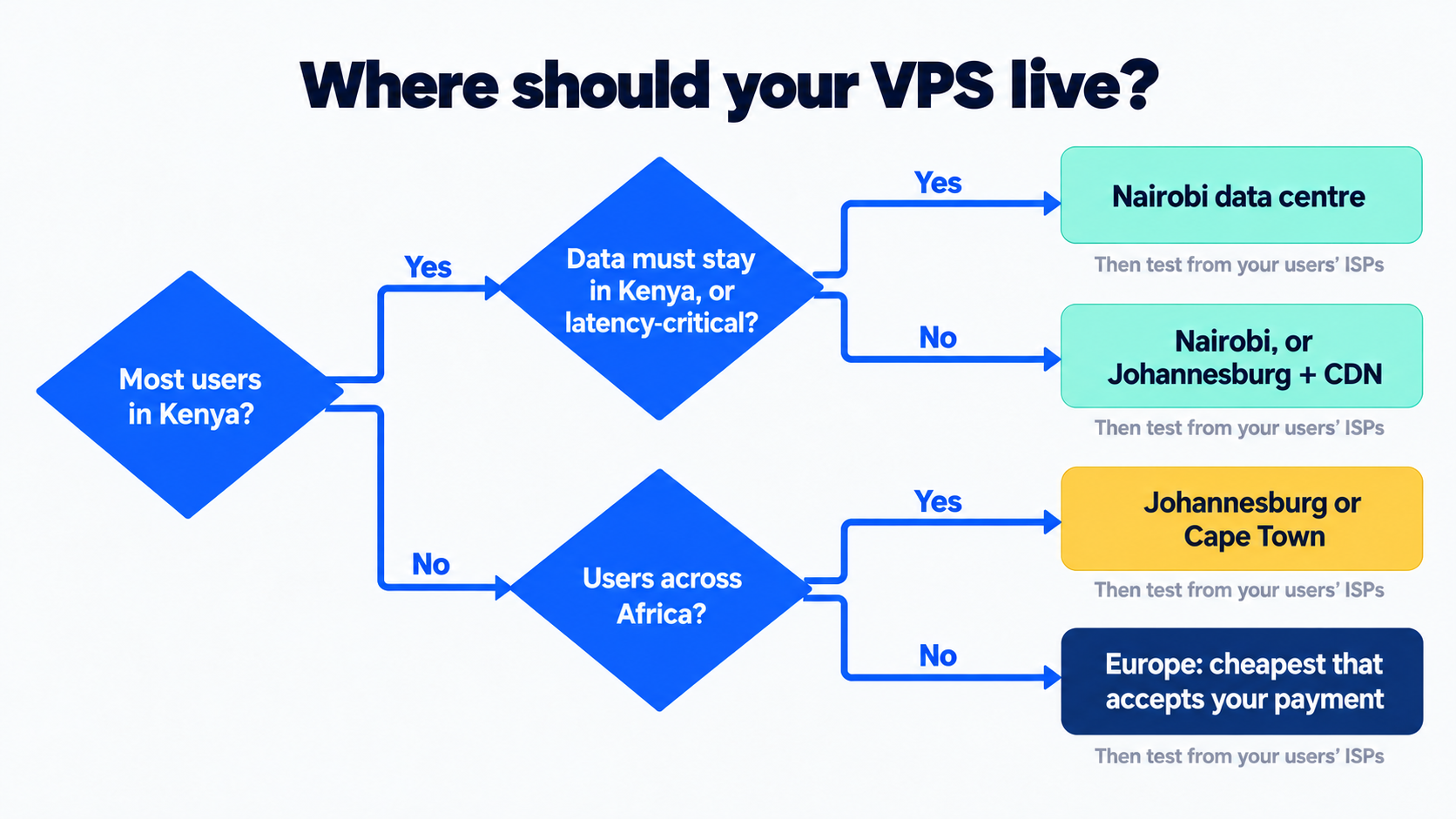
- A Kenyan e-commerce or M-Pesa-integrated site with mostly Kenyan customers: host in Nairobi. Lineserve’s NBO1 is the place to start (KES prices, M-Pesa, 5.7–8.7 ms in our test), with Servercore, Truehost Kenya VPS, HostAfrica Kenya and Angani as the alternatives to compare. Test from Safaricom, and keep an off-site backup with a second provider.
- An app with users across East and Southern Africa: Johannesburg (Vultr, AWS, Azure, Oracle, Huawei) or Nairobi plus a CDN. Compare Nairobi and Johannesburg from your users’ ISPs.
- Regulated data covered by regulation 26 (health care, education, public finance systems and others on the list): a Nairobi data centre, with the facility name and data-processing terms in writing. Lineserve names iColo and ADC for NBO1; ask any host for the same.
- A side project, a CI runner or a bot with no Kenyan latency needs: whatever is cheapest and accepts your payment. Often that’s Contabo, Hetzner, Vultr or a free tier.
- A startup that needs managed databases, queues and an ecosystem: AWS Cape Town or Azure South Africa North. Budget for egress and support plans.
FAQ
Which VPS providers actually have servers in Kenya?
We confirmed Nairobi addresses for Servercore (iColo NBO1), Truehost’s Kenya VPS range, HostAfrica’s network, Angani and Lineserve (NBO1), as of 18 October 2026. Safaricom runs an enterprise cloud in Nairobi and Kisumu. Others say they’re in Kenya, but we couldn’t verify it from public data.
Is there an AWS, Azure or Google region in Kenya?
No. AWS has announced a Nairobi Local Zone that wasn’t open yet, and has a Direct Connect location in Nairobi. Microsoft’s planned Kenyan data centre with G42 stalled. Oracle plans a Nairobi region at iXAfrica with no date. Google’s nearest region is Johannesburg.
Is Johannesburg good enough for Kenyan users?
For most websites and APIs, yes. We measured about 58 to 61 ms from Kenyan networks to Johannesburg, against 136 to 158 ms to Western Europe. Real-time apps, voice and chatty APIs benefit from Nairobi.
Do I pay VAT on a foreign VPS?
Often. DigitalOcean, Akamai/Linode and AWS say they charge 16% VAT to Kenyan customers. Hetzner doesn’t charge Kenyan customers VAT. Check each provider’s tax page. VAT on digital marketplace supplies has applied in Kenya since October 2020.
Can I pay for a VPS with M-Pesa?
Yes, with Kenyan providers. Truehost, Servercore and Lineserve name M-Pesa, and HostAfrica lists mobile payments. None of the international providers we checked takes M-Pesa directly.
Why is my “Kenyan” server slow?
Either it isn’t in Kenya (check the IP), or your ISP and your host don’t exchange traffic locally, so it goes abroad and back. Run mtr and send the output to the host.
Which Kenyan VPS host is the most reliable?
We found no independent, published uptime data for Kenyan VPS providers, so any “most reliable” ranking is opinion. Community reports are mixed for every local host we looked at. Judge reliability by the SLA terms, the data centre named, the network’s peering, and your own monitoring during a trial month.
What uptime should I expect?
Most hosts here promise 99.9% to 99.99%. 99.9% allows about 43 minutes of downtime a month. The promise only matters if an SLA gives you credit when it’s broken.
Should I choose a managed or unmanaged VPS?
Unmanaged (most plans here) means you patch, secure and back it up yourself. If nobody on your team can do that, a managed plan or managed hosting usually costs less than the downtime you’d otherwise have.
If Nairobi is on your shortlist, Lineserve’s NBO1 plans and prices are listed in shillings on its site.
Checked on 18 October 2026. Latency figures are medians from five Kenyan Globalping probes (Jamii/Faiba, Wofbit, Xcobean, Imani Labs, Vijiji Connect) to provider network addresses, not to purchased servers, and exclude Safaricom and Airtel. Prices and plans change often, so recheck before you buy.