Why Local Cloud Infrastructure Matters for African Businesses
Why local cloud hosting helps African businesses: lower latency, data-sovereignty compliance (DPA, NDPR, POPIA), smoother mobile-money integration, and predictable costs.
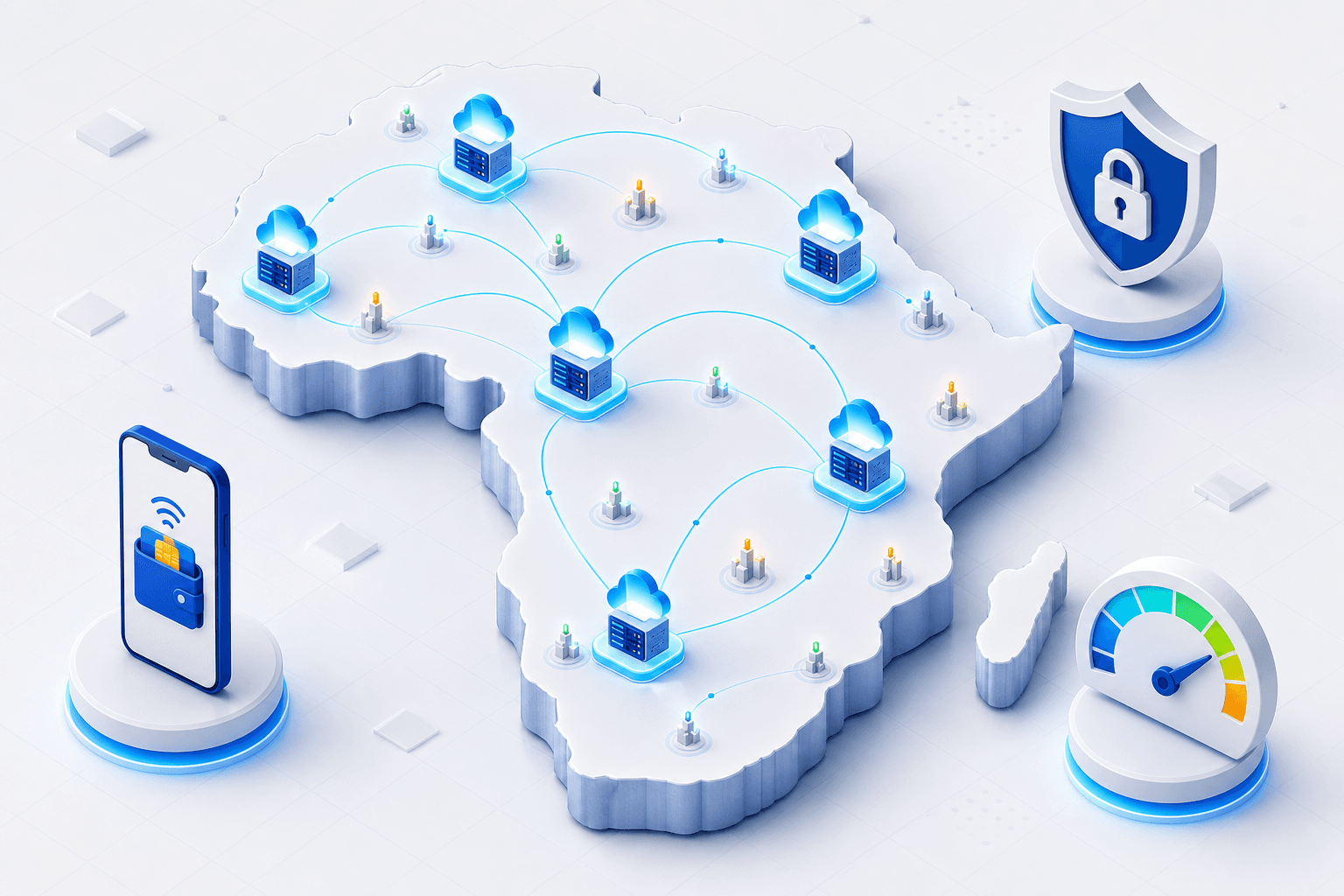
For years, the default answer to “where should we host our application?” was a data center in Europe or North America. For a business serving customers in Nairobi, Lagos, or Accra, that default quietly imposes a tax — on speed, on cost, and sometimes on compliance. Hosting closer to your users changes the equation. Here is why local and regional cloud infrastructure increasingly makes sense for African businesses.
Latency is a feature your users can feel
Every request from a user in East Africa to a server in Frankfurt travels thousands of kilometres and back. That round trip can add 150–300 milliseconds before your application does any real work. Multiply that across the dozens of requests a modern web page makes, and pages feel sluggish no matter how well written the code is.
Hosting regionally cuts that round trip dramatically. Faster responses mean higher conversion rates, lower bounce rates, and interfaces that feel instant. Latency is not a vanity metric — it is something your customers experience on every click.
Data sovereignty and compliance
Data protection regulation across the continent is maturing quickly. Kenya’s Data Protection Act, Nigeria’s NDPR, and South Africa’s POPIA all place expectations on how and where personal data is stored and processed. Keeping data within the region simplifies compliance conversations and reduces the risk of cross-border transfer complications. For businesses handling financial, health, or government data, that clarity is worth a great deal.
Payments that actually work locally
African commerce runs on mobile money and local payment rails — M-Pesa, Paystack, Flutterwave, and more. Infrastructure that understands this ecosystem, and sits close to it, integrates more smoothly and settles transactions with fewer moving parts. When your servers, your users, and your payment providers are all in the same region, the whole stack gets simpler.
Cost and currency predictability
Bandwidth-heavy applications can rack up surprising egress bills when traffic has to cross continents. Regional hosting keeps more traffic local and often more affordable. Billing that reflects local realities also protects you from the currency swings that make foreign-denominated cloud invoices hard to budget around.
Building for the next billion users
Internet adoption across Africa is growing faster than almost anywhere on earth. The businesses that win the next decade will be the ones that build for their users’ actual conditions — real network paths, real devices, real payment methods — rather than treating the continent as an afterthought served from far away.
Local cloud infrastructure is not just a technical preference. It is a strategic decision to meet your customers where they are. And increasingly, it is a decision you no longer have to compromise on.